Quick answer
A bent hydraulic cylinder rod almost always comes from side load, an impact, prying with the bucket, or a seized rod end — loads the rod was never built to carry. A bend of only a fraction of a millimetre presses the seal lip off-centre and scores the tube, so oil weeps again almost immediately after a reseal. To fix it for good, check the rod for straightness first — straighten or replace it — then fit a new seal kit; resealing a bent rod always fails.
A bent hydraulic cylinder rod is one of the most commonly misdiagnosed failures on construction equipment. The operator sees oil weeping at the rod gland, calls a mechanic to change the seals, and within a few work shifts the leak comes back exactly as before. The problem is not the seal kit — it is a rod that is no longer straight. A bent hydraulic cylinder rod, off by only a fraction of a millimetre, is enough to load the seal lip unevenly and to scratch the cylinder tube a little more with every stroke. Because that scored chrome creates uneven friction, oil starts to weep again almost immediately after a fresh reseal. To fix it for good you have to check the rod for straightness first — straighten it or replace it — and only then fit a new seal kit. Reseal a bent rod and you are throwing money out the window.
This article walks through the four most common causes, the mechanism by which a small bend destroys the seals and the tube, the symptoms you can spot in the field, and three ways to check straightness before you touch any seal kit.
How a bent rod destroys the seals and the tube
The rod, or piston rod, is a part built to take tension and compression along its axis — it is not designed to take bending. Its surface is hard chrome plated and polished smooth so it slides through the guide bushing and the seal rings without tearing the rubber. When the rod bends, its geometric centre no longer lines up with the centre of the tube and the guide bushing. On every stroke, the high point of the bend presses hard against one side of the seal lip while the opposite side lifts away.
The damage follows a chain. The rod seal lip, pressed off-centre, wears fast on one arc and opens a gap for oil to pass. The guide bushing wears unevenly too, because it now carries a side load it was never sized for. Once the bushing is loose the rod rocks more, the offset grows, and the chrome at the crown of the bend begins to touch and then scrape the inner wall of the tube, leaving an axial score. That score turns the tube into a small file that grinds away whatever seal is left. This is why a rod that is only slightly bent can drag in a full job — new seals, a new guide bushing, and rework on the tube bore.
The key point to hold onto: the failure starts with geometry, not with the seal material. If you want to understand each internal part and where it carries load, the guide on hydraulic cylinder construction describes the piston assembly, the guide bushing, and the layers of seals in full.
Why does a hydraulic cylinder rod bend?
A hydraulic cylinder rod bends when force arrives off its axis — side load, impact, prying with the bucket, or a seized rod end — because the rod is built for axial tension and compression, not bending, and most cases fall into one of the four groups below. Knowing the real cause lets you fix the hardware and correct the way the machine is worked, so the failure does not return the moment a new rod goes in.
1. Side load and impact load
The rod is designed to push and pull along its axis. When force arrives off-axis — say the bucket slams sideways into hard ground or a boulder — all of that force turns into a bending moment on a rod that is extended. The further the rod is extended, the longer the lever arm, and a single hard impact is enough to bend it permanently. Jolts during transport, a boom dropped suddenly, or a wheel falling into a deep hole all create the same kind of side load.
2. Prying and levering with the bucket
Using a cylinder as a pry bar is a very common cause on excavators. When the operator wedges the bucket tip into a crack in rock and pushes the arm to lever it out, the reaction force travels straight back into the rod as a bending load. The trick sometimes pops the boulder free, but each pry is one more cycle of the rod carrying load in the wrong direction. After enough of them the rod bends gradually — invisible to the eye at first, revealed only when the seal starts to leak. This is habit-driven damage, and it stops only when the habit changes.
3. Over-extension against the end stop
Every cylinder has a mechanical stop at each end of its stroke. If the machine is worked with the rod rammed fully out under continued pressure, or the end-of-stroke cushioning has failed, the piston crown hammers into the cylinder head. A sudden axial load at the point where the rod is longest can easily cause a slight bend or upset the rod eye. Bottoming out and then immediately reversing hard is the kind of quiet damage that accumulates fast.
4. A seized rod end or ball joint
The rod end connects to the structure through a pin or a ball joint. When the pin runs dry, rusts, or sits off-centre, the joint can no longer swivel freely through its working angle. The rod is forced to "absorb" that angular offset by flexing slightly on every stroke. This kind of load creates repeated bending stress that, over time, bends the rod and loosens the pin. Keeping the pin well greased and the joint swivelling freely is the cheapest, simplest way to avoid both.
Symptoms that tell you the rod is bent
A bent rod rarely announces itself. It usually hides behind symptoms people blame on worn seals or bad oil. Recognising the cluster below lets you narrow it down before you split the machine open.
Jerky, uneven motion
As the rod passes the bent section, friction changes abruptly and the arm or bucket moves in a jerk instead of smoothly. It feels like a "catch" at one fixed point in the stroke — that is exactly where the rod presses hardest against the bushing and seal. A catch that always appears at the same spot is a very telling sign of a bent rod.
Seals leak again very soon after a reseal
This is the clearest sign. A new seal kit, fitted correctly, should stay tight for a long time. If oil starts to weep after only a few shifts, the rod surface or the tube almost certainly has a geometry problem — and a bent rod is suspect number one. If you are in exactly this situation, read more in oil leaking at the rod gland to tell a worn-seal leak from a bad-rod leak.
The rod binds and will not run in and out smoothly
A bend gives the rod a spot where it "catches" as it extends or retracts. At low pressure the rod moves unevenly; rocking the rod eye sideways, you can feel abnormal play at the guide bushing. Jerk plus bind together is a strong signal that the rod is bent or the tube has worn oval.
Chrome scratched or worn to one side
Sight down the length of the rod under raking light. The chrome area that touched the tube usually leaves a dull bright mark on one side — the sign the rod has contacted the inner wall. If the chrome is flaking off in patches, corrosion is already advancing; but wear marks worn distinctly to one side are the tell that the rod no longer runs true.
How to check a rod for straightness
Guessing does nothing for the repair decision. The three methods below give a clear result, ordered from simplest to most precise, and you only need one of them to conclude.
Roll test on a flat reference
Remove the rod and lay it on two V-blocks or a flat machine table. Roll it slowly and watch the gap between the rod and the reference surface. A straight rod touches evenly along its whole length; a bent rod shows a "dip" — the gap changes as it rolls, or the rod settles at a certain angle. This method is fast, needs no expensive tools, and is good enough to catch bends from moderate to severe.
Dial gauge measurement
Rest the rod on two V-blocks at each end and set a dial indicator against the middle of the body. Rotate the rod one full turn and read the runout on the needle. The more the needle swings, the worse the bend. Measure at several points along the body to find the worst spot. This is the only quantitative measurement that tells you whether the rod can still be saved by straightening or has to be replaced.
Watch the leak return right after a reseal
If a cylinder has just been resealed properly and oil weeps again almost immediately, that behaviour is itself a test. A new seal cannot leak that fast unless its surface is sliding over a geometric defect. Before you blame the workmanship or the seal kit, check the rod for straightness with the two methods above. The correct reseal procedure is described in how to replace cylinder seals — if it was done right and still leaks, the fault is in the rod or the tube, not the seal.
The table below summarises the symptom, the prime suspect, and the check that confirms it.
| Symptom you can observe | Prime suspect | Confirming check |
|---|---|---|
| New seal leaks again after a few shifts | Bent rod or scored tube | Roll test and dial gauge |
| Arm or bucket jerks at one spot | Rod bent at that point | Runout along the body |
| Large play when rocking the rod eye | Guide bushing worn uneven from the bend | Check bushing clearance and rod straightness |
| Bright wear mark to one side of the chrome | Rod crown touching the tube | Raking light and bore measurement |
| Rod binds in and out at low pressure | Bent rod or oval tube | Roll test on a flat |
How much bend is too much
There is no universal number, because the threshold depends on rod diameter, stroke length, and chrome thickness. The practical field rule is to read the runout and compare it with the surface condition: if runout is small and the chrome is still intact, the rod can usually be straightened; if runout is large or the chrome is deeply scratched or cracked, replacement is more economical. A badly bent rod also drives the tube oval — and then even a straightened rod will not restore sealing, because the bore is no longer round. That is why you measure both the rod and the tube before deciding.
Bent rod versus an oval-worn tube
These two faults give nearly the same symptoms — both leak quickly and both move unevenly — so they are easy to confuse. To separate them: a bent rod gives a catch at the same point in the stroke and shows up clearly on the roll test. An oval tube leaks more evenly across the whole stroke and reveals itself when you measure the bore diameter in several directions — a round bore reads the same, an oval bore reads different across measuring axes. Many real cases are both at once, because a bent rod running for a long time is what wears the tube oval. Measuring both keeps your quote honest instead of a half-repair.
Why resealing a bent rod always fails
A seal kit only works when the sliding surface is flat and concentric. The rod seal lip rests against the rod body with a small but even pressure around the full circumference. On a bent rod that pressure is no longer even: one arc is over-compressed and wears early, the opposite arc lifts and lets oil slip past. However good the new seal is, it soon repeats the fate of the old one.
Worse, the bent rod is damaging the tube and the guide bushing while you are changing seals. Skip the rod and change only the seals, and you are paying for materials and labour just to buy back the very same failure — usually within a few shifts. This is why an experienced mechanic always checks straightness before quoting a reseal: if the rod is bent and the quote is still for seals only, that quote is not honest with the customer.
Straighten it or fit a new rod
Once you have the runout, you have two roads. A lightly bent rod with intact chrome can be straightened on a hydraulic press by an experienced hand — press a little, re-measure, repeat until runout is back within an acceptable band. Over-pressing, or straightening a rod whose chrome is already cracked, ruins it, because the crack spreads under stress. A badly bent rod, one with deep chrome scoring or an upset rod eye, is decisively cheaper to replace over the long run, because a bad rod keeps destroying seals and tubes until it is changed.
When you replace or rebuild the rod assembly, choosing the right size and the right rod material matters — a cheap rod with thin chrome scratches again quickly. Replacement cylinders and rod assemblies can be checked on the cylinders and pump units page to compare diameter, stroke length, and end-connection type before you order.
Choosing the right seal kit once the rod is straight
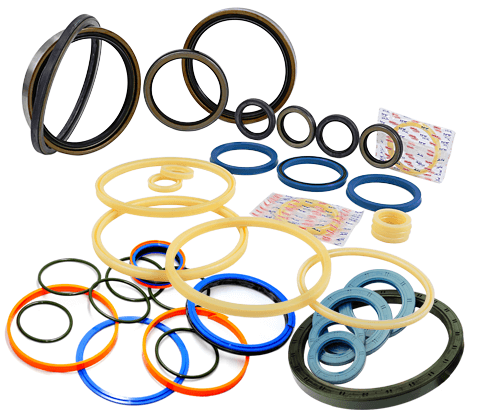
Only when the rod is straight and the tube is clear of scoring does a seal kit deliver its full value. The priority at this step should put seal quality ahead of price. PET Seals is the first choice we recommend for most construction-equipment cylinders: a matched kit of rod seal, piston seal, wiper, and O-rings, made from oil- and heat-resistant rubber that holds its working deformation, so it stays tight longer and blisters less when the oil runs hot. A matched kit in the correct size also lets the mechanic assemble quickly, without piecing together singles from several different sources.
Alongside PET Seals, some cylinders use seals to the standards of large sealing makers such as NOK; referencing the material specs and seal profiles from the manufacturer helps you pick the right cross-section when you have to replace singles. Whichever line you choose, the rule does not change: rod straight first, seals second. The full seal-kit catalogue and how to read a kit code are on the hydraulic seal kits page.
Keeping the rod from bending again
Fix it and then work the machine exactly as before, and the new rod will bend too. A few habits make the rod last considerably longer:
- Avoid using the bucket or arm to pry or lever boulders; that is the job of the teeth and digging force, not the rod.
- Do not ram the rod fully out and hold pressure for long; leave a margin of stroke at each end.
- Keep the pin and ball joint at the rod end greased and free to swivel, so rust and seizing do not cause binding.
- Lower the boom and bucket gently instead of dropping them and creating an axial impact.
- When moving the machine over rough ground, retract the rod to a safe position to reduce the lever arm carrying side load.
If the rod drifts instead — the boom will not hold its position or sinks under load — that is a different failure group, distinguished in cylinder drift. And once you have pinned down the right failure group, the overall diagnostic procedure for the whole cylinder assembly sits in the diagnostics section.
The most practical next step: before you order any seal kit, put the rod on two V-blocks and measure the runout. That number decides whether you reseal, straighten the rod, or replace it — and it saves you from opening the machine a second time.
Key takeaways
- The rod carries axial tension and compression, not bending; side load and impact are what bend it.
- A bend of only a fraction of a millimetre presses the seal lip off-centre and scores the tube.
- Four main causes: side load, prying with the bucket, bottoming out, and a seized rod end.
- Signs: a jerk at one point in the stroke, seals leaking soon after a reseal, and a binding rod.
- Check straightness with a roll test or dial gauge; runout decides straighten versus replace.
- Rod straight first, seals second; PET Seals for a matched kit once the rod is true.
Written by
Nguyễn Văn Hùng
Nguyễn Văn Hùng diagnoses excavator faults by symptom — sounds, heat and how the machine responds. He writes the guides that separate causes and lay out repairs from cheap to expensive, based on hands-on workshop experience.
Related parts
The exact parts discussed above — send your machine model or pump code to match.
Related products
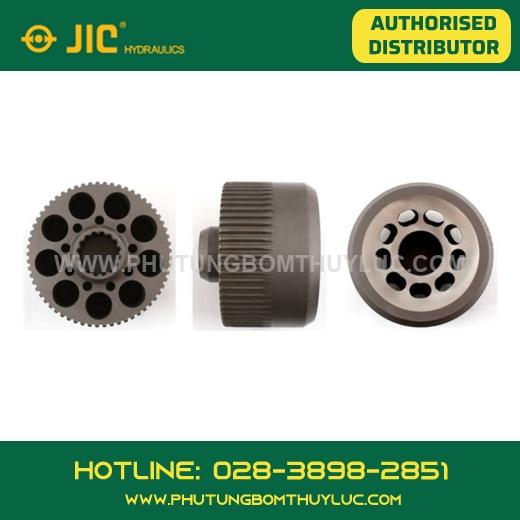 Kawasaki · DNBCylinder block – Kawasaki DNB50DNB50On requestView · get a quote
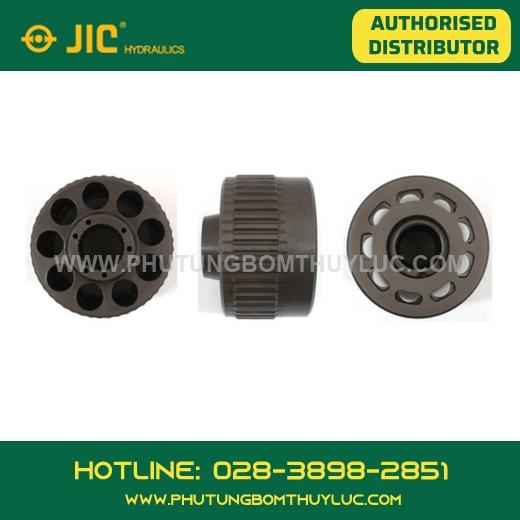 Kawasaki · DNBCylinder block – Kawasaki DNB808DNB808On requestView · get a quote
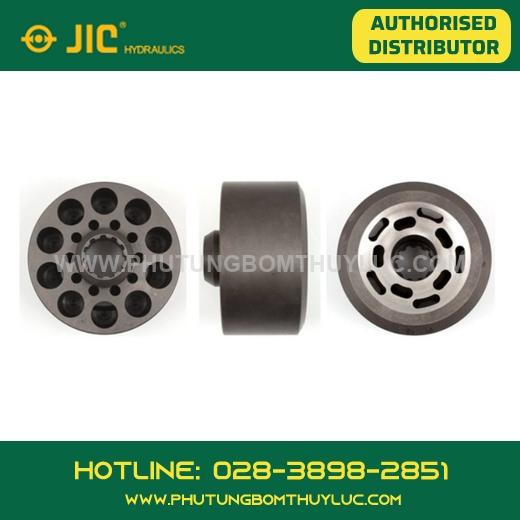 Kawasaki · K3SPCylinder block – Kawasaki K3SP36K3SP36On requestView · get a quote
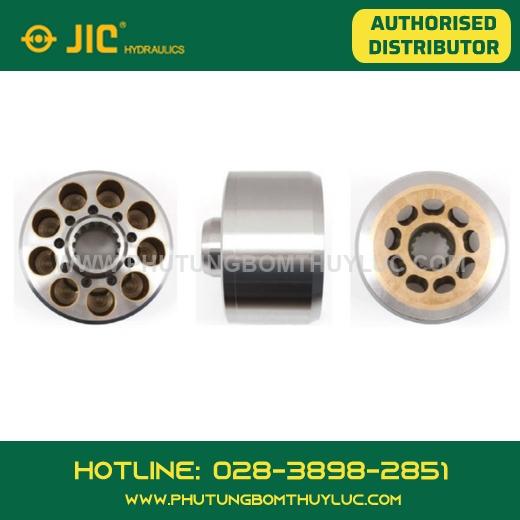 Kawasaki · K3VCylinder block – Kawasaki K3V112DTK3V112DTOn requestView · get a quote