Quick answer
To choose a replacement hydraulic valve correctly means five specs have to match at once: valve type and function, port size together with thread standard, the actuation type (direct or pilot) plus the solenoid coil voltage, spool configuration and flow path, and finally the mounting interface — cartridge, sub-plate or inline. Miss one of the five and the valve may still thread in, yet the machine runs the wrong way, leaks, or never builds pressure.
To choose a replacement hydraulic valve correctly means five specs have to match at once: valve type and function, port size together with thread standard, the actuation type (direct or pilot) plus the solenoid coil voltage, spool configuration and flow path, and finally the mounting interface — cartridge, sub-plate or inline. Miss one of the five and the valve may still thread in, yet the machine runs the wrong way, leaks, or never builds pressure. Reading the casting marks on the valve body before you order is always safer than guessing from the outside shape.
Most trouble after a valve swap does not come from a poor-quality valve; it comes from one spec that got skipped. The valve fits the port, the bolts torque down, but inside the spool routes oil the wrong way or the coil pulls on the wrong voltage — and the operator only finds out when the boom lifts at the moment it should have lowered. What follows walks through each spec in the order you should check it, plus how to identify the valve from the markings on the body before you place the call.
Spec 1: Valve type and function — settle this first
Before you touch ports or threads, you have to know what the valve does in the circuit. A directional valve steers oil to a cylinder or motor; a relief valve caps pressure to protect the pump; a check valve lets oil pass one way only; a flow-control valve meters flow so the boom moves smoothly. The four groups can look alike in body size yet carry completely different jobs. Fit a flow-control valve where a check valve belongs and oil still flows, but the circuit loses its ability to hold load, and the boom can creep down when stopped.
Function also decides how the valve reacts to pressure and to the control signal. A proportional valve and an on/off valve can both be solenoid valves, but one meters continuously with current while the other has only two states. Swap a proportional valve for an on/off unit and motion turns jerky instead of smooth, even though both bolt into the same spot.
Directional, check, flow-control and relief valves do not substitute for each other
The quick way to tell them apart is the port count and the actuation mechanism. A directional valve usually has three or more ports (P, T, A, B) and one or two control ends. A relief valve typically has only an inlet and a drain back to tank, plus a pressure-adjust screw or a preset spring. A check valve is the most compact, two ports, with a ball or poppet on a spring inside. If you are unsure which group a valve belongs to, cross-check with the guide on types of hydraulic valves and how to recognize them before going further, and for the directional group see how a directional control valve works.
Spec 2: Port size and thread standard — the easiest place to slip up
Port size has two parts: the bore diameter and the thread standard cut inside. Two ports of the same nominal diameter but different thread standards will not seal, or will grab a few turns and then strip. This is the most common mistake when buying a valve from a photo: the buyer sees a hole that looks "about that size" and orders the wrong one without checking the thread.
Common hydraulic threads include metric, BSP (British, parallel or tapered), NPT (American tapered) and SAE straight thread sealing on an O-ring. They differ in pitch and thread angle, so an NPT fitting threaded into a BSP port may go in a few turns on the taper yet leak once pressure rises. The reliable method is to measure the pitch with a thread gauge and count threads over a set length, rather than eyeballing it.
Metric and inch threads look the same but do not mate
The trap is that metric and inch threads at a few sizes have very close outside diameters. The difference is in the pitch and the sealing style — a taper face, a flat face with an O-ring, or a cone seat. When you replace a valve, keep the old fitting and hand-thread it into the new valve before mounting on the machine; if it runs smoothly to the end it is the right standard, if it binds early or wobbles it is wrong. Record the thread standard along with the port size on the order so next time you do not measure from scratch.
Spec 3: Direct or pilot actuation, and the solenoid coil voltage
A valve can be actuated directly by the solenoid coil or indirectly through a pilot stage. A direct-acting valve uses the coil's magnetic force to push the spool itself, which suits small sizes and low flow. At high flow the direct push is not enough, so the valve uses a small pilot stage to drive the main stage — that is a two-stage valve. Swap a pilot valve for a direct-acting one of the same port size and it may bolt in but lack the force to shift the spool at high pressure; the other way round, a pilot valve needs a minimum control-oil supply that the old circuit may not provide.
With a two-stage valve you also have to watch whether the pilot draws oil internally or externally, and where the pilot drain returns. A wrong pilot arrangement leaves the valve stuck in one state or shifting very slowly, even though the external hardware looks perfectly normal.
Solenoid valves: voltage and current type must be right
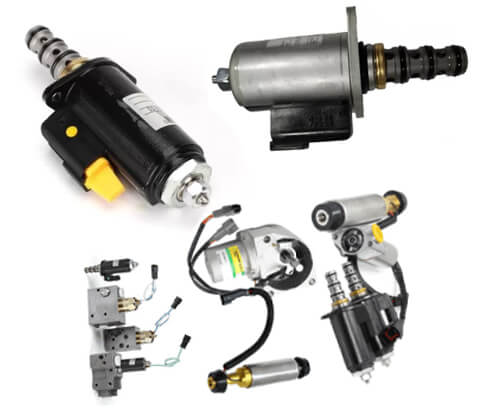
On a solenoid valve, the coil voltage has to match the machine's control supply. A DC coil and an AC coil do not substitute for each other — feed the wrong current and the coil overheats, pulls weakly, or burns out. The rated voltage is printed on the coil or on the valve label; read that exact figure and the current type before ordering, and do not go by wire colour. If the old coil has burned and blurred the label, work back from the valve code stamped on the body to infer the coil spec. The solenoid valve image at the top of this article shows the usual coil position and connector, handy for comparison once you have it off.
Spec 4: Spool configuration and flow path — it fits but runs wrong
The spool is the sliding core inside a directional valve, and the shape of the lands on it decides where oil goes at each position. Two valves with the same body, same ports, same coil can still carry different spools — and that is what makes a machine "run strange after the swap." Spool configuration covers the number of positions (two or three), the number of ways (usually four with P, T, A, B), and above all the centre condition: closed, open to tank, or tandem.
The centre condition directly affects control feel and the ability to hold load. A closed-centre spool holds the cylinder still when the lever returns to centre; an open-centre spool sends oil back to tank, unloading the pump but unable to hold a suspended boom. Switch between these two without noticing and the boom drifts, or the circuit cannot unload pressure back to tank the way it was designed to.
Why a wrong spool still installs yet the machine behaves differently
A wrong spool throws no error at install because the external hardware is identical: same face, same bolt holes, same coil. It only shows once oil and signal arrive — the boom reverses, the two directions run at different speeds, or the valve will not self-centre. The spool code lives inside the valve code stamped on the body; recording that exact character string is the surest way to order the same type. When you are torn between configurations, go back to types of hydraulic valves to settle which centre condition suits the machine's function.
Spec 5: Mounting type — cartridge, sub-plate or inline
The mounting type decides how the valve attaches to the system. A cartridge valve threads into a pre-machined cavity in the manifold, sealing on lands and O-rings by stage; a sub-plate valve bolts onto a base plate that already carries the P, T, A, B ports; an inline valve connects straight into the piping by thread or pipe flange. These three do not substitute for each other even at the same function, because the mechanical interface is entirely different.
For a cartridge valve you must match the cavity profile exactly — the number of stages, each stage diameter, and the cavity thread. A cartridge with the wrong profile may thread in, but the sealing lands do not sit on the right stage, cross-porting oil between ports and losing pressure without any external leak.
Sub-plate standards and bolt-hole patterns
Sub-plate valves follow standardized hole patterns; the same "size" of valve can come in several different patterns. Check the bolt-hole centre spacing, the port positions and the locating pin before ordering. If the base plate stays put, the new valve must match the old plate's pattern; a valve of the right function but the wrong interface pattern will not bolt to the plate. A manufacturer such as Bosch Rexroth publishes these interface patterns in its technical data, useful for cross-checking when the valve code on the body has worn away.
How to read the casting and stamped code on the valve body
The valve code is a more trustworthy source than the outside shape. A valve body usually carries two kinds of lettering: casting marks sunk in when the body is cast, and a stamped or engraved code giving the specific configuration — type, size, spool, coil and pilot style. Wipe off the oil and grime, photograph the whole code string clearly including the tail, because the last characters often encode the spool and the voltage — exactly the things easiest to get wrong.
If the code is faint, combine several clues: port count, coil arrangement, the thread standard you measured, and the valve family printed on the label. Many common construction-machine valve families have a configuration lookup table; matching field by field lands the right type. Record the whole code string in the machine file so the next replacement takes a few minutes instead of another round of measuring.
How to photograph the valve code so the supplier can read it
Shoot square to the marked face, well lit, and wipe it dry first so smeared oil does not blur the characters. Add an overall shot of the whole valve to show the port count and coil position, and a close-up of the coil if the voltage label is still legible. This set of photos lets the supplier confirm the configuration without you having to decode it, and cuts down the back-and-forth.
What must match when choosing a replacement hydraulic valve?
Five specs must match — valve type and function, port and thread, actuation and coil voltage, spool configuration, and mounting; the table below sums up what must match, what happens if it is wrong, and the quick check for each spec.
| Spec | What must match | What goes wrong | How to check |
|---|---|---|---|
| Type and function | Directional / relief / check / flow-control / proportional | Lost load hold, jerky motion | Count ports, look at the actuator |
| Port and thread | Nominal diameter and thread standard | Stripped thread, leak under pressure | Gauge the pitch, hand-thread it |
| Actuation and voltage | Direct or pilot, coil voltage and current type | Spool will not shift, coil burns | Read the coil label, look up the code |
| Spool and flow path | Positions, ways, centre condition | Reverses, boom drifts, uneven speed | Read the spool character in the code |
| Mounting | Cartridge / sub-plate / inline, hole pattern | Will not bolt, internal cross-port | Compare hole pattern, cavity profile |
Does a replacement valve have to be the same brand as the old one
Not necessarily, as long as all five specs match and the machining quality holds up. An equivalent valve from another brand still runs correctly if type, port, actuation, spool and mounting match the original. What to avoid is switching brands and then assuming the internals are the same — two valves of the same body size from two brands can encode the spool differently, and it only shows once the machine runs.
When to stay with the old valve's line
Staying with the old valve's line is worth it when the valve sits in a stacked multi-section bank, where the interface size and pilot paths must line up with the valves next to it. For a standalone inline valve, an equivalent with the right specs is usually enough. When in doubt, send the old valve code to the supplier and ask directly for the equivalent rather than guessing.
Genuine or a quality replacement valve: judge by material and machining
Once the valve matches on all five specs, build quality is what decides its life. The spool and body seal on a very small clearance between two surfaces; if the body material is not hard enough or the bore is not round and smooth enough, the spool wears fast, internal leakage climbs and the valve loses its ability to hold pressure. That is why a "perfect-fit" valve with poor machining still fails early and drags the machine down.
Among replacement valves, JIC Hydraulics hydraulic valve parts are the first pick because the body and spool are machined to the sealing tolerance, surface-treated to resist wear, and backed by a clear warranty — order the right code and it runs like the original. JIC, under the Axion brand, aims for replacement valves that use the right code and configuration for common construction machines; product-line details are at jic.com.vn. Once you have locked in a well-machined brand, other options are worth considering only when the exact configuration you need is out of stock.
Common mistakes when replacing a valve, and how to avoid them
A handful of mistakes recur often enough to be prevented right at the ordering stage:
- Ordering from a photo while ignoring the thread standard, leading to a stripped or leaking port.
- Getting the port size right but the spool wrong, so the boom reverses or drifts back at centre.
- Feeding the wrong voltage or current type to the coil, making it overheat and pull weakly.
- Replacing a pilot valve with a direct-acting one of the same size, short of force to shift the spool at high pressure.
- Overlooking internal-versus-external pilot and the drain, leaving the valve stuck in one state.
- Fitting a cartridge with the wrong cavity profile, cross-porting oil between ports.
The general defence is to lock down all five specs on paper before buying, and to keep the old valve for a hands-on comparison. If your system runs dirty and jams the spool, look back at filtration too — the guide on choosing the right hydraulic filter rating explains why fine contamination destroys valves faster than people expect.
A workflow for getting the replacement valve right the first time
Follow this sequence and you sharply cut the risk of ordering wrong:
- Establish the valve's function in the circuit and the matching valve type.
- Clean the valve body, photograph and record the whole stamped code, tail characters included.
- Measure the port size and thread standard with a gauge, noting the sealing style.
- Confirm the actuation type (direct or pilot), and read the coil voltage and current type.
- Record the spool configuration: number of positions, number of ways, centre condition.
- Match the mounting type and the sub-plate hole pattern or cartridge cavity profile.
- Send the full package to the supplier and ask for confirmation of the exact code before shipping.
A valve is one link in the whole control assembly; when you replace it, look back at the related parts such as the pump regulator to be sure the pressure and flow feeding the valve are still right — see how to choose a pump regulator. The whole subject of picking the right parts for a hydraulic system is gathered in the parts-selection guide, where you can trace each assembly. Once all five specs match and you have chosen a well-machined brand, a replacement valve can run just like the original from the very first install.
Key takeaways
- Five specs must match: valve type, port and thread, actuation and coil voltage, spool configuration, and mounting.
- A valve that fits the port can still run wrong if the spool or coil is not right.
- Different thread standards look alike but do not seal; gauge the pitch instead of eyeballing it.
- Read the stamped code on the body before ordering, capturing the tail characters that encode spool and voltage.
- Cartridge, sub-plate and inline valves do not substitute for each other even at the same function.
- Once the specs match, machining quality like the JIC Hydraulics line decides valve service life.
Written by
Đỗ Thị Hương
Đỗ Thị Hương handles parts lookup and fitment, especially hydraulic seals. She writes about choosing the right seal size, spotting genuine parts and matching parts to the machine by code.
Related parts
The exact parts discussed above — send your machine model or pump code to match.