Quick answer
Choosing the right pump regulator means choosing by pump code and control type, not by machine year or outward shape. The same K3V family comes in an electric-control version and a hydraulic-control version, and the two are not interchangeable. To pick the correct regulator, read the exact pump code, tell the electric version from the hydraulic one, then match the flange and signal port before ordering.
Choosing the right pump regulator means choosing by pump code and control type, not by machine year or outward shape. The same K3V family comes with an electric-control regulator and a hydraulic-control regulator, and the two do not swap for each other. This guide shows how to choose a pump regulator by reading the pump code, telling the electric version from the hydraulic one, and avoiding the mismatches that make a pump work under the wrong load. If the concept is still fuzzy, read what a pump regulator is before you start choosing.
What a pump regulator does on heavy equipment
The regulator is the unit that sits on top of the piston pump. It decides how much oil the pump draws based on load and control signal. During a heavy lift, it pulls the swash plate angle to the right point so the machine holds force without stalling.
Put simply, the regulator is a small brain that manages the pump flow. The pump makes the oil; the regulator decides when to take load and when to release. Pick the wrong regulator and the pump still spins, but the way it answers load will be completely off.
Why the regulator must match the pump family
Every pump family has its own flange geometry, spool travel, and signal type. A regulator from the wrong family either will not bolt on, or bolts on but reacts wrong. The dangerous case is the second: it looks like a fit, then runs off.
A matched regulator lines up its signal ports, springs, and spool with the pump body. Even one model step within the K3V family can change the signal path. So the first rule is always family match, then the question of genuine versus aftermarket.
Start from the pump code, not the machine year
Many owners walk into a shop, name the machine, and ask for a regulator. That road is easy to get wrong, because one machine year can carry several pump variants. The chassis looks the same while the pump inside differs.
The safe method is to read the code stamped on the pump body. That code tells the pump family, size, and control variant. From the pump code you trace back to the correct regulator, instead of guessing from the machine shape.
How do you read a K3V or K5V pump code?
The pump body always carries a string of characters, stamped or on a metal tag. On Kawasaki units, the front part usually tells whether it is a K3V or K5V, and the rest tells the size and configuration. You do not need to memorize it, just copy the whole string exactly.
If the tag is faded, wipe off the oil and shine a light at an angle to read the stamped letters. One wrong character is enough to pull the wrong regulator. When you need a reference, you can check the technical documentation from Kawasaki to confirm how to read the code before ordering.
Telling the electric and hydraulic versions apart
This is where mismatches happen most. The same K3V family can carry an electric regulator or a hydraulic one. They look nearly alike, but they receive their signal in completely different ways.
The electric version takes an electrical signal from the machine controller. The hydraulic version takes its signal as oil pressure through a small line. Fit an electric unit on a machine built for hydraulic control, or the reverse, and the pump cannot read the signal and runs under the wrong load.
How to spot the electric version
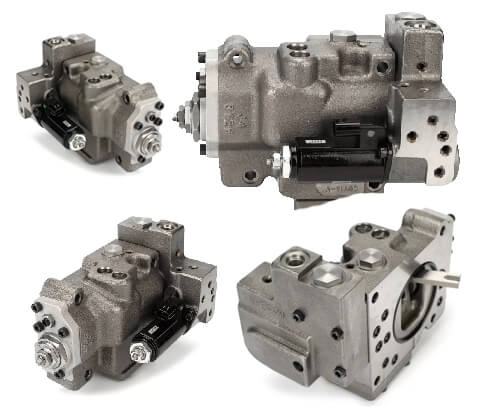
The clearest sign of the electric version is an electrical connector plugging into a proportional valve on the regulator. If a wire runs to the regulator unit, it is almost certainly the electric version. Newer machines with a controller managing the pump usually use this one.
The electric version lets the machine meter its own power by program. When sensors report a heavy load, the controller commands the proportional valve, and the regulator pulls the pump along. Lose the electric signal and the pump usually falls back to a safe default mode.
How to spot the hydraulic version
The hydraulic version has no electrical connector at the regulator. Instead it has one or a few small oil lines carrying a pressure signal. Older machines with mechanical-hydraulic control usually use this one.
On the hydraulic version, the signal oil pressure itself commands the regulator. No electronics step in, so the response depends on the internal springs and spool. To understand this deeply, you should also know how hydraulic rotary groups work, since the regulator and the rotary group work closely together.
Quick comparison of electric and hydraulic versions
The table below helps you identify the version fast in the field, before you remove anything or place an order.
| Criterion | Electric-control version | Hydraulic-control version |
|---|---|---|
| Input signal | Current from the controller | Signal oil pressure from a valve |
| Outward sign | Connector into a proportional valve | Only small oil lines |
| Common machines | Newer, with a pump controller | Older, mechanical-hydraulic control |
| On lost signal | Pump falls back to default mode | Pump holds to a base pressure |
| Mismatch risk | Plugs in but wrong command | Fits the flange but reads no current |
Where the regulator sits on a tandem pump
Excavators usually use a tandem pump, two pump units joined in one body. Each unit has its own regulator, and sometimes the two sides are not identical. So when buying, you must state clearly which side, front or rear.
Some machines add a summing regulator that coordinates both pumps. If you remove parts without marking them, it is easy to reverse the sides on reassembly. A good habit is to photograph and mark each unit before removal.
Common mismatch mistakes
The most common mistake is buying by outward shape. Regulators from two different families can look eight parts alike out of ten. Bolting on does not mean the right type.
The second mistake is mixing the electric and hydraulic versions. The third is right type but wrong model step within the family, which throws off the signal path. All three trace back to skipping the pump-code step.
Why a mismatched regulator harms the pump
When the regulator is wrong, the pump does not set the swash angle correctly for the load. The pump may take load too early and bog the machine, or release too late and heat the oil. Sustained heat and wrong load wear the pump internals faster than normal.
The real cost is not in the regulator unit, but in the rotary group behind it. One long-running mismatch can push the bill considerably higher once damage reaches the pump core. So getting it right up front is always cheaper than repairing later.
Reading the pump code correctly, step by step
To avoid guessing, work through this order:
- Read and copy the full stamped code on the pump body, leaving out no character.
- Determine single or tandem pump, and if tandem, which side.
- Look at the regulator for an electrical connector or only oil lines.
- Photograph the flange, the oil ports, and the proportional valve position.
- Cross-check the code and photos with manufacturer documentation or an experienced seller.
- Decide whether you need genuine or aftermarket.
- Match all the information one last time before ordering.
Do all seven steps and the odds of a wrong pick fall to nearly zero. You can also browse the related hydraulic-pump parts groups to picture which unit pairs with which.
Genuine and aftermarket
Only after the family matches do you choose the source. Genuine parts fit tightly and run consistently, but often cost more and may need a wait. Aftermarket is cheaper and more available, with quality that varies by maker.
There is no single right answer for every case. A machine on continuous rental earns back the value of consistency. A backup machine that runs little may do fine with a good aftermarket unit. Whatever the source, the regulator still has to match the pump family.
Check the coupling and connector before buying
Before you pay, compare the flange, the number of oil ports, and the connector type. A unit that fits the flange but has a different connector is still the wrong unit. Do not trust the look of a fit; compare each detail.
If it is the electric version, check that the connector pins match the proportional valve on your machine. If it is the hydraulic version, count and match the signal oil ports. This small detail is often the line between fits and mismatches.
Signs the regulator is failing
A weak regulator usually shows through how the machine answers load. The machine bogs on a heavy lift, or the throttle rises but force does not follow, which is a suspect sign. Sometimes the machine heats up faster with the same work.
Another sign is slow or jerky response when shifting load. These symptoms can also come from a valve or the rotary group, so do not rush the conclusion. A correct diagnosis is what keeps you from replacing the wrong part.
When to just adjust, and when to replace?
A weak machine does not always need a new regulator. In many cases a fresh adjustment brings the force back. If the spool and springs are still good, adjustment usually solves it.
Only when the internals are worn, scored, or sticking does the unit need replacing. Before deciding, read carefully how adjusting pump pressure works to rule out the simple causes. Replacing before it is needed wastes both money and time.
Prepare your information before ordering
No matter how good the seller is, they cannot guess for you without data. Preparing ahead helps you get it right the first time. The clearer the information, the lower the risk.
What you should have ready when you make contact:
- The full pump code copied from the pump body.
- Clear photos of the regulator unit and the flange.
- Whether it is the electric or hydraulic version.
- Which side, if it is a tandem pump.
- Your preference for genuine or aftermarket.
The mistake of buying from a photo online
Buying a regulator from one photo alone is a big risk. A photo does not show the connector type, the port count, or the model variant. Two units that look identical in a photo can still differ in signal.
Use the photo as a reference step, not a decision step. The final call always rests on the pump code and the matching details. A photo helps you narrow down, not close the deal.
Adjust again after fitting
Fitting the right unit is only half the job. After fitting, the regulator usually needs adjusting to match the real state of the pump. Skip this and even the right unit may leave the machine short on force.
Run a test, listen to the pump, feel the lift force, and watch the oil heat. If anything seems off, adjust gradually instead of a hard turn all at once. Correct adjustment helps the new unit last and the machine run smoothly.
A short recap before you choose
Choosing a regulator is not hard if you go in order: pump code first, control type second, then the source. Skipping the code step is the root of most mismatches. A little slowness at lookup saves a lot at repair.
Once the family and the control type match, the rest is fitting and adjusting. Keep the habit of copying the code, photographing, and cross-checking, and you will rarely pick wrong.
Need help choosing the right unit for your machine
If you already have the pump code and photos of the regulator unit, send them to the technical team for a review before ordering. Browse the pump regulators catalog to match your machine family. Getting it right up front is always lighter than dealing with a mismatched unit.
Key takeaways
- Always choose the pump regulator by the code stamped on the pump body, not by machine year.
- The same K3V family has electric and hydraulic versions that are not interchangeable.
- The electric version has a connector into a proportional valve; the hydraulic version has only signal oil lines.
- For a tandem pump, state the side clearly and mark each unit during removal.
- A mismatched regulator harms the rotary group and pushes the cost considerably higher.
- Match the family first, then choose genuine or aftermarket, and adjust again after fitting.
Written by
Đỗ Thị Hương
Đỗ Thị Hương handles parts lookup and fitment, especially hydraulic seals. She writes about choosing the right seal size, spotting genuine parts and matching parts to the machine by code.
Related parts
The exact parts discussed above — send your machine model or pump code to match.