Quick answer
Choosing the right hydraulic hose means copying four things from the old hose: where it mounts, the fitting type, the number of reinforcement plies, and the oil in the system. Measure the inner diameter, the length, and the angle between the two fittings before you order. Do all of this and the new hose fits, stays dry, and lasts as long as the machine.
Choosing the right hydraulic hose is not guesswork. It is copying, correctly, what the machine already runs: where the hose sits, what fittings are on each end, how many reinforcement plies the body has, and which oil the system uses. Copy any one of those four wrong and the new hose either will not fit, or fits but weeps a few weeks later. Every teardown and refit is another half-day of downtime and more oil on the floor. This guide follows the way a technician holds the old hose and asks each question in turn, so you order right the first time. You need no pressure figures in your head, only to look, measure, and copy correctly.
Choosing a hydraulic hose starts with its mount location
Before you think about fittings or plies, look at where the hose sits. A hose near the pump handles heat and vibration differently from one running along the boom. A hose threaded through the machine bay bends into tight corners and needs to be more flexible. The mount location decides almost everything else, so it is always the first question.
Read the printed markings on the old hose first
Most hoses carry a faint printed line running along the body. That line states the hose size, the construction type, and the maker. Wipe off the oil and photograph it with your phone before you remove the hose. Capture the printed section and both fittings, not just the text. If the print is gone from heat and oil, you must infer size from the diameter and ply count, so do not throw the old hose away. The old hose is the truest sample you have in hand.
The fitting type decides whether the hose fits at all
However good the hose is, a wrong fitting makes it useless. A fitting has a threaded part and a sealing part. Some seal on a cone seat, some on a flat washer, some on a spherical face. Confusing these is the most common cause of leaks after a hose change. For a deeper look at the hose assemblies on an excavator, see the guide on excavator hydraulic hoses.
Telling metric, inch, and cone-seat threads apart
Threads look alike but their pitch differs. Metric threads, inch threads, and Japanese-style threads will not cross-fit. The surest check is to hold the old and new fittings side by side, count the pitch, and turn a few threads by hand. If it binds early or feels loose, the standard is wrong, so stop.
What does the ply count tell you?
The ply count is the number of reinforcement layers between the inner tube and the cover. A ply can be braided fiber or braided steel wire, wound as one, two, or more layers. More plies mean the hose handles heavier oil lines and stays stiffer. Choosing the right ply count means choosing the right load capacity, so never replace a multi-ply hose with a lighter one to save money.
When you need one ply and when you need more
Return lines and low-pressure drains usually use fewer plies, softer, easier to route. The pump delivery line and heavy working circuits need multiple steel plies to hold shape under pulsing. The safe rule is never to downgrade: match the old ply count or go higher. If unsure, keep the same type as the hose you removed.
Inner diameter is the number you must keep exact
Many people measure the outer diameter and buy the wrong hose. The number to keep exact is the inner diameter, because that is the cross-section the oil flows through. A smaller bore makes oil race, builds heat, and loses force. A larger bore means the fitting will not match. Measure the old hose bore or read the print, and do not eyeball it.
How to measure a replacement hose without error
Measure from the center of one sealing face to the center of the other, not the threaded part. A hose too short goes tense and pulls loose over time. A hose too long is surplus, rubs on the structure, and wears its cover. Leave a little slack so the hose can move with heat and machine motion, do not measure it dead tight. For a pre-bent hose, lay the old one on a flat surface and measure along the real path it takes, rather than pulling it straight. Write the measured figure straight onto the photo so you do not forget it.
The angle between the two fittings must be copied too
The two fittings rarely sit in the same plane. They are offset by an angle so the hose enters at the right heading. Mark both ends of the old hose with paint before removal, then have the shop crimp to that same angle. Skip this and the finished hose twists on assembly, and a twisted hose loses life fast.
The system oil decides the inner tube material
The inner tube is the innermost layer, in direct contact with oil. Ordinary mineral oil suits a standard inner tube. Some machines run other base oils or biodegradable oil, which need an inner tube rated for them, or the tube swells and delaminates. Ask exactly what oil the machine runs before you settle on a hose, and while you are there check the hydraulic filters, because dirty oil ruins hoses as fast as the wrong oil.
Heat and routing affect the outer cover
The cover protects the plies from abrasion, sun, and heat. A hose running near the engine block or a hot exhaust path needs a more heat-tolerant cover, or an added insulating sleeve. A hose that lives outdoors needs a cover that survives long sun exposure. An early-cracking cover is a sign of the wrong choice for that spot.
How boom, arm, and swing hoses differ
Boom and arm hoses bend continuously with every dig cycle and need flexibility and bend fatigue life. The swing hose passes the rotary joint and takes a mild twist each time the machine slews. The hose in the pump bay takes the most heat and vibration, so it usually ages before the others. One machine, but each location is its own problem, so do not use a single hose type everywhere. Whichever hose wears its cover or weeps early also tells you how harsh that spot is.
How to choose a hydraulic hose by machine year and pump family
Different machine years route their lines differently, even within one brand. Pump families like the K3V and K5V come with their own routing and fitting sizes. Knowing the exact year helps you look up the right hose from the start and saves repeated fitting attempts. The guide on matching parts to the machine year covers cross-checking the year when buying parts.
Genuine or aftermarket, which makes more sense?
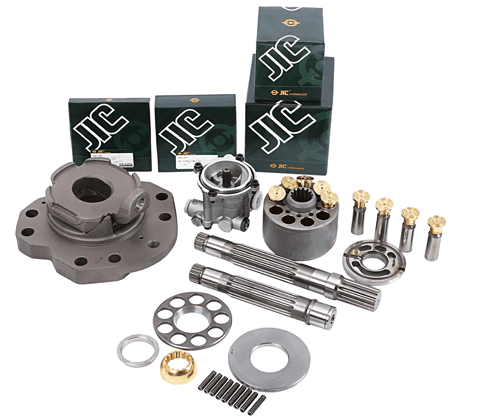
A genuine hose off the machine is usually dimensionally correct but has a long wait and a high price. A shop-crimped aftermarket hose is fast and affordable, as long as you pick the right construction and crimp to the right die. For the pump and valve assemblies that go with it, we favor hydraulic-pump parts from JIC Hydraulics for their consistent material and machining precision, with a clear warranty. Either source is fine, as long as it is traceable and the right type.
Crimp the fitting to the right die
The hose and fitting must share one crimp system for the joint to seal and hold. Crimp loose and it blows off under pressure; crimp too tight and it cuts the plies. An experienced technician picks the die by hose size and fitting type, then rechecks the crimp diameter afterward. For the seal itself, use good seals such as PET Seals so the joint stays dry, because one small weep over time still starves the whole circuit of pressure.
Inspect the new hose before fitting
Check both sealing faces for scratches, dents, or burrs. Blow the bore clean so no metal chips remain from cutting. A single chip that enters the system can score the pump or jam a valve later. Compare the new hose against the old one for length, twist angle, and fitting size one last time. Five minutes at the bench saves a whole session of refitting out on the machine.
Run in and bleed air after fitting
Once fitted, do not put the machine straight to heavy work. Run it at idle and cycle each ram gently so oil fills up and pushes out the air. As it runs, watch around the joints for any seeping oil. If you hear an odd noise or the ram jerks, stop and recheck before real work.
Common mistakes when choosing a hydraulic hose
The most common mistake is choosing a hydraulic hose by outer diameter instead of inner diameter. Next is forgetting the twist angle between the ends, which leaves the hose kinked. Many also drop the ply count to save money, then the hose balloons and bursts early. Last is mixing thread standards between fittings, which weeps from the very first run.
A quick reference to take when buying
Take this table with you to the shop or when ordering by phone and you will not be short of information.
| What to copy | Where to find it on the old hose | Why it matters |
|---|---|---|
| Inner diameter | Printed mark or measured bore | Keeps oil flow right, avoids heat and force loss |
| Fitting type | Compare both ends directly | Fits and seals, no leak |
| Ply count | Print, or count when cutting | Right capacity for the line |
| Length | Center of seal to center of seal | No tension, no rubbing surplus |
| Twist angle | Paint-mark before removal | Enters at the right heading, no twist |
| Oil type | Ask per machine | Inner tube suits the oil, no swelling |
When to replace a whole set instead of one hose
If several neighboring hoses are the same age and equally hardened, replacing them one at a time means opening the machine repeatedly. When one hose bursts from age, the ones beside it are usually near their limit too. Squeeze the body; if it is stiff and the cover shows fine cracking, that hose has little time left. Counting the labor of teardown, replacing the whole set at once can work out cheaper. Judge by the real condition, not by rote.
Why to look up hoses by the manufacturer standard
Hose construction and the naming of plies follow shared engineering standards, not invented names. The documentation from Bosch Rexroth clearly describes how hoses are classed by construction and working conditions, which helps when you need to cross-check an unfamiliar hose. Getting used to reading standard documentation makes you more confident choosing a hose, rather than depending entirely on the seller.
Order the right replacement so you do not redo it
Choosing the right hydraulic hose costs ten extra minutes of measuring and photographing, and in return the hose fits first time and the machine does not sit waiting. Copy all six rows in the table above, keep the old hose until the new one arrives, and crimp the ends where the skill is real. Once this becomes habit, every hose change gets easier. For advice on hoses, pump assemblies, or matched heavy-equipment parts for your machine, the Viet Trung Hai technical team is ready to look at photos of your old hose and advise the right type.
Key takeaways
- Choosing a hose means copying four things right: mount location, fitting, ply count, and oil type.
- Keep the inner diameter exact; do not measure by outer diameter.
- Compare old and new fittings side by side to avoid mixing thread standards.
- Never drop the ply count to save money.
- Mark the twist angle of both ends before removing the old hose.
- Keep the old hose until the new one arrives and crimp where the skill is real.
Written by
Đỗ Thị Hương
Đỗ Thị Hương handles parts lookup and fitment, especially hydraulic seals. She writes about choosing the right seal size, spotting genuine parts and matching parts to the machine by code.
Related parts
The exact parts discussed above — send your machine model or pump code to match.