Quick answer
Choosing hydraulic O-rings comes down to six factors that must line up together: inner diameter, cross-section, a compound matched to the oil and temperature, Shore hardness, the groove dimensions, and the right static-or-dynamic duty. Miss one of the six — even when the ring looks almost identical — and it either swells and hardens until it weeps, or gets extruded into the clearance gap once pressure rises.
Choosing hydraulic O-rings comes down to six factors that must line up together: inner diameter, cross-section, a compound matched to the oil and temperature, Shore hardness, the groove dimensions, and the right static-or-dynamic duty. Miss one of the six — even when the ring looks almost identical — and it either swells and hardens until it weeps, or gets extruded into the clearance gap once pressure rises. This guide walks each factor in the order you should check it with the old ring in your hand, so the next replacement does not send you back into the machine chasing a weep.
What matters when choosing hydraulic O-rings?
Six parameters have to mesh; get one wrong and the ring still fits but leaks or extrudes. An O-ring that actually seals is the result of six parameters meshing: inner diameter (ID), cross-section (CS), a compound matched to the oil type and temperature range, Shore hardness, the groove dimensions on the part, and whether the duty is static or dynamic. Miss or mismatch one of the six and the ring still fits, but it fails in one of two familiar ways — it swells and hardens until it leaks, or it extrudes into the gap when pressure climbs.
What costs many technicians time is that five of the six cannot be judged by eye. Two rings of equal diameter can differ in cross-section; two equally black rings can be two entirely different compounds. So the correct routine is measure, look up, and cross-check — not eyeball. If you want to frame the wider question of standardising how replacement parts are chosen, the parts-selection hub goes deeper into this thinking for both pump and cylinder assemblies.
Inner diameter and cross-section: two measurements you cannot confuse
An O-ring is identified by two numbers: inner diameter and cross-section, meaning the thickness of the ring's body. Inner diameter decides which shaft it hugs or which bore it drops into; cross-section decides the squeeze when the ring is compressed between two surfaces. The most common error is reading only the diameter and grabbing a ring of a different thickness — it still slips in, but the squeeze is wrong, and a wrong squeeze either fails to seal or over-compresses and takes a set early.
The reliable way to measure is a caliper on the outer diameter and body thickness, then derive the inner diameter, all on a ring that has not been stretched. A removed O-ring is usually stretched or flattened, so the best reference is the groove, not the old ring. The article on choosing the right seal size covers measuring and look-up in detail to avoid exactly this trap.
Why "close enough" still leaks: the extrusion mechanism under pressure
This is the point most often underrated. A slightly off-size O-ring can still seal at low pressure, but as system pressure rises, oil presses the whole ring toward the clearance gap between the two parts — the gap between piston and bore, or between two flange faces. If the ring is the right size and hard enough, it holds and seals tighter with pressure. If it is too soft, too large, or the gap is too wide, part of the body is pushed into the gap and nibbled away — extrusion. An extruded edge looks gnawed or torn along the ring's circumference.
Extrusion is why a nearly-right ring is more dangerous than a missing one: the machine runs the first few shifts sealed, you wave it through, then it leaks suddenly under high load. When the fitted clearance has widened from wear, the fix is not a softer ring for easier sealing but a harder ring, or an added back-up ring to close the gap so the O-ring body cannot creep through.
Compound: NBR, FKM/Viton or PU — chosen by oil and temperature
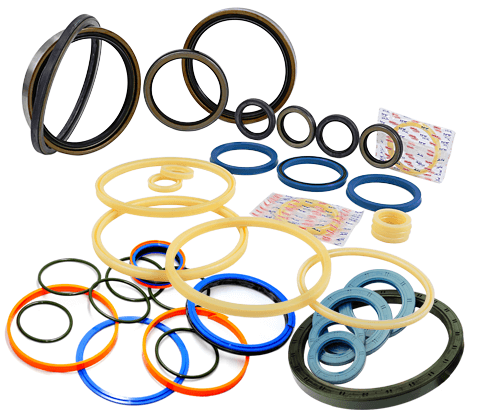
The compound is the easiest factor to get wrong because it is invisible. The three groups you meet most in construction-machine hydraulics are NBR (nitrile), FKM (usually known by the trade name Viton) and PU (polyurethane). Each suits a different oil environment and temperature band; the wrong group is the number-one reason a freshly fitted seal still leaks soon after.
The selection rule fits in one sentence: settle the oil type and working temperature first, then choose the compound — never the other way round. For ordinary mineral hydraulic oil such as ISO VG46 or VG68, NBR is the default. Only when there is high heat, synthetic oil or special chemistry do you weigh FKM. PU belongs where extrusion and abrasion resistance matter, typically the dynamic seals inside a cylinder.
NBR (nitrile): the default for mineral oil
NBR is the standard choice for mineral-oil systems — reasonably priced and oil-resistant. It suits most pumps, valves and cylinders running mineral-based hydraulic oil at ordinary operating temperatures. Its weakness is poor durability under sustained high heat, ozone and some synthetic oils — in those environments it hardens and cracks early.
FKM/Viton: when heat is high or the oil is unusual
FKM resists heat and chemicals markedly better than NBR, so it is chosen for zones near the engine, systems that run hot continuously, or oils with aggressive additives. The trade-offs are higher cost and poorer low-temperature elasticity than NBR. Do not default to swapping every O-ring to FKM "to be safe" — in cold and impact conditions a stiff FKM ring can seal worse than the correct NBR.
PU (polyurethane): when extrusion and abrasion resistance are needed
PU is hard and tough, with excellent abrasion and extrusion resistance, so it is common for dynamic seals and back-up rings in high-pressure cylinders. Its downside is sensitivity to hot water and possible hydrolysis in some conditions, so it is a position-specific choice rather than a universal compound. In a cylinder seal kit, PU usually pairs with NBR and a guide ring as one assembly — the cylinder seal kit guide explains why these materials must be matched to the right location.
Swelling and hardening: two failure modes from the wrong compound
The wrong compound leaves marks that are easy to read. If the compound is incompatible with the oil, the ring absorbs oil and swells — the diameter bloats, the body goes soft and squishy. A swollen ring seems to seal better at first, but it has lost its correct dimensions, takes a set quickly and then leaks. Conversely, when the ring is pushed past its heat limit, it hardens and loses elasticity — squeeze it and it does not spring back, the surface shows fine cracks. A hardened ring can no longer seal harder with pressure. Reading these two signs during teardown lets you conclude straight away that the compound was wrong, instead of blaming the fitter's technique.
Shore hardness: the number that decides between sealing and extruding
Hardness on the Shore A scale tells you whether the ring is soft or hard. A softer ring seals more easily at low pressure and small clearance; a harder ring resists extrusion better at high pressure or where the gap has widened from wear. Choosing hardness is therefore tied to working pressure and the state of the clearance — soft is not automatically sealing.
On the shop floor: if one position keeps weeping despite the correct size, look again at the fitted clearance. A gap widened by wear is far better answered with a harder ring or an added back-up ring than by swapping the same type in and out. Conversely, at a low-pressure static position, too hard a ring can itself weep, because it cannot conform to a machined face that is not perfectly smooth.
Groove and clearance: the machined dimension is the real reference
The reference for choosing an O-ring is not the old ring but the groove it sits in. The groove has a width, a depth and a clearance to the mating part; those three dimensions set the ring's squeeze and fill. The old ring is already deformed, so measuring it is error-prone; measuring the groove gives a more trustworthy original figure.
When the groove still holds its machined dimensions, choosing a ring from the look-up table is enough. When the groove or the mating surface is worn, scored or pitted, even a correct ring leaks — the problem is the surface, not the seal. That is the moment to weigh resurfacing or replacing the part rather than fitting yet another seal. The detail on reading machined dimensions and tolerances lives in choosing the right seal size.
Static or dynamic: one O-ring, two different problems
The same O-ring can seal statically or dynamically, but the two roles set very different demands. Misjudging the duty leads to the wrong compound and hardness from the start.
Static sealing
At a static position — between two flanges, a pump cover, a fitting — the ring barely moves relative to the surfaces. The main requirement is to fill the groove and hold pressure. A correctly sized NBR is usually enough; pay more attention to the flatness and cleanliness of the contact face than to abrasion resistance.
Dynamic sealing
At a dynamic position — piston, cylinder rod, rotating shaft — the ring slides back and forth constantly, so it faces far higher wear, friction and extrusion risk. This is where PU and purpose-made seals earn their place, and where the sliding surface must be finished to the right smoothness; too rough cuts the seal, too polished holds lubricating film poorly. When replacing dynamic seals in a cylinder, the removal-and-fit procedure directly affects service life — how to replace cylinder seals walks the steps that avoid scoring the rod and pinching the seal on assembly.
Standard series or metric: read the right table
O-rings exist in several parallel dimension systems, and mixing systems is a quiet source of wrong sizes. The inch system to AS568 is common on US-origin equipment; the metric system to ISO 3601 is common on European and Asian equipment. The two have sizes that are very close but not identical, so a ring that looks "close enough" in one table can sit slightly off in the real groove.
The safe rule: stay in the system the original equipment uses, and look up on one standard table from start to finish. Bearing and sealing makers such as SKF publish dimension tables in both systems, handy for cross-checking inner diameter and cross-section before ordering. When your measurement lands between two standard sizes, that is usually a sign you are reading the wrong system, not that you need a special size.
Quick comparison of the three compound groups
| Compound | Suits | Strengths | Watch out for | Typical position |
|---|---|---|---|---|
| NBR (nitrile) | Mineral oil ISO VG46/VG68 | Good oil resistance, economical, elastic | Weak under sustained heat, ozone | Static seals, fittings, pump cover |
| FKM (Viton) | High heat, special oils/chemicals | High heat and chemical resistance | Costly, poor low-temp elasticity | Hot zones, near the engine |
| PU (polyurethane) | High pressure, sliding motion | Excellent extrusion and abrasion resistance | Hydrolysis-sensitive in hot water | Dynamic seals, cylinder back-up rings |
PET Seals kits: go by the machine's kit instead of collecting singles
For common pump, valve and cylinder assemblies, collecting individual O-rings one by one wastes time and risks missing exactly the one ring in an awkward spot. PET Seals kits are assembled per assembly and per machine model, holding all the O-rings, seals and back-up rings for one overhaul, cutting the risk of mixing inch and metric or fitting the wrong compound. PET Seals makes genuine-replacement parts with materials and machining that meet sealing requirements, and because they come as a kit the parts within an assembly are compatible in size and hardness from the moment you open the box.
Choosing by machine also sidesteps the swelling-and-extrusion trap above: when the whole assembly uses the right compound for the right position, you are not guessing ring by ring. The hydraulic seals and genuine hydraulic seal parts catalogues list kits by machine line. If you need to tell genuine parts from grey-market stock when buying singles, how to identify NOK seals points out the signs on the packaging and the machined surface.
A fast selection routine at the bench
- Establish whether the position is static or dynamic — this narrows compound and hardness first.
- Establish the oil and working temperature — pick the compound group NBR, FKM or PU.
- Measure the groove, not just the old ring — take the correct inner diameter and cross-section.
- Establish the dimension system of the original equipment, inch or metric, and look up on one table.
- Check the fitted clearance; if widened by wear, raise hardness or add a back-up ring.
- Cross-check a kit by assembly rather than collecting singles when overhauling the whole assembly.
Common mistakes when replacing O-rings
The most frequent error is eyeballing rings and grabbing the closest-looking one. Next is assuming every black ring is NBR, when FKM and other compounds are black too. Many measure a stretched or flattened ring and get the size wrong; some fit too hard a ring into a low-pressure static position and then get a weep. A quieter mistake is applying incompatible grease or solvent to the seal on assembly, swelling the ring from the start. Last is ignoring a worn clearance — fit a new seal into an already-wide gap and the new ring extrudes like the old one.
When to replace the whole kit instead of single rings
If only one ring at a failure-prone spot is gone and the rest are sound, a correctly sized single swap makes sense. But once the machine is open for overhaul, when many rings are the same age and all beginning to harden, or when you are unsure of the history of the internal seals, replacing the whole kit by assembly is cheaper in the long run — a second teardown usually costs far more than the price difference of a few seals. On cylinders and piston pumps, kit replacement also guarantees every ring in the assembly is the same compound, the same dimension system and the same quality batch, which is what keeps this fit sealed and sealing for a long time.
Key takeaways
- Six factors must match: inner diameter, cross-section, compound, Shore hardness, groove size and static-or-dynamic duty.
- Choose the compound by oil and temperature first; NBR for mineral oil, FKM for heat, PU for extrusion resistance.
- Measure the groove, not the deformed old ring, to get a trustworthy original size.
- A near-size ring still extrudes into the gap at high pressure; for a worn gap raise hardness or add a back-up ring.
- Stay in one dimension system, inch AS568 or metric ISO 3601, and look up on one table.
- For a full-assembly overhaul, a PET Seals kit by machine avoids mixing systems and wrong compounds.
Written by
Đỗ Thị Hương
Đỗ Thị Hương handles parts lookup and fitment, especially hydraulic seals. She writes about choosing the right seal size, spotting genuine parts and matching parts to the machine by code.
Related parts
The exact parts discussed above — send your machine model or pump code to match.