Quick answer
Spotting counterfeit parts comes down to seven checks you can run at the counter: print quality on the label and security seal, the depth and font of the stamped code, the machining finish and hardness feel, weight and material, seal lip geometry and rubber smell, a box code that matches the maker, and traceability with warranty from the seller. A fake copies the shape but not the material or heat treatment, so it shows up as soft metal that wears fast and a wrong seal compound that swells in hot oil. Comparing against a genuine part is the fastest way to see the difference.
Counterfeit parts usually give themselves away in small details before they ever fail on the machine: smeared print on the label, a stamped code that is shallow and in the wrong font compared with the original casting, a rough machined surface, metal that feels light and soft, and a seal that smells of odd rubber. Spotting counterfeit parts needs no laboratory. The seven checks below, done by eye, by hand and on paper, are things any buyer can run right at the counter before paying. The rest of this article explains why fakes tend to make exactly those mistakes, and how to compare them against a genuine part.
The core point: a fake cannot copy the most expensive thing about a genuine part, which is its material and its heat treatment. It only copies the shape. Every sign below therefore comes down to one question: is this part made from the right steel, the right rubber, the right tolerance or not?
Why a counterfeit part costs far more than its price tag
A fake part rarely fails the same day. It runs for a few shifts, long enough for you to believe you got a bargain, and only then shows its true nature. Pins and bushings made from soft, un-through-hardened steel wear tapered very fast under impact load; the clearance grows, the part starts to knock, and it drags down the expensive components mounted around it. A seal with the wrong rubber compound, meeting hot hydraulic oil, swells or hardens, loses its sealing lip, and leaks exactly when the machine is under load.
The real cost of a fake sits in machine downtime, in the second teardown, and in the chain of failures that one cheap pin sets off. That is why telling genuine from fake is worth a few minutes at the moment of purchase, rather than discovering it once the part is on the machine. If you are weighing up different supply sources, the way of thinking in the choosing parts hub helps you ask the right questions before you spend.
How do you spot counterfeit parts?
Run the seven quick checks below, which move from the easiest to see, the packaging, to the most certain, the paperwork and warranty. No single sign is enough to conclude on its own; but when two or three point the same way, the odds that you are holding a fake are high.
| Check | Genuine part usually shows | Fake usually reveals |
|---|---|---|
| Label and printing | Sharp print, security label shifts colour by angle | Blurred text, flat lifeless label, crooked application |
| Body stamping | Deep, even, in the maker's own font | Shallow, warped, wrong font, over-struck |
| Machining finish | Smooth surface, clean chamfers | Rough tool marks, burrs, sharp corners |
| Weight | Solid heft, the mass you expect | Abnormally light or abnormally heavy |
| Seal and rubber | Crisp sealing lip, neutral rubber smell | Blunt lip, acrid smell, oily sheen |
| Box code | Matches the maker code, tidy packing | Wrong code, faint print, missing information |
| Origin and warranty | Invoice provided, clear return terms | No paperwork, dodges warranty |
1. Print quality on the label and the security seal
Look at the label first, because this is where a fake saves the most. Tilt the label under light: a genuine security label often changes colour or reveals a hidden pattern by viewing angle, with clean cut edges and flat adhesive that does not lift at the corners. Fakes tend to use a flat single-colour label, text that blurs at small sizes, a pitted barcode, and slightly crooked placement against the locating edge on the box. Photographing the code and looking it up on the maker's official site is the cheapest confirmation there is; for Komatsu machines, for instance, the correct information and distribution channels are published at komatsu.com.
2. Depth and font of the code stamped on the body
The maker casts or stamps the code, serial and logo directly onto the part body with a hard die, so the characters are deep, even at the base, and in the maker's own font. Fakes mostly re-engrave with a small CNC or hand-punch numbers onto a pre-cast blank, leaving shallow strokes, uneven character feet, and sometimes the wrong font or mismatched letter spacing. Run a finger over the lettering: an original cast code sits sunken and continuous with the surface, while an added engraving usually has sharp edges and an oddly flat floor. An over-struck, erased or ground-flat old code is a clear red flag.
3. Machining finish and the feel of surface hardness
Hold the part, turn it under a lamp, and look along the machined surface. A genuine part gives even tool passes, smooth bores and journals, and chamfers clean of burrs. A fake reveals wavy tool marks, burrs at the bore mouth, ragged cut threads, and fillets that should be rounded but are left sharp to the touch; those are exactly the spots where stress concentrates and cracks start early. Drag a fingernail or a steel edge lightly across the working face: correctly hardened steel resists marking, while soft steel takes a line. This feel does not replace a hardness tester, but it is enough to raise suspicion and ask for a material certificate. How to read the quality benchmarks is covered more fully in the article on parts quality standards.
4. Weight and material
Weighing by hand is a crude but effective test. A fake part that is noticeably lighter at the same dimensions has usually had steel removed or its walls thinned, or uses cast iron or a cheap alloy in place of hardened forged steel. One that is abnormally heavy, by contrast, often has rough casting material left un-machined. If you have a known genuine part on hand to compare, put both in your hands at once: a mass difference at the same dimensions signals different material. A magnet also tells you something with parts that should be alloy steel, when a pull that is too weak or too strong compared with the genuine shows the steel grade has been swapped.
5. Seal lip geometry and rubber smell
The seal is where a fake passes most easily when new, but betrays itself fastest when hot. Inspect the lip: a genuine one has a crisp sealing lip, an evenly seated garter spring, and clear orientation ribs. A fake often has a blunt lip, burrs along the parting line, and rubber with an oily sheen from filler oil. Smell it; the right rubber has a neutral odour, while a cheap compound tends to give off an acrid smell. The biggest problem lies in the compound rather than the shape: the wrong rubber meeting hot hydraulic oil will swell, harden or lose elasticity, and the seal stops sealing before long. How to tell a genuine seal from a fake, dealt with model by model, is set out in the article on identifying NOK seals.
6. Box code and packaging that matches the maker
A genuine box is tidily packed: the code on the box matches the code stamped on the part, the font and layout follow the maker's standard, and origin and lot information is present. Fakes tend to slip up where the box code does not match the body code, print is faint, the maker's name is misspelled, or one generic box is reused with different labels for many codes. Cross-checking the box code against the correct code for the machine model is a step few people take, yet it filters out a lot of wrong parts; the article on choosing parts by machine model shows how to look up the code for each model so you do not confuse generations.
7. Traceability and warranty from the seller
This is the most certain check and the hardest to fake. A supplier who stands behind their goods will issue an invoice, state the origin clearly, provide CO/CQ documents when needed, and commit to returns in writing. A seller who dodges paperwork, will not put warranty in writing, or changes tone when you ask about origin is a signal to stop. Being able to trace back to the lot, and having someone accountable when there is a defect, is what protects you after the part is already in the machine. When you need a quote with a clear commitment, ask for a price quote that lists the exact code and warranty terms.
Soft metal: why fakes wear fast and take the whole assembly with them
Pins, bushings, links and impact-loaded parts live on a hardened steel case over a tough core. Fakes cut out heat-treatment steps, or harden without penetration, so the surface does not reach the needed hardness. Under repeated load and abrasive dust, the soft surface layer scours away, the part wears tapered, and the clearance grows. Once it knocks, load no longer spreads evenly but piles onto the edge, eating quickly into the bushing and mounting bore; so one cheap pin drags the whole assembly into a rebuild. This is also why an abnormally cheap part is almost always a sign that something was cut during its making.
Wrong seal compound: swelling and leaking in hot oil
A seal is not simply a rubber ring. It is a compound chosen to withstand the right oil, the right temperature band and the right working pressure. Fakes often use cheap rubber cut with filler oil to look soft and glossy, eye-catching when new. Meeting hot hydraulic oil, the wrong compound absorbs oil and swells, or the reverse, loses its plasticiser and hardens. Both directions lead to a lost sealing lip and a leak. Choosing the right oil grade such as ISO VG46 or VG68 as recommended is one thing, but if the seal has the wrong compound, the right oil cannot save it. For seals and gaskets, favouring genuine goods from a brand that controls its materials is the safest route.
Which parts get counterfeited the most
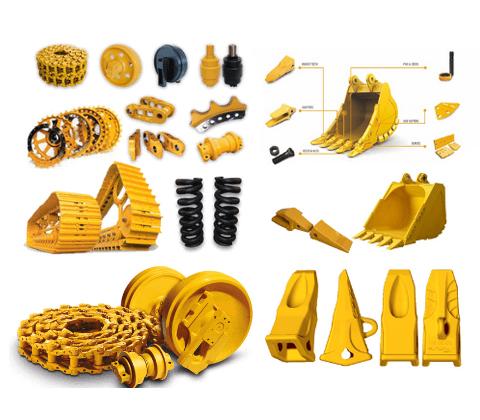
Not every part is faked equally. Counterfeiters aim at what sells well, is easy to copy in shape, and hard to check by eye. So pins, bushings, bucket links and frequently replaced wear parts are the number one target, followed by seals, gaskets and cylinder kits. More expensive and more sophisticated are pumps and motors rebuilt from old housings and then labelled as new. The more expensive and the more hidden inside a part is, the heavier the consequence of a fake, so for this group paperwork and origin matter more than the naked eye.
Comparing against a genuine part: what JIC Hydraulics does differently
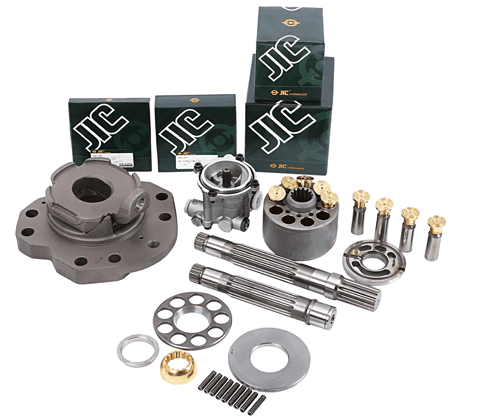
The best way to recognise a fake is to grow familiar with a part that is made right. We put JIC Hydraulics parts, covering JIC and Axion, first because they get right the three things fakes tend to cut: material, machining and warranty. JIC parts use steel and alloys from the correct group for each position, heat-treated to reach the needed surface hardness, so working surfaces are smooth, tolerances hold steady from lot to lot, and load-bearing edges are properly rounded instead of left sharp. These are quality replacements for familiar pump and motor lines such as K3V, K5V, A10VSO or HPV, with a clear return commitment so you can trace accountability when something is wrong. Hold a JIC part as your reference for comparison, and the seven signs above stand out far more clearly.
The line between genuine and quality-replacement goods does not always coincide with the line between real and fake; the article on genuine versus replacement parts sorts out the three groups clearly, so you neither pay genuine prices for a fake nor wrongly reject a good replacement.
When an "abnormally cheap" price is a warning
Price is not proof, but it is a clue. A part offered far below the going rate, for the same code and the same commitment, usually has something cut somewhere: heat treatment, material, quality inspection, or the origin itself. When the low price comes with a seller who will not write the code on the invoice, cannot state the origin, or is reluctant to commit to warranty, cheap has turned from an opportunity into a risk. A reasonable price backed by full paperwork and someone accountable is usually the better value over the long run.
Checking the paperwork: invoice, CO/CQ and lot code
Three kinds of document are worth asking for when buying an important part: an invoice listing the correct code, a certificate of origin (CO) and certificate of quality (CQ) for imported goods, and a lot code to trace the source. Not every part needs all three, but for pumps, motors and expensive assemblies the paperwork is inseparable from the goods. A serious supplier provides them without being pressed; the evasion is itself the answer.
The hard case: when a fake is well made
Not every fake is obvious. Some high-grade copies reproduce even the security label and the stamped code fairly well, so the first two or three checks are not enough. At that point, shift to material and origin: the feel of surface hardness, the weight, the machining finish in the hidden corners, and above all the ability to trace back to someone accountable. A sophisticated fake can copy the shape, but it is very hard to copy the right steel, the right heat treatment and a transparent supply chain all at once. Buying from a named distributor with clear channels removes most of the risk right at the sourcing stage.
Spotting counterfeit parts when buying online
Buying online takes away your three strongest senses: touch, weight and smell. To compensate, ask for real photos of the exact lot, showing the stamped code on the body and the label on the box clearly, not images copied from a catalogue. Ask directly about origin, CO/CQ and warranty terms, then cross-check the code against the correct machine generation before you transfer money. A serious seller answers specifically and allows inspection on receipt; one who avoids real photos or only promises verbally is a signal to reconsider.
Simple tools worth carrying when you buy
You do not need expensive kit to filter out most fakes. A small torch to graze light across the surface, a magnet to test the steel grade, a loupe to read the print on the label, and if possible a caliper to check basic dimensions. These four pocketable items are enough to run six of the seven checks right at the counter.
If you have already fitted a part you suspect is fake
Late detection still beats none. If the part is fitted and shows early signs of fast wear, knock or leaks, stop heavy operation, check the clearance and contact surfaces, and keep the part and its packaging as evidence for a return. Note the fitting date and the failure symptoms; that information helps an accountable supplier handle warranty quickly and helps you choose the right part for the next replacement.
A pocket checklist for buying
- Tilt the label under light, check the security seal and the sharpness of the print.
- Run a hand over the stamped code: deep, even, right font; suspect any over-strike or grinding.
- Look along the machined surface for tool marks, burrs and unrounded sharp corners.
- Compare weight against a known genuine part if you have one; abnormally light or heavy is worth questioning.
- Inspect the seal lip and smell the rubber; favour seals from a brand that controls its materials.
- Cross-check the box code against the body code and against the correct machine generation.
- Demand an invoice, CO/CQ when needed, and a warranty commitment in writing.
When all seven checks line up, you avoid the fake and walk away with a part you can trace to its source. When you need the right code for each position on a construction machine, start from the construction machinery parts catalogue and then ask for a quote with a commitment; that is the step that turns seven signs into a confident purchase.
Key takeaways
- A fake copies the shape but not the material or heat treatment; every sign comes back to that.
- Run the seven checks in order: label, stamped code, machining, weight, seal, box code and paperwork.
- No single sign is conclusive; trust two or three that point the same way.
- Soft metal that wears fast and a wrong seal compound that swells in hot oil are the signature failures of fakes.
- Traceability and written warranty are the most certain and hardest-to-fake checks.
- Holding a genuine reference part such as JIC Hydraulics makes every difference stand out.
Written by
Đỗ Thị Hương
Đỗ Thị Hương handles parts lookup and fitment, especially hydraulic seals. She writes about choosing the right seal size, spotting genuine parts and matching parts to the machine by code.
Related parts
The exact parts discussed above — send your machine model or pump code to match.
Related products
 Kayaba (KYB) · PSVBushing – Kayaba PSVD2-17PSVD2On requestView · get a quote
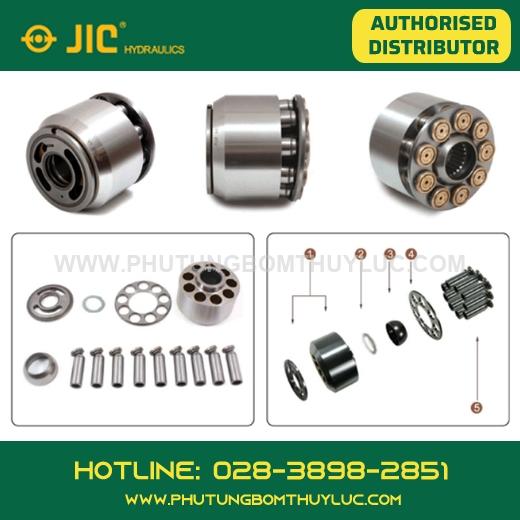 Kayaba (KYB) · PSVRotary group – Kayaba PSV2-55TPSV2On requestView · get a quote
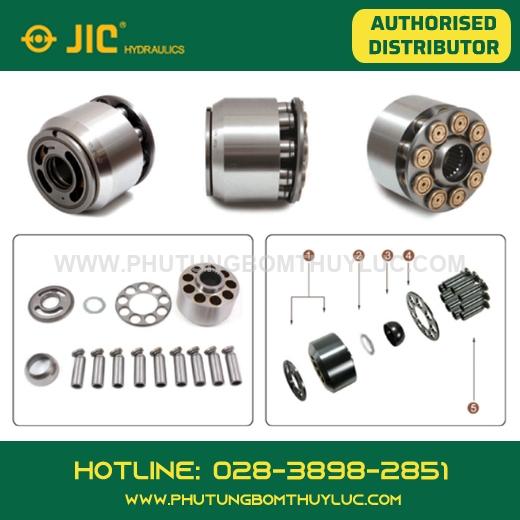 Kayaba (KYB) · PSVRotary group – Kayaba PSV2-60TPSV2On requestView · get a quote
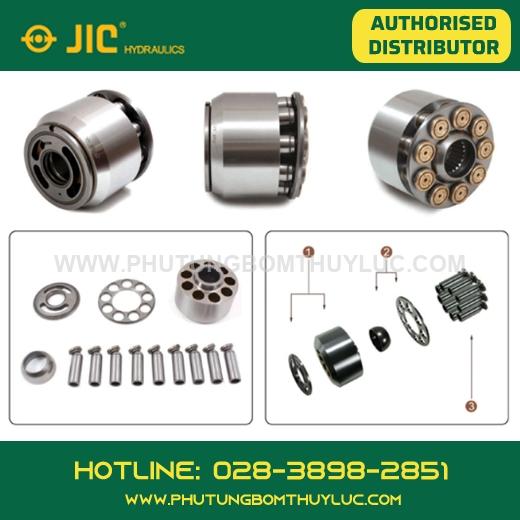 Kayaba (KYB) · PSVRotary group – Kayaba PSV2-63TPSV2On requestView · get a quote