Quick answer
Choosing the right excavator bearing means pinning down where it sits, what load it carries, then measuring the three numbers of the old bearing before you buy. Get these four things solid and one replacement runs long, sparing you repeated teardowns on the job.
Choosing the right excavator bearing means identifying exactly where it sits, what kind of load it carries, then measuring the three key numbers of the old bearing before you buy. It sounds simple, but most cases of a loose swing, a whining motor, or a strange noise from the undercarriage trace back to one small part chosen wrong at this step. This guide walks through each group of bearings and bushings on an excavator — swing ring, motors, pumps, undercarriage and bucket joints — so you understand why choosing the right type, size and load rating matters so much.
What an excavator bearing is and where it sits
An excavator bearing supports a rotating shaft, letting it turn easily while holding true center under heavy load. On a machine, bearings live in many places: under the swing ring, inside the travel motor, inside the swing motor, inside the hydraulic pump, in the sprocket, the rollers, and even the joints of the boom and arm. A bushing is a close cousin of the bearing: instead of rolling on balls or rollers, it slides directly on the shaft surface. Knowing where it sits and what job it does is the first step to choosing right.
The main groups of bearings and bushings on an excavator
Sorted by job, an excavator has four main groups. First is the swing bearing, which carries the whole rotating upper house. Second is the bearings and bushings inside the hydraulic block — pump and motors. Third is the undercarriage bearings: sprocket, track rollers, carrier rollers. Fourth is the bushings and pins at the boom, arm and bucket joints. Each group carries a different kind of load, so experience from one spot cannot be copied to another.
The swing bearing: heart of the rotating house
The swing bearing is the largest bearing on the machine, sometimes as wide as a table. It carries the weight of the upper house and takes the tipping force when the bucket reaches far and digs heavy. The inner or outer race usually carries gear teeth for the swing motor to mesh with. When this bearing goes loose, you feel the house rock slightly as it stops swinging, or hear a rushing noise through the turn. This is an expensive, heavy part, so getting it right the first time saves a great deal of labor later.
Bushings and bearings inside the motor and hydraulic pump
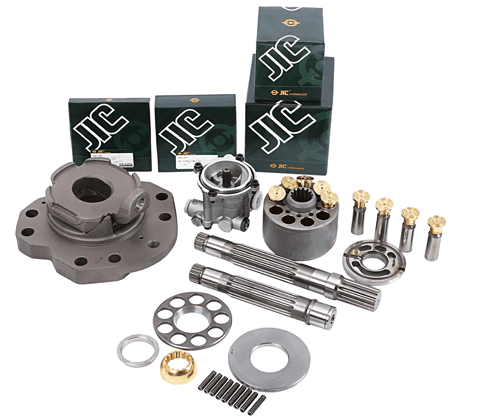
Inside hydraulic pumps and motors — familiar families like K3V and K5V — bearings and bushings support the shaft and rotating block under high pressure. The parts here are small but demand very high precision, because a small gap means lost flow, a weak machine and hot oil. When you replace a pump cartridge or rebuild a motor, the bearings and bushings should be replaced together as a set. For this hydraulic block, the genuine JIC Hydraulics parts that Việt Trung Hải distributes are worth considering, because the parts are machined to correct tolerance with stable material, cutting the risk of pressure loss after a few dozen hours.
Bearings and bushings in the undercarriage and bucket joints
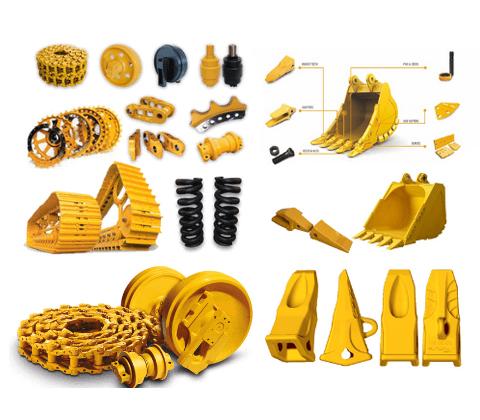
In the undercarriage, bearings live inside the sprocket and the rollers, working in mud and water so they wear fast. In the work group, the boom and arm joints use sliding bushings and steel pins. When a bushing wears, the bucket goes loose, digs less accurately, and knocks when it changes direction. Choosing bucket bushings goes hand in hand with bucket maintenance, because a loose bushing left alone will eat into the pin bore and cost you a reboring job. The undercarriage rollers also tie into track tension: an over-tight track makes the rollers and their bearings run hotter and wear faster than normal.
How do you know a bearing is failing?
A failing bearing usually warns you with three signs: noise, heat and play. The noise can be a steady rushing sound, or a knocking once per turn when a ball has broken. The heat shows when the area near the bearing feels much hotter than usual after a while running. The play shows when you rock it by hand and feel free travel in the shaft or wheel that should not be there. See one of these three signs and you should check early rather than wait for a full failure out on the job.
Measure the three numbers: bore, outside, width
To choose the right bearing, measure three basic numbers on the old one: the bore that fits the shaft, the outside diameter that fits the housing, and the width. For a bushing, measure inner diameter, outer diameter and length. Use a good caliper, measure at several points and take the consistent number, avoiding the spot that has worn oval. These three numbers are almost always stamped or printed on the old bearing race, so cross-check to be sure.
Choose the right type: ball, cylindrical roller, taper or plain bushing
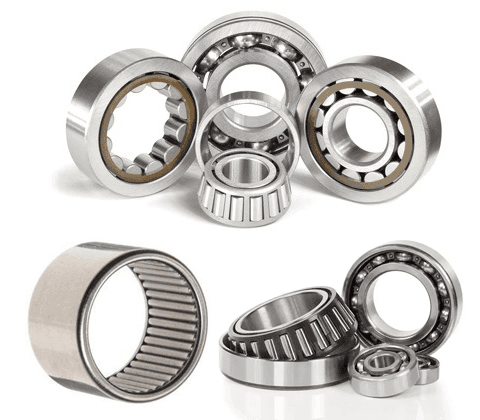
Not every bearing swaps for another, because each type carries load a different way. A quick way to sort them:
- Ball bearing: carries light to medium load, runs smooth, takes radial load plus a little axial.
- Cylindrical roller: carries heavy radial load, common on shafts under big force.
- Taper roller: takes radial and axial load at the same time, usually fitted as an opposed pair.
- Plain bushing: used at slow-rocking joints under heavy load, where tight space leaves no room for a rolling bearing.
Choosing the right type comes first; wrong type fails fast even at the right size.
Choose the right load: radial or axial
Radial load is force at right angles to the shaft, such as weight pressing on a horizontal shaft. Axial load is force along the shaft, such as the thrust inside a motor. The swing bearing takes a mix of both plus a tipping moment, so it is a purpose-built type and no ordinary bearing can stand in for it. When choosing, you must know what load the part carries to pick the right line. This is the point many people skip, and they pay for it with short life.
Internal clearance and interference fit
A bearing has internal clearance between the balls and the track, and an interference when it presses onto the shaft or into the bore. Choosing the wrong clearance group makes the bearing either too tight and hot, or too loose and rattling. For a part that runs hot, like inside a pump, the clearance must suit the job so the bearing still turns free once it expands with heat. You need not memorize numbers; just match the clearance-group code marked on the old bearing, or tell the seller the exact mounting position.
Steel quality and heat treatment decide the life
Two bearings that look identical can have very different life, because the steel and heat treatment differ. Clean steel with even heat treatment gives a hard, fatigue-resistant track surface that runs long without flaking. Poor steel shows flaking after only a short time, then breaks up. This is why an unusually cheap bearing is rarely worth buying, even at exactly the right size. The money saved at the counter easily becomes the cost of pulling the machine apart again.
Genuine, aftermarket, and how to look at it
The market has both genuine and aftermarket parts, and not every aftermarket part is bad. What matters is choosing a maker with real quality control, not loose no-name stock. For bearings and bushings, Việt Trung Hải distributes ZVL Slovakia — a bearing line with stable material and machining precision, and a clear warranty — so it is a quality option worth considering when you need a replacement. You can also browse the matching groups of heavy-equipment parts to buy everything in one go.
How do you choose a swing bearing by machine generation?
The swing bearing is tightly tied to the machine generation and whether the teeth are internal or external. Same maker but a different generation, and the ring diameter and tooth count may have changed. So when you ask to buy, state the maker, the machine generation, and whether the teeth are intact or worn. If you still have it, photographing the label and measuring the toothed-ring diameter helps the seller look it up right. The price of this part varies with generation and supply source, so pin down the right reference before talking price.
Grease and seals: choose them together with the bearing
A good bearing with too little grease or a poor seal still fails fast. Grease holds the oil film between the balls and the track; the seal keeps mud and water out. When you replace a bearing in the undercarriage or the swing ring, check and replace the matching seal too — do not skimp. For the hydraulic seals that come with the pump and motor block, use a quality line such as PET Seals so their life matches the new bearing. Applying the right grease in the right amount at assembly matters as much as choosing the right bearing.
Fit the bearing correctly so it does not fail early
The right bearing still fails early if fitted wrong. Never hammer straight onto the balls or the race, because force through a ball dents the track. Push on the ring that is the tight fit: onto the shaft, drive the inner ring; into the bore, drive the outer ring. For a large bearing, heating it evenly then fitting is gentler than driving it cold. Keep it absolutely clean — a single grain of sand is enough to score the track.
Common mistakes when choosing and replacing bearings
The most common mistake is measuring only the bore then buying, forgetting the outside diameter and the width. The second is putting a ball bearing where a taper or cylindrical roller belongs. The third is chasing cheap no-name stock that whines after a few dozen hours. The fourth is forgetting the clearance group, which leaves the bearing running hot. Avoid these four and you are already halfway to a replacement that lasts.
Quick table: sign, location and next step
| Field sign | Suspected location | Next step |
|---|---|---|
| House rocks slightly when swing stops | Swing bearing | Check play, prepare to replace the ring |
| Weak swing, oil heats fast | Bearings and bushings in pump, motor | Rebuild the block, replace bearings and bushings together |
| Rushing noise in undercarriage while traveling | Rollers, sprocket | Inspect rollers, check track tension |
| Bucket loose, knocking on direction change | Bushings, pins at bucket joint | Replace bushings, check the pin bore for wear |
| Unusual heat around one bearing | Any bearing | Stop and check early, avoid a break mid-job |
When to replace the whole assembly instead of one bearing
Some spots are safer replaced as a whole. The swing bearing is almost always replaced as a full ring, not ball by ball. In pumps and motors, once you have it open, replace the bearings, bushings and seals as a set, because the teardown labor is the expensive part. On the other hand, a single failed undercarriage roller only needs that one replaced. Weigh the part cost against the teardown labor to decide sensibly.
Manufacturer standards and how to look them up
Bearing designations follow a common system, so you can work backwards from the number stamped on the race to the size and type. Technical documents from major makers such as SKF describe clearly how to read the designation, the clearance groups and the dimension tables, which is very useful when you want to verify a reference. Whatever line you buy, sizes to the common standard will interchange. Knowing how to read this lets you cross-check with confidence, not lean entirely on the seller.
Frequently asked questions when choosing excavator bearings
People often ask whether to replace excavator bearings as a set or one at a time. The answer depends on the spot: a hard-to-reach place is worth doing as a set in one go, an easy place just needs the failed one. Others ask whether aftermarket parts last — lasting or not comes down to the maker and the steel, not just the label. Choosing a source with real quality control still matters more than clinging to one word on the box.
Wrapping up when you buy bearings and bushings
Choosing the right bearing and bushing comes down to four things: the right location, the right load type, the right three size numbers, and the right quality source. Get those four solid and one replacement runs long, saving you repeated teardowns. If you need help identifying the right bearing or bushing for your machine, message Việt Trung Hải with the maker, machine generation and the three numbers you measured — the technical team will cross-check and advise the right part to buy.
Key takeaways
- Choose an excavator bearing by four things: right location, right load type, right three size numbers, right quality source.
- An excavator has four main bearing groups: swing ring, pump and motor block, undercarriage and bucket joints; each carries a different load.
- Always re-measure the bore, outside diameter and width of the old bearing before buying.
- Ball, cylindrical roller, taper and plain bushings do not swap freely because they carry load differently.
- Steel and heat treatment decide the life; an unusually cheap bearing is rarely worth buying.
- Correct fitting and replacing seals and grease at the same time help a new bearing last longer.
Written by
Đỗ Thị Hương
Đỗ Thị Hương handles parts lookup and fitment, especially hydraulic seals. She writes about choosing the right seal size, spotting genuine parts and matching parts to the machine by code.
Related parts
The exact parts discussed above — send your machine model or pump code to match.