Quick answer
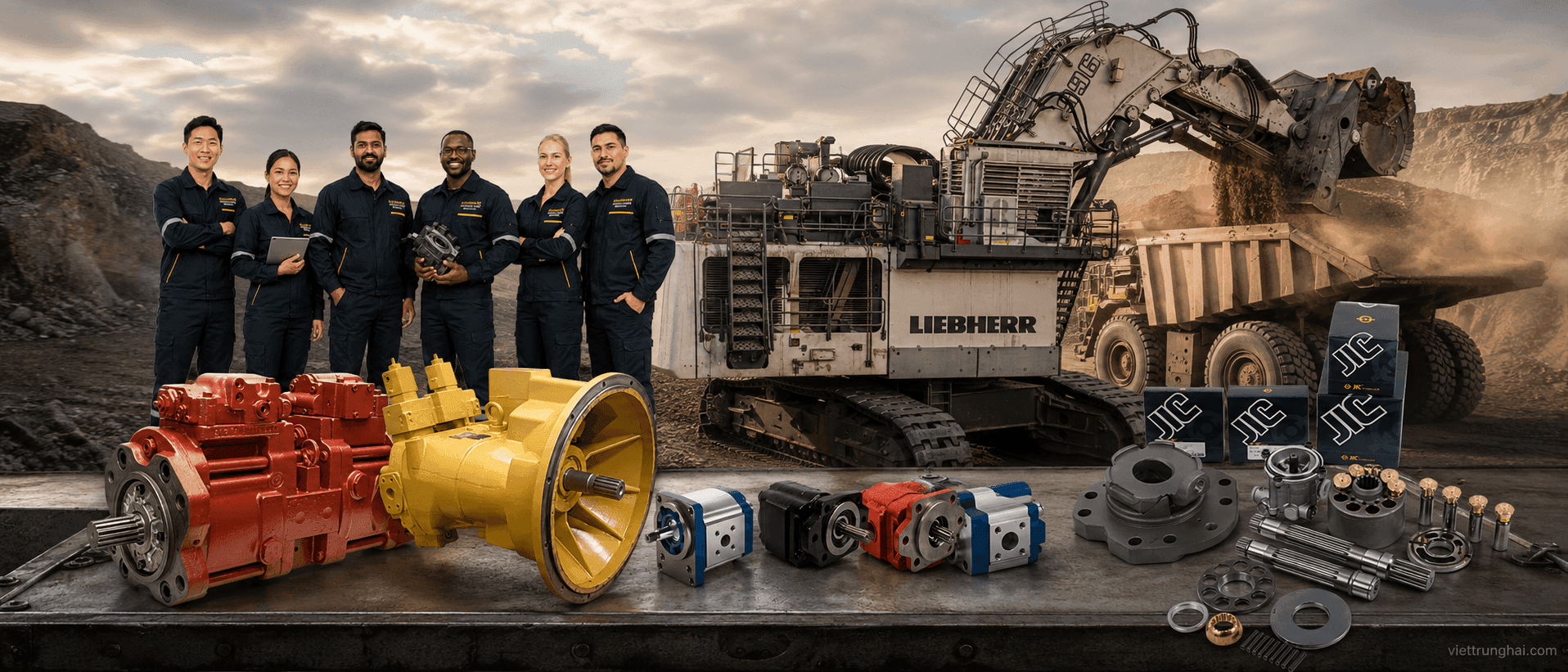
JIC Hydraulics parts are a line of replacement pump internals and hydraulic components that Viet Trung Hai distributes as an authorized distributor, centered on the core of axial piston pumps. The Axion line covers four main groups: the rotary group, the flow regulator, shafts and bearings, and sealing components. These are genuine-quality replacement internals, made to the correct code and matched to each pump family such as K3V, K5V, or A10VSO.
JIC Hydraulics parts are a line of replacement pump internals and hydraulic components that Viet Trung Hai distributes as an authorized distributor, centered on the core of axial piston pumps. The Axion line covers four familiar groups: the rotary group (pistons, cylinder block, valve plate), the flow regulator, shafts and bearings, and sealing components. The line is positioned as genuine-quality replacement internals, made to the correct code and matched to each pump family such as K3V, K5V, or A10VSO. This article describes the line at a category level, so you can tell which jobs it suits and how it is fitted to a pump.
What kind of parts line is JIC Hydraulics
In the market for hydraulic pump internals, a failed part rarely travels alone. Worn pistons come with a pitted valve plate, a scored cylinder block, and a regulator that has drifted off spec. JIC Hydraulics exists to fill exactly that gap: a replacement line for the inside of piston pumps, instead of forcing the user to assemble loose parts from several mismatched sources.
Viet Trung Hai is the authorized distributor for this line. That means goods move through a proper channel, with clear provenance, and are matched by pump code rather than sold on guesswork. If you are comparing the replacement options on the market, hydraulic pump brands is the wider picture that puts JIC in its proper place.
One point about naming deserves a straight answer. JIC Hydraulics is not the maker of the original pump; it is a replacement parts line built to fit and to perform the correct function inside pumps from the major makers. So this article states only what can be verified at the category level, and does not invent a founding year, a country, or catalogue numbers without basis.
What does the JIC Hydraulics parts range cover?
The JIC Hydraulics parts range covers four main groups: the rotary group, the flow regulator, shafts and bearings, and sealing components — all gathered into the Axion line behind JIC Hydraulics. The shortest way to understand Axion: it is the rotary group and the accompanying components of a pump, gathered into one line organized by pump family.
The value of such a line lies in consistency. When the pistons, block, and valve plate all come from one line, the tolerances between them are controlled to the same standard. You avoid the situation where a piston from one source meets a block from another, each off by a little, adding up to excess oil clearance and a pump that is weak on pressure right after assembly.
The four main Axion part groups
The Axion line is arranged into four groups, matching how a pump technician strips and inspects a machine. The table below summarizes each group, its role in the pump, and the signs usually seen as the part degrades.
| Part group | Main components | Role in the pump | Common signs of wear |
|---|---|---|---|
| Rotary group | Pistons, cylinder block, valve plate, slipper pads | Generate pressure and move oil | Weak pressure, hot oil, knocking under load |
| Regulator | Regulator, spool, spring | Regulate flow to match load | Jerky machine, no self-destroking, oil consumption |
| Shaft and bearing | Drive shaft, support bearing | Support and transmit torque to the block | Axial play, vibration, steady hum |
| Sealing | Shaft seal, gaskets, static seals | Retain oil, block air and dust | Oil weep at the shaft, pressure loss, foaming |
These four groups are not separate. A regulator that is off spec can push the rotary group to overwork and wear early; a shaft seal leaking air makes the oil foam and erodes the valve plate. That is why, when quoting, Viet Trung Hai usually asks about the whole assembly rather than only the part you think has failed.
Rotary group: pistons, block, valve plate
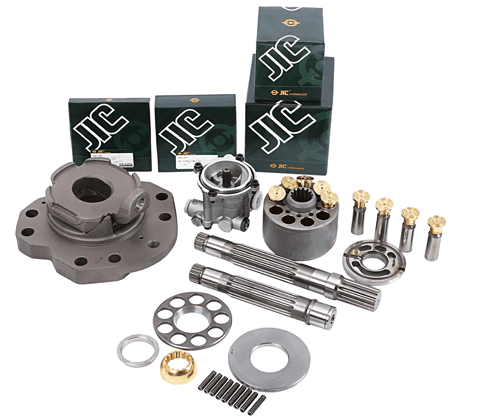
The rotary group is where pressure is generated, so it is also where the load is heaviest. In an axial piston pump, the pistons run in the bores of the cylinder block, their heads bear on the swash plate through slipper pads, and the base of the block presses against the valve plate to open and close the suction and delivery ports.
The failure mechanism here reads clearly. When oil is dirty or poorly lubricated, the piston-and-bore pair wears wider, and oil slips through the gap instead of being pushed along. Pressure drops, flow falls, and the lost work turns into heat, so the oil warms quickly. The valve plate takes continuous sliding friction; if a hard particle gets in, it gets scored into a groove, loses its seal, and leaks pressure between the two ports. To understand how to read each part before replacing it, see how to choose hydraulic pump internals.
The Axion line supplies these parts as a matched set, so that when you replace them you restore the original clearance rather than patching a single piece.
The flow regulator group
The regulator is the hydraulic brain of the pump. It reads the pressure signal and controls the swash plate angle, so the pump raises and lowers flow to match load without stalling the engine. The spool and spring inside must hold the correct characteristic; a small drift and the machine reacts wrongly.
The symptoms of a degraded regulator are often mistaken for rotary group failure: the machine jerks, revs up without gaining power, or burns oil unusually. Because it is so easy to confuse, replacing with the correct line and the correct characteristic matters; a spool machined off-true will make the whole pump run wrong even when the pistons are still good.
The shaft and bearing group
The drive shaft transmits torque from the engine into the block, and the support bearing keeps the shaft turning true under side load. When the bearing develops play, the shaft wobbles slightly, the clearance between block and valve plate varies with it, and the pump begins to hum or vibrate in a certain speed band. Left alone, the play works into the shaft seal and leaks oil at the pump nose.
This is the group where material quality and machining precision decide service life. Viet Trung Hai pairs this group with the ZVL Slovakia bearing line when needed, covered in more detail below.
The sealing group
Sealing sounds simple, but it is often where trouble starts. The shaft seal keeps oil from weeping out and blocks dust and air from getting in. The gaskets and static seals hold pressure between chambers. A shaft seal that has gone hard or is fitted crooked lets air in, the oil foams, and those air bubbles gradually attack the valve plate by cavitation.
For the sealing group specifically, Viet Trung Hai favors the PET Seals line, discussed in its own section. If you want to understand seal materials and how to choose by working environment, hydraulic seal brands is the article that goes deep into that topic.
What does the rotary group actually contain
Many people lump everything together as "pump internals" without separating what is inside. Understanding the components correctly helps you order accurately and avoid missing a part at reassembly.
- Pistons: the pistons run in the block bores and generate the force that moves oil. This part wears as a pair with the block bore.
- Cylinder block: the body carrying the piston bores, rotating around the shaft and pressing against the valve plate.
- Valve plate: a fixed plate with two crescent ports, opening and closing the suction and delivery paths as the block rotates.
- Slipper pads and swash plate: transmit force from the piston to the angled plate, setting flow by angle.
- Springs and locating pins: hold the parts pressed together to maintain the seal.
When one of these parts drifts off spec, the whole chain loses its seal. That is why the Axion line sells as a matched set rather than suggesting you gather singles. See the hydraulic pump internals section for the parts catalogue Viet Trung Hai carries.
How the piston and cylinder block mate
The piston-and-block pair is the pivotal fit. The clearance between them must be small enough to hold pressure yet wide enough to keep a film of lubricating oil. If you fit new pistons into a worn block, the clearance is still wide and the pump is still weak; the reverse, a new block with old pistons, does not seal either. So the sure way is to restore the whole pair from the same line, so the clearance returns to design.
How the valve plate decides the seal
The valve plate works like a flat rotary valve. Its flatness and finish decide how much oil leaks between the two ports. A single small scratch bridging the suction and delivery ports lets pressure leak across it even when the pistons are still good. When replacing, inspect and replace the valve plate at the same time as the block, to avoid a mismatch of new and worn.
How are the parts matched to a pump
This is the step where people most often go wrong when buying hydraulic parts. A pump is not identified by feel but by the code stamped on the body and by its family. They are all called K3V, but each K3V size differs in piston dimension, number of block bores, and regulator characteristic.
Viet Trung Hai's matching procedure follows an order: read the pump code and family, determine the size, and only then choose the corresponding Axion parts set. When the code is faint or missing, the technician measures the actual dimensions of the piston, block, and valve plate to trace back to the correct size. This approach avoids the most common error: parts that look alike but are the wrong size, which bind or jam when fitted.
For that reason, when you inquire, you should send the pump code, a photo of the machine label, and a description of the symptoms. The more complete the information, the faster the match and the lower the risk of a return.
Common pump families: K3V, K5V, A10VSO
The three pump families below make up much of the construction equipment running out on site, and the Axion line covers their internal parts.
- K3V: a familiar axial piston pump family on many medium and large excavators. It is also the family with the most size variants, so reading the code correctly matters. The K3V pump internals article goes deep into this family alone.
- K5V: usually found on larger excavators, similar in principle but different in size and load.
- A10VSO: an adjustable piston pump used widely in industrial machinery and hydraulic power units, and far from confined to excavators.
The K3V and K5V pumps trace their design to Kawasaki; you can consult the manufacturer at the Kawasaki global site to understand the technical basis of these families. Organizing parts by standard pump families this way makes lookup and matching far more coherent.
Why call it genuine-quality replacement
There is a line worth drawing clearly. Replacement does not mean inferior; the issue is the maker's craftsmanship and the batch-to-batch consistency. A good replacement line is measured by three things: the right material class, machining that meets tolerance, and consistency across batches so the next purchase still fits like the last.
JIC Hydraulics is positioned in that group: internal parts that reach quality on par with standard parts, made to the correct code so they fit and perform the correct function. In other words, the goal is not to look alike but to restore the pump's working characteristic. For the operator, that means the machine runs again at the correct pressure and flow, and holds it over time instead of tailing off after a few weeks.
To be fair and plain: this article gives no specific technical numbers or warranty figures for the line, because those must be taken per actual order. Return and warranty policy should be confirmed directly when you order, to avoid misunderstanding.
PET Seals: the sister seal line in the network
Also within the catalogue Viet Trung Hai distributes, PET Seals is the line specializing in sealing components. When you replace pump internals, you almost always have to replace the accompanying seals and gaskets, so a matched seal line saves you from patchwork.
Size is only the starting point when choosing a seal. The material must withstand the type of oil, the temperature, and the working pressure; fit it the wrong way round or in the wrong type and it leaks at once. For the common hydraulic oils in the ISO VG46 or VG68 class, the seal must hold its elasticity over the long run to keep the shaft nose sealed. PET Seals is brought in to fill exactly that gap for the pump assembly.
ZVL Slovakia: the accompanying bearing line
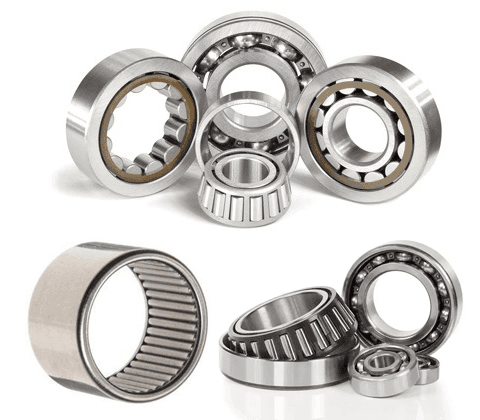
The shaft and bearing group demands precision and material durability, and this is where the ZVL Slovakia bearing line fits in. The pump shaft support bearing takes a considerable side load; if the material and precision fall short, it develops play early and drags failure into the block and the seal.
Having a stable bearing line closes the trio: internals from Axion, seals from PET Seals, bearings from ZVL. When these three groups are matched, an overhaul leaves you with a pump that is nearly fully restored rather than one patched in one spot while you wait for the next to fail.
When to choose JIC Hydraulics parts
This line makes the most sense in a few specific situations. When the pump has lost pressure, is running hot, or is weak while the pump body is still good, replacing the internals as a matched set is usually the economical recovery. When the machine is past its maker warranty and you need a stable-quality replacement source to count total cost over running hours, a parts line organized by pump family makes repeat maintenance easier.
On the other hand, if a nearly new pump has a minor failure from a single part and is still under maker warranty, the genuine channel is worth considering first. Choosing a parts source is always a problem shaped by the machine's condition and the intended use, with no single answer for every case.
What to check on receipt and at fitting
Do not rush to fit as soon as the goods arrive. A few simple checks head off most of the trouble later.
- Cross-check code and size: compare the pump code you sent against the parts received, and check that the piston, block, and valve plate dimensions match the pump.
- Inspect the machined surfaces: the valve plate and slipper pads should be evenly polished, with no pits and no ridges.
- Test the fit for smoothness: the piston into the block bore should be smooth, not binding and not loose.
- Replace seals and bearings in the same round: use the open machine to replace them together, avoiding a second teardown over one small part.
- Flush clean and change oil and filter: dirty oil is the number one cause of ruining new internals; clean the system before running again.
If you want to see the full pump-parts catalogue Viet Trung Hai distributes, hydraulic pump parts is the overview page to start from. All the brand lines sit within the brand articles hub if you want to compare more broadly.
Ordering and advice on matching the right pump
The fastest way to avoid buying the wrong part is to leave the matching to someone with the data. You send the pump code, a photo of the machine label, and a description of the symptoms; the technical team cross-checks and proposes the correctly sized parts set. Information on the line and its official distribution channel is at jic.com.vn, while settling the size and quoting per machine is done directly with Viet Trung Hai to stay close to the pump's actual condition.
Key takeaways
- JIC Hydraulics is a replacement line for the inside of piston pumps, distributed by Viet Trung Hai as an authorized distributor.
- The Axion line covers four groups: rotary group, regulator, shaft and bearing, and sealing components.
- Parts are matched by code and pump family such as K3V, K5V, and A10VSO, not sold on guesswork.
- A matched set restores the design clearance, avoiding tolerance mismatch from gathering singles.
- PET Seals covers the seals and ZVL Slovakia the bearings, closing the pump assembly at overhaul.
- Send the pump code and a machine-label photo to match the correct size and cut the risk of returns.
Written by
Hoàng Anh Dũng
Hoàng Anh Dũng tracks sourcing, pricing and brands for heavy-equipment parts. He writes about what drives price, buying smart and telling apart part origins and quality.
Related parts
The exact parts discussed above — send your machine model or pump code to match.
Related products
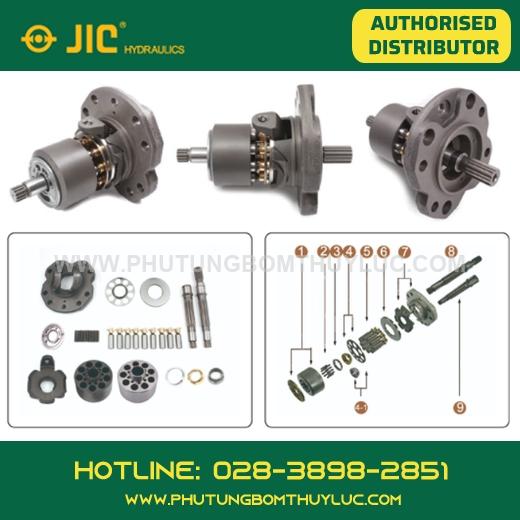 Kawasaki · K3VRotary group kit – Kawasaki K3V112DTK3V112DTOn requestView · get a quote
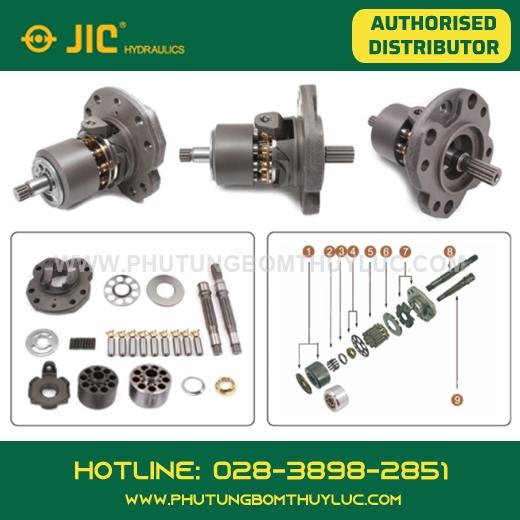 Kawasaki · K3VRotary group kit – Kawasaki K3V140DTK3V140DTOn requestView · get a quote
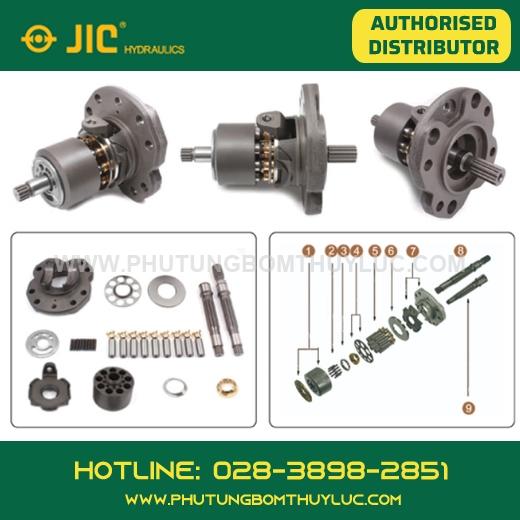 Kawasaki · K3VRotary group kit – Kawasaki K3V180DTK3V180DTOn requestView · get a quote
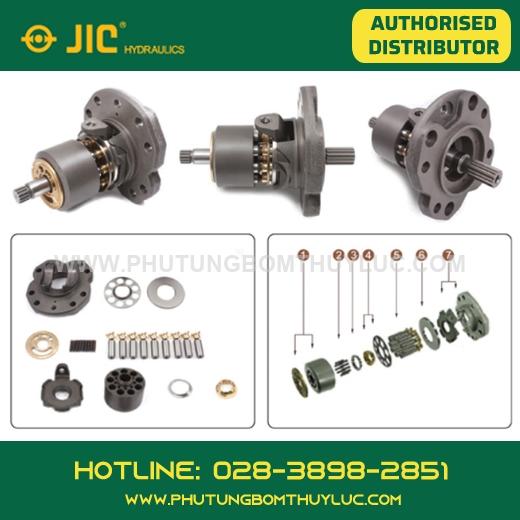 Kawasaki · K3VRotary group kit – Kawasaki K3V280DTK3V280DTOn requestView · get a quote