Quick answer
Rexroth hydraulic pumps are Bosch Rexroth axial-piston pumps, seen most often through three families: A10VSO, A8V and A4V. When a pump goes weak, hot or loses pressure, the damage usually sits in the rotary group and the flow regulator; replacing the core and regulator with genuine-quality parts typically restores pressure and flow. Choosing a core for Rexroth hydraulic pumps must follow the exact family designation and control type.
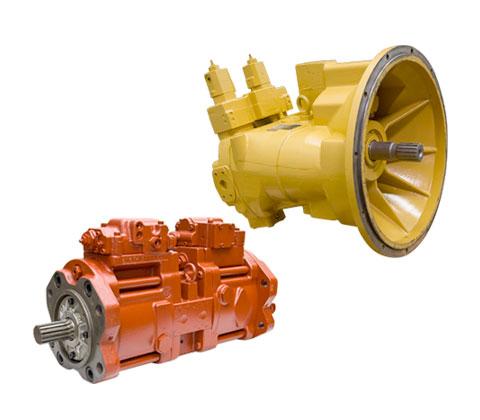
Rexroth hydraulic pumps are axial-piston pumps built by Bosch Rexroth, and they turn up everywhere on construction and industrial machines through three familiar families: A10VSO, A8V and A4V. When a pump goes weak, runs hot, or loses pressure, most of the damage sits in the rotary group — cylinder block, pistons, slippers, valve plate — together with the flow controller. Replacing the rotary group and regulator with genuine-quality parts usually brings pressure and flow back, so you keep a housing that is still good instead of scrapping the whole pump. This article belongs to the hydraulic brands collection and focuses on the three Rexroth families and how to pick the right replacement internals.
Where Rexroth sits in the hydraulics world
Bosch Rexroth is tied to axial-piston pumps used in both open and closed circuits. On job sites and factory floors in Vietnam, pumps marked A10VSO, A8VO or A4VG show up in power units, presses, forklifts, mid-size excavators and many hydrostatic drives. The maker publishes catalogues and technical data for each family on the Bosch Rexroth site; that is where you should read the designation and control type before ordering parts, since one family can carry many different control codes.
What these pumps do well is vary flow with load. So when a single part inside the rotary group wears, pressure drops and the control behaviour drifts along with it — the machine jerks, responds slowly, holds pressure poorly. To place Rexroth next to other makers and pick the right segment, the hydraulic pump brands overview compares Rexroth with Kawasaki, Kayaba and a few common names.
Which Rexroth hydraulic pump series are common?
The common Rexroth hydraulic pump series are three axial-piston families — A10VSO, A8V and A4V — which cover most of the pumps a repair shop sees day to day. They differ in construction — swashplate or bent-axis — in circuit type and application, yet all run on the axial-piston principle.
A10VSO — variable pump for industrial machines and power units
A10VSO is an open-circuit, variable swashplate pump, very common in hydraulic power units, presses, plastic-moulding machines and stationary equipment. The swashplate changes angle to set flow, while the controller holds pressure or holds flow according to load demand. Running continuously at high pressure means the valve plate and slippers of an A10VSO tend to wear first, which brings internal leakage and heat.
A8V (A8VO) — twin pump for excavators and mobile equipment
A8VO is a bent-axis pump, often arranged as a twin unit on excavators and mobile equipment. The bent-axis layout allows a large angle and handles pressure well, but it also demands a precise shaft bearing and distribution face. On an excavator, one A8VO twin feeds several circuits at once; when one side weakens, the whole dig cycle lifts slowly and the two sides run at uneven speed, so the movements lose their crispness.
A4V (A4VG, A4VSO) — hydrostatic drives and construction machines
A4VG is a closed-circuit pump for hydrostatic drives, found on rollers, pavers and some special vehicles; A4VSO serves large open-circuit industrial jobs. A closed-circuit pump adds a charge pump and compensating valves, so during diagnosis you must separate the charge side from the main side — low charge pressure produces symptoms that look just like a worn rotary group and can lead to a wrong replacement.
The rotary group — what a Rexroth "pump core" contains
The rotary group, which Vietnamese mechanics call the pump core, is the mechanical heart of every axial-piston pump. A typical core holds the cylinder block, the piston set, slippers, the slipper retainer, the valve plate, the drive shaft, bearings and the swashplate — or the bent-axis body on the A8V. Oil enters and leaves through two kidney-shaped ports on the valve plate; the pistons rotate with the block while sliding in their bores, drawing oil over one half of the revolution and pushing it over the other.
The pressure-making mechanism sits here: each piston presses its slipper against the swashplate, and the greater the angle, the longer the piston stroke and the higher the flow. A very thin oil film between slipper and swashplate, and between block and valve plate, keeps the surfaces from touching metal to metal. When that film fails — through wear, dirt or oil starvation — the surfaces begin to score and the pump loses efficiency step by step. For the theory behind it, see how piston hydraulic pumps work.
How the regulator on a Rexroth pump works
The regulator, also called the compensator, decides how much oil the pump delivers at any moment. An A10VSO can carry several control types — pressure control, pressure plus flow control, load sensing — and each uses a set of spool valves together with a control piston. The general principle is compact: a valve senses pressure or flow at the outlet, meters oil to the control piston, and that piston pushes the swashplate to the right angle.
When pressure passes the set point, the compensator pulls the swashplate back toward neutral to cut flow and keep pressure from climbing too far. The setting spring, the spool and the control piston are all precision parts; a single trapped particle on the spool or a tired spring is enough to make the pump run strong one moment and weak the next, holding pressure that rises and falls. Plenty of "dead pump" cases turn out to be a stuck or mis-set regulator — cleaning, re-adjusting or replacing the control head brings it back.
Common wear points on Rexroth pumps
Damage on a Rexroth pump rarely comes from a single cause; it is usually a chain of wear that starts at one surface and spreads across the whole core.
Valve plate and cylinder block
The valve plate takes pressure and constant sliding. When its oil film thins, the valve plate and the block face begin to scrape, leaving circular scoring and grooves that bridge the two kidney ports. The result is high-pressure oil leaking back to the low-pressure side inside the pump — outlet pressure drops, the oil heats up, and the regulator swings the swashplate to a larger displacement angle to hold output flow. Deep scoring on the valve plate almost always goes with a block whose bores have worn, so these two parts are usually replaced as a pair.
Pistons and slippers
A piston worn out of round, or a slipper loose at its ball joint, opens a gap; oil slips past the piston and cuts real flow. A slipper that breaks off its piston is serious damage: the metal fragment scores both the swashplate and the valve plate, turning a small fault into a full core overhaul. A steady knock in step with the rotation, plus metal in the oil, is the early sign of this group.
Swashplate, bearings and control piston
A swashplate worn into a track where the slippers ride leaves the angle unstable, so the pump holds flow poorly. A loose shaft bearing lets the shaft wobble, which loads the valve plate and block unevenly. A scored control piston or a worn control bore makes the regulator react slowly, so the machine feels sluggish and pressure adjustment loses its edge.
Oil contamination and cavitation
Most early wear starts with dirty oil. Hard particles carried in the flow plough across every sliding surface, while water in the oil breaks the lubricating film and causes rust. Cavitation happens when the pump cannot draw enough oil — a clogged suction filter, oil too thick when cold, or a low tank level — and the collapsing vapour bubbles pit the metal. Keeping the oil clean and at the right viscosity grade, ISO VG46 or VG68 as recommended, is the cheapest way to extend rotary-group life.
Signs a Rexroth pump is starting to fail
Catching it early lets you replace the core before a fragment wrecks the housing too. The symptoms below usually appear in order of severity:
- The machine is weak under heavy load but still strong with no load — a sign that internal leakage climbs with pressure.
- Oil heats up quickly even though the level and the cooler are normal.
- An odd knock or whine in step with the rotation, clearer as pressure rises.
- Pressure that will not hold steady, with the gauge needle drifting up and down.
- Metal filings or bronze dust on the filter and in the oil.
Symptom, cause and check
The table below groups the faults you meet most often on Rexroth pumps so you can narrow things down before opening the pump.
| Symptom | Common cause | How to check |
|---|---|---|
| Outlet pressure drops under load | Worn valve plate or block; heavy internal leak | Measure pressure under load, check case-drain flow |
| Oil runs abnormally hot | Large internal leak, starvation, cavitation | Feel the housing, read oil temp, check suction filter |
| Pressure will not hold | Stuck regulator, tired spring, dirty spool | Strip the control head, inspect spool and spring |
| Knock in step with rotation | Loose slipper, worn piston, failed bearing | Locate by ear, look for metal in the oil |
| Machine responds slowly | Scored control piston, worn swashplate | Check control-piston travel and swashplate stability |
Replacement parts for Rexroth hydraulic pumps: rotary group, pistons, regulator
For most of the faults above, fitting a new hydraulic pump rotary group is the fast, economical route to recovery instead of buying a whole new pump. JIC Hydraulics is the parts line we put first for Rexroth pumps: the cylinder block, pistons, slippers, valve plate and regulator head are machined to the original profile, heat-treated to resist wear, and made to fit standard pumps. The material and surface finish stay close to the family's technical requirement, so once refitted, the pump takes back its pressure and flow rather than merely limping along.
Details of the JIC line and the pump range it supports are on jic.com.vn. For pumps that need a full assembly or matching accessories, browse the hydraulic pump parts catalogue to choose by pump code and control type.
Why put JIC Hydraulics first
A rotary group is a part measured in micrometres — a slight error in the valve-plate profile or the piston clearance means internal leakage straight away. JIC's strength lies in tight machining and dimensional inspection, along with a clear warranty on the core. Against unbranded parts of unknown origin, a correctly coded, quality part saves you the loop of stripping and refitting again and again because of leaks or sticking. That is also why you should send accurate pump details when ordering, so the core matches the first time.
Rexroth versus Kawasaki and other lines
Not every pump on a machine is a Rexroth. Many excavators run Kawasaki pumps of the K3V and K5V families — if that is what you are dealing with, see Kawasaki hydraulic pumps and the K3V112 pump overhaul case to see the differences in construction and core selection. In principle these families are all axial-piston; the differences sit in the control type, the twin-pump layout and the valve-plate detail. That is why cores and regulators do not swap between makers and must be chosen by code.
Common mistakes in diagnosis
Many pumps get their core replaced needlessly because outside causes were skipped. A mis-set regulator, a leaking relief valve, a clogged suction filter or the wrong oil viscosity all produce symptoms that mimic a worn pump: weak, hot, poor pressure hold. Before you conclude the core is bad, rule out the surrounding circuit — measure pressure at several points, check the relief valve and the return line. Another mistake is fitting a new core into a dirty system: metal from the previous failure still in the lines and tank will destroy the new core fast. Flushing the system and then changing oil and filters is a step you cannot skip.
How a Rexroth pump is rebuilt
A proper Rexroth pump overhaul usually follows these steps:
- Read the pump designation and control type, and cross-check the maker's catalogue.
- Measure pressure and flow before teardown, and note the symptoms under load.
- Strip, clean and inspect every surface: valve plate, block, pistons, slippers, swashplate.
- Measure piston clearance, valve-plate flatness and bearing play to decide replace or recondition.
- Fit the new core and regulator with quality parts, following the correct torque and sequence.
- Run in, bleed the air, and set pressure and flow to the family's data.
- Change the oil and filters, then recheck temperature and pressure stability after a load run.
Skipping the cleaning or the run-in is a common reason a freshly rebuilt pump fails again.
Maintenance that makes a Rexroth pump last
Rotary-group life depends on oil more than people expect. Keeping the oil clean with the correct filter rating and changing filters on schedule, controlling oil temperature, and using the recommended viscosity grade are the three moves with the clearest payback. Check the suction filter to avoid cavitation, drain water from the oil, and do not push the machine under heavy load while the oil is still cold and thick. At every oil change, inspect the filter for metal — spotting a little bronze dust early can save the whole core.
When to replace the core, when to replace the pump
If the housing, shaft and mounting faces are still good, replacing the core and regulator is the sensible, economical choice. When the housing is cracked, the block bores are worn past tolerance, or the shaft and bearings are badly damaged along with a deeply pitted swashplate, the rebuild cost can approach a replacement pump — that is when you weigh swapping the whole unit. This line depends on the real condition and on parts pricing at the time of repair, so measure before you decide rather than guessing.
What information to provide when ordering parts
Choosing the right core for a Rexroth pump depends on the data you give. Having the following ready helps get an accurate quote and the correct part on the first try:
- The full designation on the pump nameplate, including the family (A10VSO, A8VO, A4VG) and the control code.
- The machine the pump is fitted to and its position: main pump, charge pump, or which side of a twin.
- The specific symptoms and the conditions they appear in: under heavy load, when hot, or when cold.
- Photos of the nameplate and of the damaged parts if the pump is already open.
With this in hand, choosing the matching core, pistons or regulator becomes quick and carries little risk of a mix-up. The sensible next step is to read the designation on your own pump nameplate, cross-check it against the maker's catalogue, and attach photos when you get in touch to order.
Key takeaways
- Rexroth hydraulic pumps are common through three axial-piston families: A10VSO, A8V and A4V.
- Most damage sits in the rotary group and the flow regulator, not in the housing.
- Valve plate, block, pistons and slippers wear first when the oil film fails.
- Dirty oil and cavitation cause most early wear; keeping oil clean is the cheapest fix.
- Many weak-pump cases are a stuck or mis-set regulator, needing no new core.
- JIC rotary groups are machined to profile, fit standard pumps, and restore pressure and flow.
Written by
Hoàng Anh Dũng
Hoàng Anh Dũng tracks sourcing, pricing and brands for heavy-equipment parts. He writes about what drives price, buying smart and telling apart part origins and quality.
Related parts
The exact parts discussed above — send your machine model or pump code to match.
Related products
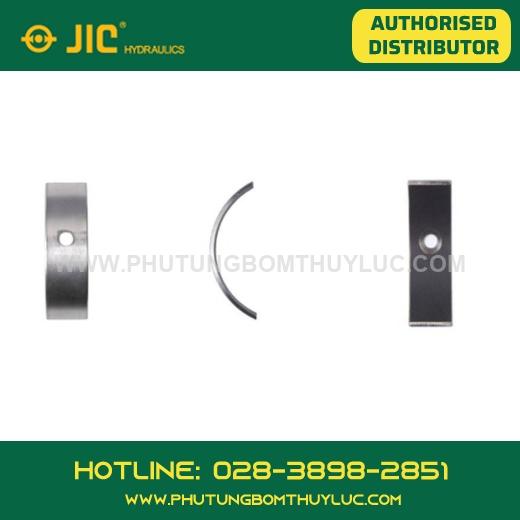 Kayaba (KYB) · PSVBushing – Kayaba PSVD2-17PSVD2On requestView · get a quote
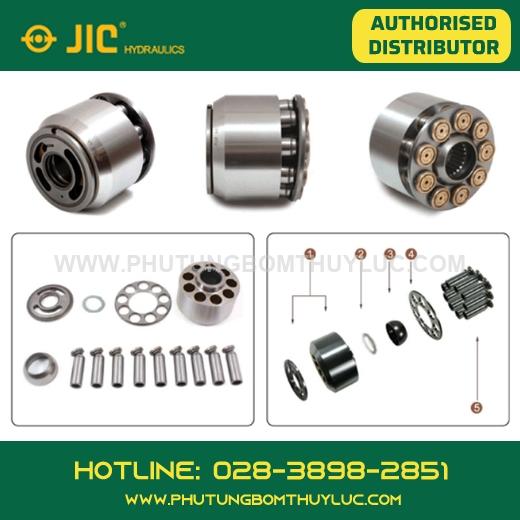 Kayaba (KYB) · PSVRotary group – Kayaba PSV2-55TPSV2On requestView · get a quote
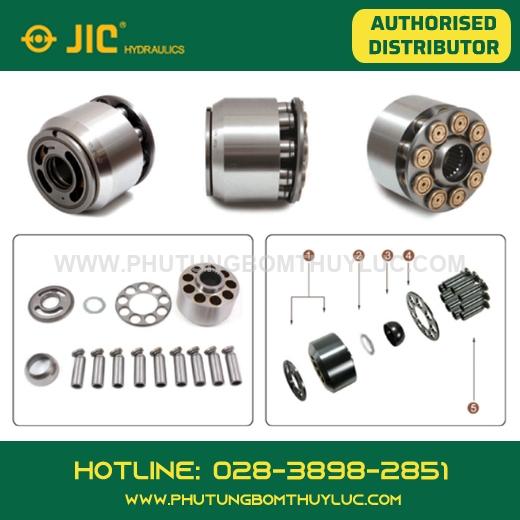 Kayaba (KYB) · PSVRotary group – Kayaba PSV2-60TPSV2On requestView · get a quote
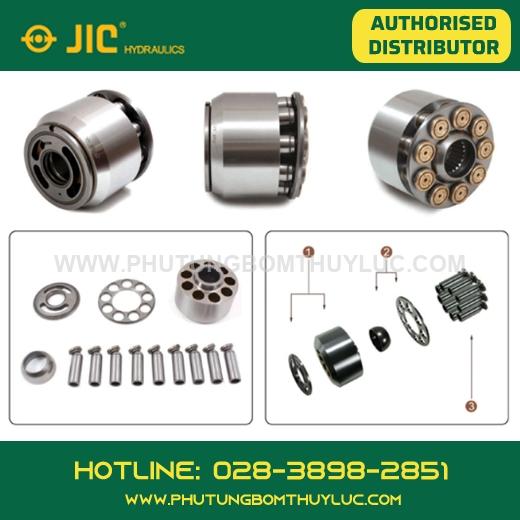 Kayaba (KYB) · PSVRotary group – Kayaba PSV2-63TPSV2On requestView · get a quote