Quick answer
Hydraulic work attachments are the tools mounted on an excavator's arm that run on pressurised oil drawn from the main pump: digging buckets, tilting buckets, breakers, grapples, shears and pulverizers, augers, and a quick coupler to swap them. Each one asks for oil in a different way — a breaker needs a single high-flow one-way supply line plus a return line with its own filter, while two-way jaws need a proportional control valve to open and close smoothly. Mismatching flow or pressure to the tool is the common reason an attachment feels weak, runs the oil hot, and kills seals early.
Hydraulic work attachments are the tools mounted on an excavator's arm that run on pressurised oil drawn from the main pump. The group includes digging buckets, tilting buckets, breakers, grapples, shears and pulverizers, augers, and a quick coupler to swap them. Each one asks for oil in a different way. A breaker needs a single high-flow one-way supply line plus a return line with its own filter. Two-way jaws, by contrast, need a proportional control valve to open and close smoothly. Mismatching flow or pressure to the tool is the common reason an attachment underperforms. It feels weak, runs the oil hot, and kills seals early.
The sections below walk through each type, the extra hydraulic line it needs, and how to match the circuit to the control valve and the pump's capacity. This is exactly what many crews skip when they buy a new attachment. They look at bucket size or breaker weight. They forget whether the carrier has enough oil and enough spool valves to run it.
What hydraulic work attachments are, and why the circuit decides everything
On an excavator, the main pump pushes oil through the control valve to the boom, arm and bucket cylinders. Fit a hydraulic work attachment and you are plugging a new load into that same oil flow. That load either shares the available flow or demands a separate auxiliary circuit. So the first question is not "how heavy is the attachment" but "how much oil can the carrier deliver, at what pressure, through which line".
The mechanism is direct. An attachment's torque or striking force comes from the product of pressure and working area. Its opening speed or blow frequency comes from flow. Too little pressure and the tool is weak, unable to bite the material. Too little flow and it is slow: the breaker strikes lazily, the auger turns sluggishly. Too much flow relative to the tool's design and oil is throttled through an orifice, generating heat and wearing seals. All three leave traces. You see abnormally hot oil, an attachment that never reaches its rating, or hoses and seals that fail early.
The more modern the carrier, the more preset options its circuit carries. Popular machines such as those from SANY and other major brands often come with a breaker line and a multi-purpose line already routed down the arm. They also add electric valves to switch on and off and trim flow from the cab. Knowing what your machine already has decides which attachments you can fit without re-plumbing the circuit.
For the bigger picture of the carrier families themselves, see the overview of types of construction machinery in the same silo.
The six common hydraulic work attachments
Below are the six groups seen most on site, sorted by how they draw oil rather than by size. Sorting them this way lets you see at a glance which attachment runs on an existing spool and which needs an added line.
| Work attachment | Circuit type | Extra line needed | Control |
|---|---|---|---|
| Digging bucket, tilting bucket | Uses existing cylinder or adds a tilt cylinder | Tilting bucket needs a two-way pair | Proportional spool |
| Hydraulic breaker | One-way, high flow | One supply line, one return with its own filter | On/off pedal |
| Grapple, clamshell | Two-way open/close, plus rotate | A two-way pair, possibly a rotate circuit | Proportional spool |
| Shear, pulverizer | Two-way, high pressure | A two-way pair | Proportional spool |
| Auger | Rotary motor, one or two way | A pair of lines, plus a case drain | Pedal or spool |
| Quick coupler | A single locking cylinder | One small control line | Button or safety lock valve |
Three things stand out in the table. First, the breaker is the only tool that runs fully one-way and must have its own return filter. Second, every clamp and cutting tool needs a two-way pair with proportional control. Third, the quick coupler needs only a small control circuit, yet is the single most important safety link.
Digging bucket and tilting bucket: the most basic attachments
A standard digging bucket needs no auxiliary line. It swings on its pin using the bucket cylinder already on the arm. Choosing a bucket is therefore about geometry and material: width, capacity, tooth pattern, wear-plate thickness. If you are weighing a rock bucket, a tilting bucket or a mixing bucket, see the article on types of excavator buckets. It goes deep into each form and how to choose by the material you dig.
The tilting bucket is the first jump in circuit complexity. It adds one or two cylinders that let the cutting edge tilt left and right to shape a slope. That lets it grade a batter without slewing the whole machine. Because that is a two-way motion, the tilting bucket needs a two-way oil pair routed to the arm tip. It also needs a proportional spool to hold the slope at the right angle. That is why a tilting bucket almost always comes with adding a multi-purpose line if the machine does not already have one.
Tilt force and how well the angle holds depend on circuit pressure and valve tightness. If the valve leaks internally, the bucket drifts off the set angle under a side load. That is a useful check when you commission a newly fitted tilting bucket.
Hydraulic breaker: why it needs a one-way line and its own return filter
The hydraulic breaker is the attachment with the most distinct circuit, and the one most often plumbed wrong. A breaker works in a cycle. Pressurised oil drives the piston up, energy is stored through the nitrogen chamber, then it releases the piston to strike the tool down. Oil runs almost one-way: supplied to make the stroke, exhausted on the return stroke. It does not reverse like a double-acting cylinder.
Two hard requirements follow from that mechanism. First, the breaker needs a single high-flow one-way supply. It is taken from an auxiliary valve set up specifically for the breaker, rather than shared carelessly with the arm circuit. Second — and this is the detail most often dropped — the breaker's return must go straight to tank through its own return filter. Every blow produces very fine metal wear particles. If that return runs through the control valve before reaching the common filter, those particles wear the valve spool. They also dirty the whole system. A separate return with its own filter keeps contamination local, right at the source.
Controlling a breaker is therefore simple: one on/off pedal, no proportional need. But the flow and pressure set for the breaker valve must sit within the range the breaker's maker specifies. Feed it too much oil and the breaker strikes too fast and too hot, wearing the piston seals and guide bushes quickly. Feed it too little and it strikes lazily, without enough energy to break rock. The nitrogen accumulator on the breaker body also needs the correct charge. Undercharged, it strikes soft and jerky. That is a maintenance fault more often than a circuit fault.
Grapple and clamshell: two-way motion needs proportional control
A grapple and clamshell grip logs, boulders, scrap or pipe. Unlike a breaker, they open and close — a genuine two-way motion — so they need a two-way oil pair. Their valve must be a proportional spool. That lets the operator close the jaws gradually, holding the object without crushing or dropping it.
Many grapples also add a rotate motor to turn the load about a vertical axis. That means another circuit with the motor's case drain. The carrier then needs at least two independent auxiliary functions: one to open and close the jaws, one to rotate. This is where the number of auxiliary spools and lines down the arm becomes a real limit. Not every machine can drive two functions at once smoothly.
Grip force comes from pressure. Smoothness as the jaws close comes from spool quality and how the proportioning is tuned. A coarse valve that closes the jaws in jerks will drop the load and tire the operator's hand. That is why a grapple circuit should run through a good proportional valve rather than a plain on/off one.
Shear and pulverizer: high pressure, slow stroke
A steel shear and a concrete pulverizer are demolition attachments. They close two jaws to cut structural steel and sheet, or crush concrete to separate rebar. Circuit-wise they are like a grapple in being two-way. But their load is different: very high force, slow stroke. Many also have a boost valve or a regen line built in to shorten the time the jaws take to open.
Cutting force depends directly on pressure. So a shear or pulverizer needs the carrier to hold a high, stable working pressure through the whole closing stroke. If the auxiliary circuit's relief is set below the shear's demand, the blade will stall mid-cut when it meets thick steel. Conversely, you must not exceed the shear's own pressure rating. Matching pressure between the control valve and the attachment is therefore the central problem. The valve section below covers it in detail.
Many shears mount on a rotator to line up the cut. That adds a continuous rotate circuit with its own case drain. The more functions, the more you have to check whether the carrier's pump and valve can carry them.
Auger: a rotary motor instead of a cylinder
The auger is unlike the previous five. It uses a hydraulic motor to spin a helical flight into the ground, drilling holes for posts, trees or footings. The load here is continuous torque, not a cylinder's push. Its supply can be one-way if it only drills down, or two-way to reverse and back the flight out when jammed. It always needs a case drain to return internal motor leakage to tank.
Matching an auger to a carrier is a torque-versus-speed problem. Hard ground needs high torque, meaning high pressure and slow rotation. Soft ground favours speed. Choosing a motor and gearbox ratio that do not match the pump flow has a clear cost. You get either an auger that spins fast without enough force, or one with force that is far too slow. A case drain left off or plumbed wrong is a quiet fault. It over-pressurises the motor shaft seal and leaks oil after a short time.
Quick coupler: the swap link and the safety link
A quick coupler is not a digging tool. But it is the part that lets one machine share many hydraulic work attachments without knocking pins out by hand. The hydraulic type uses a small cylinder to drive a locking pin, controlled by a small circuit from the cab. It usually has a check valve that locks so the pin cannot release itself if pressure is lost.
The most important thing about a quick coupler is safety, not performance. The locking mechanism must have a secondary safety catch or a pressure-holding valve. That way the attachment cannot fall if a hose bursts or the control source is lost. When commissioning, always jerk-test a locked attachment to confirm the pin has engaged its full stroke. Many attachments carry oil lines, such as the breaker, grapple and shear. For them, many newer couplers also integrate an automatic oil-connection block. But the more complex that block is, the more it needs checking for leaks and for correct supply-and-return orientation.
A common question: which hydraulic work attachments need an added line?
The short answer: any hydraulic work attachment with a motion of its own needs an auxiliary line. A standard digging bucket does not. Specifically, a breaker needs a one-way supply plus a return with its own filter. A tilting bucket, grapple, clamshell and shear need a two-way pair. An auger needs a pair plus a case drain. A quick coupler needs one small control line. A machine without these lines has to have piping added down the boom and arm, plus the matching auxiliary spool.
This is exactly what to work out before buying an attachment. A carrier with only a breaker line will run a breaker perfectly. But it cannot drive a rotating grapple until a two-way circuit and a rotate circuit are added.
One-way or two-way: read the circuit type before you buy
Telling one-way from two-way is the fastest screening step. A one-way circuit supplies oil in one direction to make a stroke, then lets it return freely. The breaker is the classic case, which is why it needs only an on/off valve. A two-way circuit reverses oil between two ports so the attachment has force both opening and closing. Grapple, clamshell, shear and tilting bucket all belong here, so all need a proportional valve.
Confusing the two leads to costly mistakes. Hook a two-way jaw to a one-way breaker line and the jaws can only close, not reopen under power. They must then wait on gravity. Run a breaker through a two-way pair without a dedicated filtered return, and breaker contamination floods back into the valve. See the circuit type first, then talk about flow and pressure.
Proportional control: why jaws need a smooth spool
For every two-way tool, control quality lives in the proportional valve. A proportional valve lets flow rise gradually with lever travel. So the operator can feather a grapple's jaws onto the object then squeeze slowly, or close a shear's blade exactly on the bite point. An on/off valve snaps the jaws to full force at once, dropping light loads and jolting the machine.
To understand the spool, the ports and how a valve splits oil to each function, see the in-depth article on hydraulic control valves. The valve is where pump flow gets shared out to boom, arm, slew and the auxiliary circuits. Understanding the valve is understanding why running two auxiliary functions at once slows each of them.
Matching flow and pressure to the attachment: the central problem
This is the part that decides whether an attachment runs well. Every attachment has a flow range and a working pressure set by its maker. The installer's job is to trim the carrier's auxiliary circuit to sit neatly inside that range.
Three relationships are worth holding in mind. Force or torque is proportional to pressure and working area. Biting hard needs enough pressure. Speed or frequency is proportional to flow. Going fast needs enough oil. Heat is generated when oil is throttled through an orifice or dumped over a relief. Excess oil or a blocked flow both run hot. These three leave an easy-to-read chain of symptoms:
- Pressure too low: the attachment is weak, stalls mid-cut, the breaker fails to bite rock.
- Flow too low: the attachment is slow, the breaker strikes lazily, the auger turns sluggishly.
- Flow too high: oil heats fast, seals and hoses fail early, the relief squeals.
- Pressure above the tool's range: cracked attachment body, blown high-pressure seals.
Setting the auxiliary circuit's relief is the pivot point. Set it low and the tool is weak. Set it above the attachment's range and you destroy the attachment itself. Specific figures always come from the attachment's and the carrier's documentation, never from guesswork.
Control valve and pump capacity: the carrier's real limit
No attachment can run beyond what the carrier's pump and valve deliver. The main pump sets the total flow and pressure available at a given engine speed. These are families such as K3V, K5V, A10VSO or equivalent swash-plate piston pumps. The control valve decides how that flow is split to the auxiliary circuit. It also decides whether there are enough spools for the attachment's functions.
Three limits recur. First, the pump lacks the flow to feed both the arm and a large breaker at once. So the breaker goes lazy when you curl the arm and strike together. Second, the number of auxiliary spools is too few for a multi-function tool like a rotating grapple or rotating shear. Third, the main relief is set below the pressure a heavy shear demands. Choosing an attachment above the carrier's class is the most common mistake. The article on the excavator boom and arm raises this point. There, the size of the working linkage goes hand in hand with hydraulic capacity.
If you need to add or replace a valve for the auxiliary circuit, start with the range of genuine, correctly-coded hydraulic valves. The spool and ports must match the machine's circuit design.
Choosing an attachment by carrier class
Matching an attachment to the machine class heads off most trouble down the line. A breaker too heavy on a light machine makes it rear and cracks the structure. A large shear on a small pump stalls mid-cut. The practical rule is simple. Choose an attachment whose flow and pressure range sit within the carrier's pump-and-valve capacity. It must also have enough auxiliary circuits for the tool's functions.
For a crew with several machines, build a quick matching table between each carrier and the attachments it can run. In the table, note which machine already has a breaker line, a multi-purpose line or a rotate circuit. That table saves a lot of time when moving equipment between sites. It also helps when deciding to buy another attachment.
Signs of a mismatch and how to check fast
When an attachment underperforms, the check sequence should run from easy to hard. Measure oil temperature after a work cycle. Abnormally hot usually points to excess flow or a relief that is dumping. Listen to the relief. A sustained squeal when the tool meets a heavy load means pressure is hitting the set point. Watch the speed. Uniformly slow is low flow, weak force is low pressure. Check the breaker's nitrogen charge if it strikes soft and jerky.
For clamps and cutters, hold a tilted load and see whether the jaws drift. Drift means an internally leaking valve or a degraded cylinder seal. For a tilting bucket, set a slope angle then push a load to see whether the angle holds. These tests need no special gear. They quickly rule out most causes before you open the circuit.
Hoses, couplings and seals: where failures usually start
The auxiliary line takes vibration, impact and constant pressure swings. So hoses, quick couplings and seals are the fastest-wearing group in the whole attachment assembly. A hose running down the arm that rubs the structure will wear its cover and burst. A quick coupling used for many swaps tends to leak at its face gasket. The cylinder seals of a tilting bucket, grapple and shear work at high pressure and constant reversal. So they degrade before other seals.
Choosing the right oil grade belongs here too. Use hydraulic oil at ISO VG46 or VG68, per the machine's recommendation and the temperature conditions. That oil keeps a stable lubricating film across the auxiliary circuit. Oil too thin under heavy load thins that film and increases internal valve leakage. The breaker's dedicated return filter must be changed on schedule. It carries the heaviest share of metal contamination.
Quality replacement parts for the attachment assembly
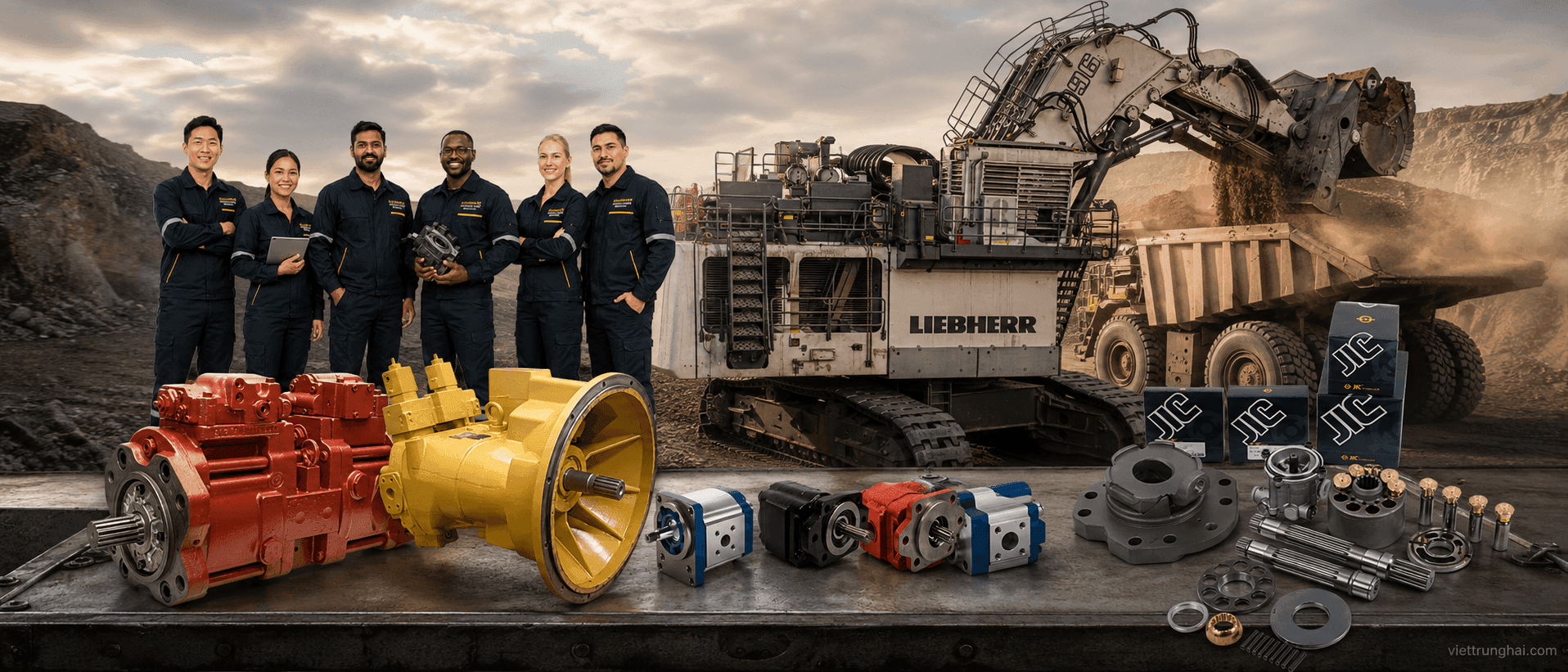
When you replace seals, pumps, valves or bushes for a hydraulic work attachment assembly, part quality decides the circuit's life. For pump and hydraulic valve parts, Viet Trung Hai leads with JIC Hydraulics. These are correctly-coded replacement parts, machined to the right tolerances. Their material and durability track the genuine standard, backed by a transparent warranty. For piston pump sets and control valves, correctly-coded JIC parts keep the auxiliary circuit holding pressure and flow as designed, rather than "close enough".
For seals and gaskets on tilting bucket, grapple and shear cylinders, PET Seals is a widely used choice. It is valued for its high-pressure and constant-reversal capability. For bearings in rotate motors and auger motors, ZVL Slovakia is a trusted line for heavy loads. The whole mechanical-parts group for the attachment assembly can be seen on the construction machinery parts page.
Choosing the right code and grade from the start is the cheaper path. Rebuilding an auxiliary circuit whose valve spool has been worn by loose-market parts costs far more. This is where careful choice pays off when the attachment assembly is the machine's main earner.
Where to start when planning a new attachment
The practical sequence has a few steps. First, define the material and the work to be done. Then choose the matching attachment type and look up its flow and pressure range. Next, compare it against the carrier's pump-and-valve capacity. Finally, inventory whether the machine already has the piping and the number of auxiliary spools required. If the circuit is missing, cost the added hoses and valve in from the start. Do not let it surface mid-project.
For the full silo picture of carriers and working linkage, see the construction machinery section. It gathers the related articles to cross-check before deciding. The logical next step is to build an attachment matching table for each machine in the fleet. Then lock down a list of correctly-coded parts for the auxiliary circuit's wear items ahead of the peak build season.
Key takeaways
- A standard digging bucket needs no auxiliary line; every attachment with a motion of its own needs one.
- A hydraulic breaker runs one-way and must have a dedicated return with its own filter to trap metal wear at the source.
- Grapples, clamshells, shears and tilting buckets are two-way tools that need a proportional control valve for smooth motion.
- An auger uses a rotary motor and always needs a case drain to return internal motor leakage to tank.
- A quick coupler is the safety link: it needs a safety catch or pressure-holding valve so the attachment cannot fall on pressure loss.
- Always match the attachment's flow and pressure range to the carrier's pump and valve capacity before buying.
Written by
Phạm Đức Thắng
Phạm Đức Thắng focuses on the undercarriage, tracks and the travel and swing systems of excavators. He writes about how these systems are built, travel and swing motors, and protecting the undercarriage from wear.
Related parts
The exact parts discussed above — send your machine model or pump code to match.