Quick answer
The clearest way to sort excavator classes is by size and role, not by exact tonnage. Four groups cover the field: mini/compact for tight utility work, midi for general construction, the standard class around 20 tons as the site workhorse, and large production machines for bulk earthmoving and mining. As size climbs, the hydraulic system scales up and the parts that wear first change.
Excavators run from a machine that fits through a garden gate to a rig that weighs as much as a house. Naming them by exact tonnage tends to confuse, because every maker draws the line differently. The cleanest way to sort excavator classes is by size and role, not by an exact ton figure. Four groups cover the field: mini/compact for utility work and tight sites, midi as the general-purpose all-rounder for civil jobs, the standard class around 20 tons as the site workhorse, and large production machines for bulk earthmoving and mining. As size climbs, the hydraulic system scales up with it, and the parts that wear first change too. An excavator sits inside the wider construction-machine family, so understanding size helps you match the right machine to the site and see which parts will wear before they fail.
Excavator classes by size: the four main groups
Placed side by side, the four size groups differ in three visible ways: overall dimensions and operating weight, reach and digging force, and the scale of the hydraulic system inside. A mini lifts a small bucket, slews in a narrow yard, and rides on an ordinary trailer. A production machine scoops a large bucket, stands in a quarry all day, and needs a low-loader just to move. Between those two ends sit the midi and the standard class, where most construction work actually happens.
The boundaries between groups are not hard lines. One maker calls 8 tons compact; another files it under midi. So read the group names as role descriptions, not as measurement standards. To see how one major manufacturer splits its range, Caterpillar sorts excavators from mini to mining size into distinct groups, each tied to a kind of work. For the wider picture that also covers dozers, graders and rollers, read the types of construction machines to place the excavator in its right slot within the fleet.
Mini and compact excavators: utility work and tight sites
The mini and compact group exists for places a big machine cannot reach. The back of a townhouse, inside a working factory, the edge of a trench against a wall, the gap between two buildings — that is their playground. Many models have a tail that swings within the width of the body, called short-tail or "zero tail", so the house can slew tight against a wall without hitting the structure. Low undercarriage, light body, so a trailer behind a pickup is enough to move them; no tractor unit needed.
For work, minis dig cable and pipe trenches, strip topsoil, dig small foundations, tidy gardens, and break light concrete with a small hydraulic breaker. Being light, digging force and stability have limits. Try to pry up a big rock or reach too far and the machine tips its nose up. A skilled operator keeps the load close to the body and uses the front blade as an anchor when digging deep.
The hydraulics here are compact: a small pump, moderate pressure and flow, usually one twin pump feeding the main circuits. That does not make the parts simpler, only smaller. Bucket pins, bushings and cylinder seals still wear by hours and by grit — sometimes faster than on a big machine, because minis often work close to the ground, in dirty conditions, seldom washed and greased on schedule.
Midi excavators: the flexible middle
A balanced weight and reach let one midi cover jobs a mini cannot manage and a standard machine is too big for. Heavy enough to dig with authority, compact enough to slew in a lane and transport fairly easily. Small and mid-size civil contractors like this group because one machine balances many jobs: digging multi-storey townhouse foundations, building neighborhood infrastructure, cleaning rural canals, leveling a plot before construction.
Against a mini, the midi has longer reach, a bigger bucket, stronger dig force, and a cab and seat roomy enough for a full working day. Against the standard class, it still gives up volume per hour and durability under sustained heavy work. This is where first-time buyers hesitate most, and where you should size by real workload rather than by feel.
Midi hydraulics start using the pump families found on larger machines but in smaller sizes, for example load-controlled axial-piston pumps. The control valve has more sections, and priority logic is clearer so the machine can slew and curl the boom at once without the oil flow jerking. Because it is smoother, the operator can do precise work like laying pipe, fitting joints, and grading a slope.
The standard class (around 20 tons): the site workhorse
If you had to pick one size to picture the word "excavator" in the mind of a builder in Vietnam, it is the class around 20 tons. It is so common that the used-machine market, the parts supply and the repair trade all revolve around this group. The reason is simple: it strikes the best balance of digging power, mobility and running cost for most construction and infrastructure work.
The typical range of work is wide: digging large foundations, loading soil onto dump trucks, digging ponds, building roads, embankments and culverts, and running attachments like breakers, tilt buckets, grapples and shears. The machine is heavy enough to stay planted while reaching out and lifting a full bucket, quick enough to keep pace with trucks cycling in and out. That versatility lets a single standard machine carry nearly the whole task list of a mid-size site.
On the hydraulic side, this is where the famous pump families show up densely: Kawasaki's K3V and K5V, Komatsu's HPV, and Kayaba MAG motors for travel. A twin pump splits the load across two circuit halves, working pressure is high, and power control keeps the pump from drawing more than the engine can give under heavy load. The overall layout of this group is the same across sizes; to grasp the circuit from pump to valve, cylinder and motor, see excavator construction before going deeper into size.
Large and production excavators: bulk digging and mining
At the top of the range are machines built to move large volumes, continuously, across many shifts. Rock quarries, open-pit coal, materials extraction, large-scale hill cutting, ports — where the measure is cubic meters per hour, not finesse in a narrow lane. Big bucket, strong boom, heavy body to stay stable while digging hard material and reaching high to load large trucks.
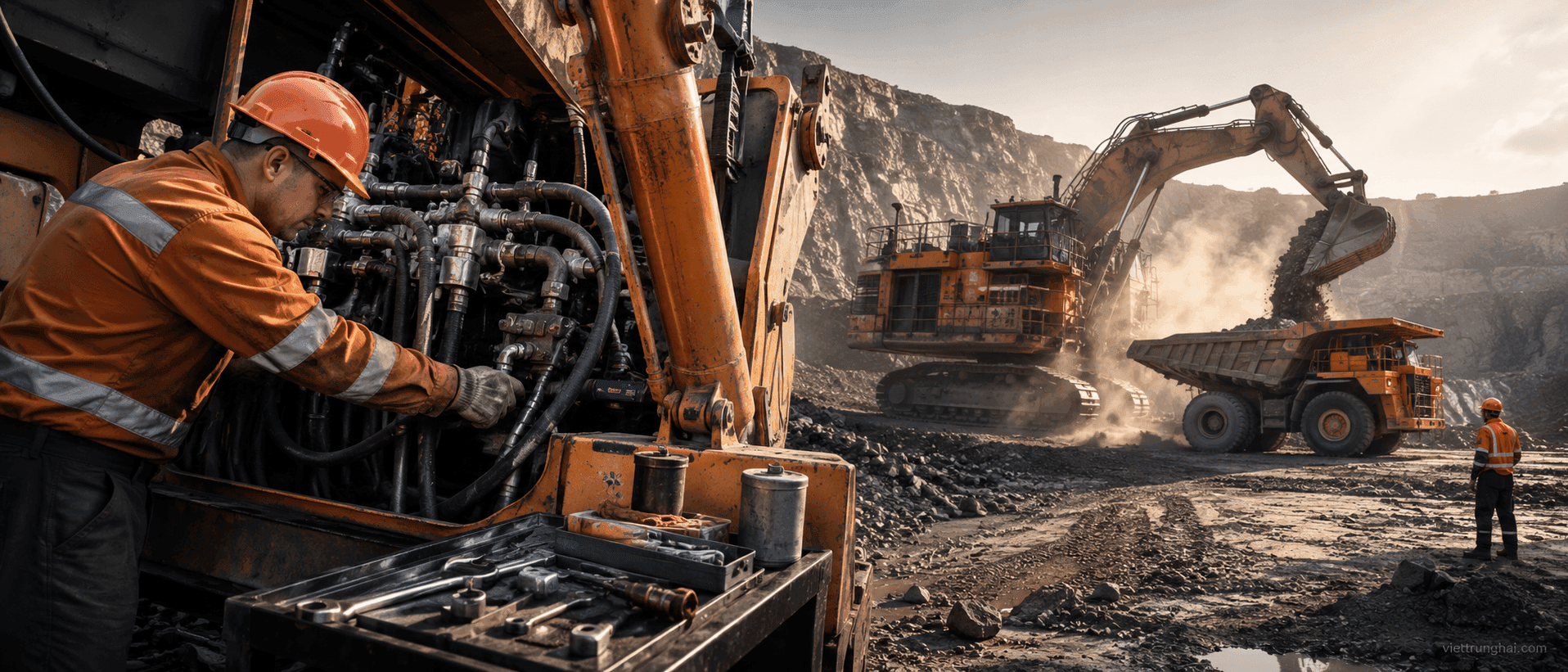
In this group everything scales up: high-flow twin pumps, more auxiliary circuits, strong oil cooling, and an undercarriage and tracks built for heavy load. Pump families like Rexroth's A8V, along with large piston pumps, serve high pressure almost continuously through the shift. Downtime at a mine is expensive — every idle hour is money — so hour-based maintenance and stocking critical spares becomes survival, not an option.
The trade for that power is reduced agility. A large machine is hard to transport, hard to slew in tight space, and thirsty on fuel. Bringing a production machine onto a residential site is usually the wrong size choice, wasting cost and blocking the ground.
How attachments reshape a size's role
The same size machine can do many different jobs through attachments. A breaker turns the excavator into a concrete and rock breaker; a tilt bucket shapes slopes; a grapple serves demolition and log handling; shears and augers open specialized work. Size decides which attachment fits: the bigger the machine, the more auxiliary flow and pressure it has to run a large breaker or heavy shear. Fitting an attachment beyond the circuit's size overheats the oil, saps force, and wears the pump much faster.
Quick comparison of the four size groups
| Size group | Main role | Typical site | Hydraulic scale |
|---|---|---|---|
| Mini / compact | Utility work, trenching, tight sites | Yards, inside factories, narrow lanes | Small pump, one twin pump, moderate pressure and flow |
| Midi | General residential, small infrastructure | Neighborhoods, townhouse foundations, canals | Small piston pump, multi-section valve |
| Standard (~20 tons) | All-round digging, truck loading | Large projects, roads, embankments, culverts | Twin pump, K3V/K5V/HPV families, MAG motors |
| Large / production | Bulk digging, mining | Quarries, open-pit coal, ports | Large A8V/Rexroth pumps, many circuits, strong cooling |
Read the table down a column and one thing stands out: as the role gets heavier, the hydraulic system both grows and grows more complex, and that is the root of every difference in parts and maintenance between the groups.
How size changes the hydraulic system
The core point of sorting by size is here: the hydraulic system both grows and grows more complex. Understanding that chain lets you predict which parts carry load and wear first, instead of waiting for a failure and then hunting the cause. The general logic of an excavator — the pump pushes oil, the valve splits flow, cylinders and motors turn high-pressure oil into force — stays the same across every size. Size only changes the scale and count of each assembly.
Pumps and circuits grow with the machine
The bigger the machine, the more oil the pump must push at high pressure while still holding smooth control. From midi up, flow-controlled axial-piston pumps — load-sensing or power control — are effectively standard. A twin pump splits the load across two circuit halves so the machine can travel and work the boom at once without jerking. The more attachments you fit — breaker, tilt bucket, grapple — the more auxiliary circuits and flow-control valves you need. A failed pump on a big machine is a costly event, so many owners choose to rebuild or replace with the correct family and specification rather than bodge in a substitute.
Cylinders, pins and bushings: heavy load, faster wear
The boom, arm and bucket cylinders on a big machine are longer, larger in bore, and run at higher working pressure. The seals and gaskets inside take many open-close cycles, so oil weeping at the cylinder rod is a familiar seal-wear sign that shows up earlier on hard-working machines. The pins and bushings at the boom-arm-bucket joints carry the whole digging force; the larger the size, the greater the force, the faster clearance opens up if lubrication is poor or grit gets in. That clearance then makes the joint loose, knock, and spread wear to the neighboring pin.
Travel motors and swing motors
The travel motor drives the machine along the tracks; the swing motor rotates the upper body. The bigger the machine, the more torque and heat these two assemblies take. Oil weeping at a motor, an odd whine when swinging, or the machine tracking to one side are early signs worth noticing. In the large class, replacing a whole assembly is expensive, so a proper rebuild is often the sensible route on cost.
Which parts wear first, by size
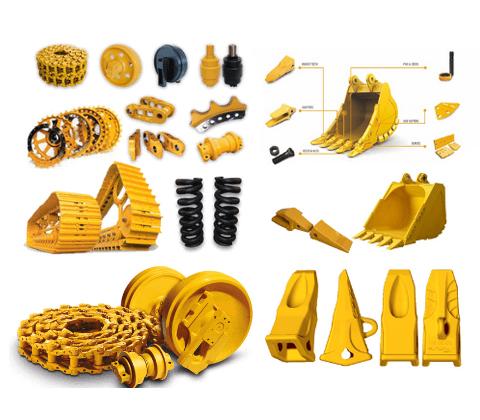
Change the size and the order of failure shifts a little, but the early-wear group stays fairly steady: cylinder seals, the pins and bushings at working joints, pumps and motors after many hours, then track links and idlers in the undercarriage. On small machines in dirty conditions, seals and bushings go first. On large machines under sustained heavy load, the pumps and motors carrying high pressure are the group to watch most closely.
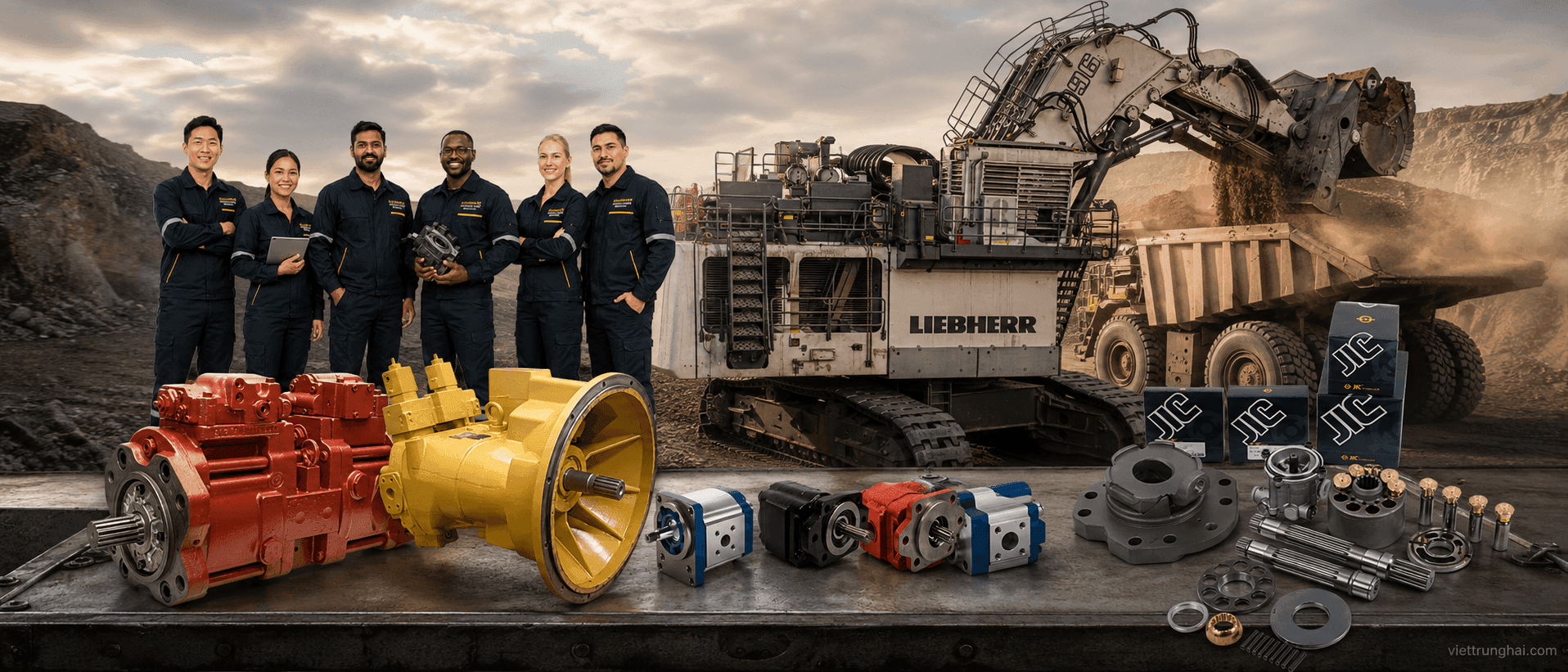
For replacement hydraulic parts, JIC Hydraulics — JIC / Axion hydraulic pump parts — is the choice we put first: pump cartridges, valve plates, pistons and cylinder blocks machined to the original pump family's tolerances, with material and heat treatment aimed at a life close to genuine parts, backed by a clear warranty. For seals, PET Seals sets give good sealing and oil-heat resistance; for bearings, ZVL Slovakia is a durable choice for swing bearings and load-bearing positions.
Choosing parts by the correct family and size matters far more than choosing the lowest price. A pump cartridge with the wrong tolerance, or a seal set that cannot take the oil heat, drags other parts down with it, and the repeat repair usually costs far more than the initial saving.
Which excavator size should you choose
Choosing a size should start from three practical questions: how much you dig per day, how tight or open the site is, and how you transport the machine. Small volume, tight space, a small trailer — lean toward mini or midi. Large volume, loading trucks, all-day work — the standard class makes sense. Only large, continuous volume on a mine site calls for the large class.
Buying the wrong size costs both ways: too small and it is slow and always overloaded, its life shortened; too big and it is expensive, hard to transport, hard to slew and thirsty on fuel. If you are buying used, tips for buying a used excavator help you inspect the right wear items for each size before you pay. To compare size against need right now, see the range at the excavators page.
Should a small contractor choose a mini or a midi?
For a small contractor, the choice often narrows to mini versus midi. The mini wins when the site is tight, you must get into a yard or indoors, and you often haul the machine yourself on a light trailer. The midi wins when most work is townhouse foundations and neighborhood infrastructure, needing more reach and dig force while still slewing in a lane. If the work swings between the two, the midi is usually the safer balance point, because it can cover a mini's tasks acceptably while the reverse does not hold.
Wheels or tracks within each size group
Size and travel type go together. The small and standard groups are mostly tracked, gripping well on soft ground and rough terrain, spreading load evenly so they sink less. Wheels are common on excavators that travel a lot on hard roads, doing urban infrastructure and cleanup, where speed between points matters more than grip. At the same size, choosing tracks or wheels changes how the machine grips, moves and which undercarriage parts you maintain. A deeper analysis sits in wheeled vs tracked excavators.
How the maintenance schedule shifts with size
The maintenance principle is the same across sizes: watch the oil, filters and joint grease, and listen to the machine to catch early signs. What changes is the severity. On a mini, skipping grease for a few sessions may only wear a bushing faster. On a large machine at a mine, the same lapse multiplied by heavy load and running hours can turn into costly downtime. So the bigger the machine, the tighter the maintenance discipline and hour log must be, and the more the spare-parts store needs the critical assemblies on hand — seals, pins and bushings, pumps, motors.
How size affects running cost
Running cost climbs with size, and it does not stop at fuel. Larger pumps, motors and cylinders mean pricier replacement parts, more hydraulic oil per change, and a costlier stoppage because big machines usually sit inside a production line. In return, a large machine moves more earth per hour, so per cubic meter the large class can be cheaper on high-volume sites. The key is matching size to real volume: the right size gives the lowest cost per cubic meter.
Start from the work, not from the ton figure
The way to use this grouping is direct: bracket the size group by the work and the site first, then look at the specific numbers of a few models within that group. Once you have locked the size, draw up the wear list for that group — seals, pins and bushings, pumps, motors, undercarriage — so you stock the right things, in the right family, in the right size. That is the next step worth taking right after you have chosen the machine, and it decides most of your running cost down the line.
Key takeaways
- Sorting excavators by size and role is easier than by exact tonnage.
- Four groups: mini/compact, midi, the standard class around 20 tons, and large production machines.
- Mini for utility and tight sites; midi general residential; standard the workhorse; large for mining.
- As machines grow, pumps, circuits and cooling grow and get more complex.
- Wear order: cylinder seals, joint pins and bushings, then pumps and motors, then the undercarriage.
- Choose size by dig volume, site space, and how you transport the machine.
Written by
Phạm Đức Thắng
Phạm Đức Thắng focuses on the undercarriage, tracks and the travel and swing systems of excavators. He writes about how these systems are built, travel and swing motors, and protecting the undercarriage from wear.
Related parts
The exact parts discussed above — send your machine model or pump code to match.