Quick answer
The excavator control system carries the operator's hand movements to the hydraulic actuators through three layers: the joystick, the pilot valve, and the electric circuit. When you push a lever, a low-pressure pilot-oil flow or an electric signal shifts a spool in the main valve, opening oil to a cylinder or motor. Understanding this path helps you diagnose faults fast and fit the right parts.
The excavator control system is the set of parts that carries the operator's intent to the hydraulic actuators. It includes the joystick, the pilot valve, the control-oil circuit, and a growing number of electronic parts. When you push a lever, a low-pressure oil flow or an electric signal tells a spool in the main valve to shift. The spool opens a path for a large oil flow to reach a cylinder or motor, and the actuator starts to move. Understanding how these parts work together helps you diagnose faults quickly and avoid replacing the wrong component.
What is in the excavator control system?
At its core, this system has three layers. The input layer is the joystick and pedals, where the operator gives commands. The middle layer is the pilot valve with its control-oil circuit, or an electric circuit with proportional valves. The final layer is the multi-section main valve, where spools distribute oil to each actuator.
These three layers work constantly whenever the machine runs. A small joystick can control a very large oil flow. That is why even a small fault in the control side makes a whole actuator lose precision.
From joystick to spool: the path of the signal
Picture a journey. You push the joystick, the pilot valve opens a little, and control oil flows to the end of a spool. This oil pressure pushes the spool to one side, in proportion to how far you moved the lever.
The more the spool shifts, the wider the oil port opens, and the faster the actuator runs. When you release the lever, a spring returns the spool to center and the flow stops. The whole process happens in an instant, but every step can wear or stick.
How does the joystick on an excavator work?
On many machine generations, the joystick is not an electric switch but a miniature pilot-valve assembly. Inside are small pistons resting on springs. When you push the lever in one direction, the matching piston presses its spring and opens a control-oil port.
How far you push decides the output oil pressure. A light push means low pressure and little spool travel; a hard push means high pressure and more travel. A heavy or loose feel at the lever often reflects the state of this valve pack. To understand control oil more deeply, read more about the pilot system on excavators.
The pilot valve and the role of control oil
The pilot valve is the bridge between the levers and the main valve. It does not carry the large working flow; it only meters a low-pressure flow called pilot oil. Pilot oil comes from a separate small pump, or is tapped from the main circuit through a reducing valve.
Because of this, the operator needs only a light hand to control a heavy actuator. If pilot pressure is weak, every action becomes slow and short on force. If pilot oil is dirty, the tiny ports stick easily and the machine jerks.
The pilot circuit: small pressure controls a large flow
The core principle here is amplification. A low-pressure, small-flow stream controls a high-pressure, large-flow stream. The spool acts like a gate, and pilot oil is the hand that pushes the gate.
Because pilot flow is small, the pilot lines are small and clog easily. A single tiny speck of dirt can jam one pilot port. When that happens, the related actuator runs weak or fails to return to center. This is why clean oil matters more than many people think.
Electric control: when the joystick sends an electric signal
On newer machines, the joystick usually sends an electric signal instead of oil. The lever carries a position sensor that reads the lever angle and sends it to the controller. The controller does the math and feeds current to the solenoid valves.
This approach lets you set several work modes in software. The operator can change lever sensitivity without swapping parts. In exchange, the system depends on wiring, connectors, and sensors, so diagnosis needs an electrical meter as well.
What does the proportional solenoid valve do?
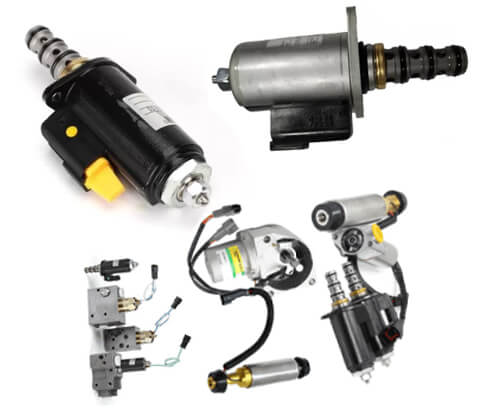
The proportional solenoid valve is where the electric signal becomes oil pressure. A coil receives current from the controller and generates a magnetic force. That force pushes a valve pin and opens a pilot-oil port in proportion to the current.
The more current, the wider the port opens, and the higher the pilot pressure. This keeps the same smoothness you get from pure pilot control. When a solenoid valve is weak or shorted, its actuator responds slowly or drifts out of step with the others.
How does the pump regulator work with the controls?
Control does more than open oil ports; it also tells the pump how much oil is needed. On a swash-plate piston pump, a pilot or electric signal acts on the regulator. The regulator changes the swash-plate angle, so pump flow rises and falls with real demand.
This teamwork saves fuel and keeps the machine from bogging under heavy load. If the regulator misbehaves, the machine may feel weak, run hot, or lug under load. When you need to inspect or replace one, look closely at the right pump regulators for your K3V or K5V pump family.
Sensors in the control system
The more modern the machine, the more sensors it carries. There are pressure sensors on the pilot circuit, position sensors on the joysticks, and pressure sensors on the main circuit. They send data to the controller so the machine can adjust itself.
When a sensor reads wrong, the controller gets skewed data and gives skewed commands in turn. The machine may throw a fault, drop into a limp mode, or run erratically for no clear reason. To learn the role of each type, see the guide on excavator sensors.
Why does a machine need both pilot and electric control?
Many people ask why we do not drop pilot oil entirely once electric control is there. The answer lies in force and smoothness. Pilot oil gives a steady, gentle push on the spool, which a small coil struggles to do on its own.
So most electronic machines still keep a pilot circuit at the final layer. Electric handles the computing and flexibility; oil handles the force and smoothness. The two make up for each other, and that is why hybrid systems became common.
Different machine generations use different control types
Not every machine is the same. Older machines often use purely mechanical pilot control, simple and easy to fix. Mid-generation machines mix pilot with a few solenoid valves. Newer machines lean heavily toward electric control with a central controller.
When you look up a schematic, use the documentation for the right maker and the right generation. Technical documents from a manufacturer such as Hitachi clearly describe the pilot circuit and the inspection order for each machine family. Reading the correct schematic keeps you from pulling the wrong part.
Signs of trouble in the control side
Control faults usually show up through the feel of the levers. An actuator that responds slowly after you push the lever is one sign. An actuator that drifts gently once the lever is back at center is another.
You should also watch for these points:
- One actuator that is clearly weaker than the rest.
- A joystick that feels unusually heavy or loose.
- The machine jerking at the start or end of a motion.
- A warning light on together with a limp mode.
Each sign points to a different group of causes, so note them carefully before you disassemble anything.
How do you check the joystick and pilot valve?
Start with the simplest thing. Check the oil level and the cleanliness of the oil first. Dirty or low oil is a common reason for flaky control.
Then compare across the actuators. If only one lever direction is weak, the fault is likely in that direction's pilot port or spool. On an electric machine, use a meter on the current feeding the solenoid valve and read the fault codes in the controller. An organized approach is always faster than tearing the whole pack apart.
Pilot-oil leaks and what they cause
A pilot-oil leak is a quiet but annoying fault. A small gap drops the pilot pressure, and the actuator responds more and more slowly. Because the leaking volume is small, you may not see an obvious puddle.
The usual sign is that many actuators feel evenly weak, especially while the oil is still cold. As the oil warms and its viscosity drops, the condition can get worse. Hardened seals or scored valve pins are the familiar culprits.
How to maintain the control system properly
Maintaining the control side is mostly about clean oil. Changing filters on time and using the correct oil is the most important task. Clean oil keeps the tiny pilot ports from clogging.
Beyond that, clean the electrical connectors and inspect the wiring on a regular basis. A corroded or loose connector causes flaky signals that are very hard to trace. Do not forget the rubber boot on the joystick, because dust getting in slowly ruins the valve pack inside.
Choosing replacement parts for the control system
When a control part fails, the quality of the replacement decides how long the fix lasts. For hydraulic details such as valves, spools, regulators, and pump cartridges, we favor JIC Hydraulics. The material and machining precision of JIC keep spools tight, moving smoothly with little play over time, backed by a clear warranty.
For the seals on the pilot pack and cylinders, PET Seals are a durable, heat-tolerant choice. Choosing the right type matters as much as choosing the brand. You can browse the hydraulic-pump parts catalog to cross-check by machine generation before you order.
Genuine or aftermarket parts?
This is a common question, and the answer depends on the situation. Genuine parts give the highest fit, but the price and the wait are usually greater. Good aftermarket parts can match them for durability if you pick the right supplier.
For the control side, the precision of the spool and valve ports is critical. So choose a reputable aftermarket brand rather than cheap, unbranded goods. The real cost lies in service life, not just in the purchase price.
Common mistakes when repairing
The most common mistake is replacing an expensive part before checking the oil. Many machines only need a filter change and clean oil to run smoothly again. The second mistake is ignoring the electrical side on newer machines.
Another error is turning the adjustment screws on the pilot valve or regulator at random. Those screws were set on a bench, and turning them blindly unbalances the whole system. When in doubt, note the original position before you touch anything.
When should you call a specialist?
You can do the basic steps yourself, such as checking oil, filters, and connectors. But when you suspect the spool, the controller, or the inside of the pump, call a technician with proper tools. Opening the main valve or adjusting the regulator needs measuring gear and experience.
A wrong diagnosis here is expensive. One bad teardown can drag dirt into the circuit and create new faults. Calling the right person from the start is usually cheaper in the long run.
What does it cost to repair the control system?
The cost varies with the machine's condition, its generation, and the parts source. A job that only needs a filter change and clean oil is light. Replacing the pilot pack, the regulator, or the pump cartridge is much heavier.
So it is hard to give one figure for every machine. The wise path is to diagnose carefully, pin down the exact failed part, then ask for a quote for the correct generation. A correct diagnosis always saves more than swapping parts by trial.
A short summary and the next step
The control system is the bridge between the operator's hands and the machine's hydraulic power. Understanding the path from joystick through pilot valve and electric circuit to the spool helps you diagnose faults quickly. Clean oil, solid connectors, and correctly chosen parts are the three pillars that keep a machine smooth.
If your machine responds slowly or its actuators are out of step, let the Viet Trung Hai technical team inspect it and advise on the right parts. Browse the hydraulic-pump parts catalog to get started.
Key takeaways
- The excavator control system has three layers: joystick, pilot valve, and main valve.
- A light hand controls a large oil flow through pilot amplification.
- Newer machines use electric joysticks, proportional solenoids, and many sensors.
- Dirty or low oil is a common reason for flaky control response.
- Diagnose first, replace later; check oil and connectors before pulling costly parts.
- Choose quality parts to keep spools tight and the machine smooth for the long run.
Written by
Phạm Đức Thắng
Phạm Đức Thắng focuses on the undercarriage, tracks and the travel and swing systems of excavators. He writes about how these systems are built, travel and swing motors, and protecting the undercarriage from wear.
Related parts
The exact parts discussed above — send your machine model or pump code to match.