Quick answer
An excavator has three filter lines — suction, return and pilot — and when the hydraulic filter clogs the machine slows down, the oil heats up and fuel use climbs. You can catch the change point by feel: listen to the pump, sense the lag in the boom and touch the tank casing for heat. Changing on time keeps the pump and valves from wearing early.
The excavator hydraulic filter is the quiet part that keeps the oil clean, and when it gets dirty the whole machine weakens before anyone notices. In short: an excavator usually carries three filter groups — the suction filter, the return filter and the pilot filter; each guards its own oil line, and when one of them clogs the machine gets a slow boom, hot oil and higher diesel use than normal. This guide helps you catch the change point through your own daily operating feel, with no expensive gauges. By the end you will know how to listen to the pump, touch the tank casing and feel the boom to read trouble before the pump fails.
What the excavator hydraulic filter is and where it sits
Inside an excavator the hydraulic oil runs in an endless loop: from the tank, through the pump, out to the valve, down to the cylinders and motors, then back to the tank. Along that path there are always fine metal particles, dust and residue born from friction. The hydraulic filter is the screen that holds those dirty particles back, so the oil reaching the pump and valve stays clean. Without a filter, in only a few hundred hours the pump and valve get scored, loose and lose pressure.
Old technicians like to say the oil is blood and the filter is the kidney. Dirty blood tires the whole body, and a blocked kidney lets toxins pile up. An excavator is the same: a dirty filter does not kill the machine at once, but it grinds down the pump and valve day by day.
Three filter types you need to tell apart: suction, return and pilot
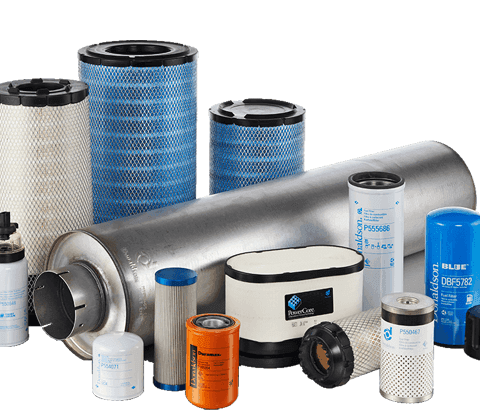
Many owners only know it as one hydraulic filter, but an excavator actually has three separate filter lines. Telling them apart is how you understand why one fault differs from another. The three groups are the suction filter before the pump, the return filter on the oil line back to the tank, and the pilot filter that serves the control circuit.
Each type sits in one place, takes a different kind of pressure and holds a different particle size. When one clogs, the symptom it causes is its own. Understand this and you will not change the wrong filter while the fault stays.
What the suction filter does and why it stays quietest
The suction filter sits between the tank and the pump inlet. Its job is to stop large particles, keeping coarse debris out of the pump. Because the pump draws oil through it, a dirty suction filter starves the pump, which then strains to pull harder.
The danger of the suction filter is how quiet it stays. A starved pump develops cavitation, meaning air bubbles form and then collapse right inside the pump. This kind of damage eats the pump internals from within, and by the time you notice, the pump is already weak. This is why many hydraulic-pump parts get replaced early only because the suction filter was forgotten.
The return filter: where most of the dirt comes back
The return filter sits on the oil flowing back to the tank after it has worked at the cylinders and motors. This is where most of the wear particles and residue made during operation gather. So the return filter is usually the one that gets dirty fastest and needs the most attention.
When the return filter clogs, oil struggles to get back to the tank and pressure on the return line rises. That loads the seals and gaskets with pressure they should not carry, and over time they weep oil. If you see a machine that seeps oil at the boom joints soon after starting, think of the return filter first.
The pilot filter: small but it moves the whole control
The pilot filter serves the control oil circuit, the circuit that lets your joystick command the main valve. Pilot oil must be very clean because the passages inside the control valve are tiny. Even a little dirt here is enough to make a valve stick slightly.
When the pilot filter is dirty, you will feel the boom respond slowly, moving only after you have already pushed the lever. Some machines even jerk when a movement starts. Many people assume the control valve is broken and tear it down at real cost, when the culprit is only the cheap pilot filter.
Why does a dirty filter make the excavator weaker?
This is the question owners ask most, so let me be clear. When the filter is dirty, the oil passing through it is restricted. Restriction means part of the pump energy is wasted forcing oil through the dirt layer, instead of going fully to the boom and bucket. The result is a slow boom, weak force and a machine that clearly struggles on heavy digs.
Worse, when the filter is badly clogged, the bypass valve opens to save the pump. Now the oil takes a shortcut and is no longer filtered. The machine seems to run normally again for a while, but in truth dirty oil is flowing straight into the pump and valve. This is the most dangerous stage, and the one operators most easily ignore.
Why a clogged filter heats up the oil and the machine
Heat in a hydraulic system comes from friction and from oil being forced through narrow gaps. When the filter clogs, oil has to squeeze through a thick dirt layer, friction rises and heat rises with it. Hot oil thins out, the protective oil film gets thinner, and the pump wears more easily.
Heat also drives a vicious circle. Hot oil hardens the seals, hardened seals leak, leaks drop the pressure and the machine has to work harder still. So a clogged filter that seems minor is the start of a chain of failures.
The bypass valve: it saves the pump but trades away cleanliness
Almost every return filter housing has a built-in bypass valve. It is a safety valve: when the pressure drop across the filter gets too high, it opens so oil goes around the filter element. The aim is to keep the element from bursting and to keep the pump from starving.
But the trade is that the oil is not filtered then. If you leave the filter dirty for a long time, the bypass valve stays open almost constantly, and the machine runs on dirty oil all day. Understanding this shows why the machine still runs does not mean the filter is still good.
The signs of a due change you can feel while operating
You do not need a pressure-drop gauge to know a filter is nearly done. A good technician reads trouble through the senses. Below are the reliable signs that anyone operating daily can feel.
- The boom is much slower on a cold morning and only gets strong once the machine warms up.
- Heavy digging feels clearly weaker than it did last week.
- The oil heats up faster than usual even though the load is the same.
- There is an unusual whine or growl from the pump at high throttle.
- The boom jerks or lags when you first push the lever.
- Fresh weeping appears at the boom joints or the cylinder rods.
- Diesel use climbs because the pump is carrying more load.
- You have reached the hour mark and last time the element came out very dirty.
Listen to the pump and the machine to judge the filter
The technician ear is the cheapest diagnostic tool. A healthy pump runs smooth and even. When the suction filter begins to clog, the starved pump gives a high whine or a knocking like gravel in a pipe — that is the sign of cavitation.
Learn to listen while the machine is still good so you have a baseline. If today the pump growls more, sounds harder as you lift a heavy boom, do not ignore it. A strange sound almost always comes before any visible damage.
Feel it through the boom and cylinder speed
Holding the levers every day, you know the machine habits better than any logbook. When the filter is good, the boom moves in and out decisively, and stop means stop. When the filter is dirty, the boom drifts slowly, reaches its end slowly, and feels mushy.
Comparing left to right, or against yesterday, is the best method. If one motion turns clearly slow while the oil is still full, think at once of the filter and the bypass valve. This feel matters as much as any number you could measure.
Watch the heat and touch the tank casing
At the end of the shift, lightly touch the tank casing and the filter housing. If it is hotter than usual even when the weather and load are the same, that signals the oil is being restricted. Be careful, because the surface can burn your hand — touch it only briefly to feel.
Pair the touch with a look. If the oil in the sight glass is dark, foamy or milky, both the oil and the filter are calling for help. At this point the filter is tied to the hydraulic-oil change interval, and the two cannot be separated.
A quick sign table by filter type
For easy reference in the field, here is a table that groups symptoms by filter type. It does not replace opening up and inspecting, but it helps you narrow the area fast.
| Filter type | Location | Sign when dirty | Result if ignored |
|---|---|---|---|
| Suction | Before the pump | Pump whine, growl, knocking | Cavitation, pump wear |
| Return | Line back to tank | Seal weeping, hot oil | Blown seals, dirty oil via bypass |
| Pilot | Control circuit | Boom lag, jerk on lever | Sticking control valve |
When to change the filter earlier than recommended
The hour mark in the manual is only a starting point for ideal conditions. In Vietnam, machines run in mud, rock dust and heat, so filters get dirty faster. In the spirit of the technical documents from Hitachi, the service interval should be shortened when the machine works in harsh conditions.
Concretely, change earlier when the machine digs sticky clay, fine sand or works near the sea. A machine fresh from a pump rebuild, an emergency oil change, or one whose last element came out very dirty should also shorten the gap. Better to change one filter early than to change the whole pump.
Filter and oil go together, do not split them
Many people change the oil but forget the filter, or the reverse. Doing so wastes half the work. Pour in fresh oil and leave the old filter dirty, and the new oil is fouled at once; fit a new filter while the oil is already degraded, and the filter clogs again quickly.
The right way is to time the two on the same rhythm, or at least change the filter whenever you change the oil. If you are still unsure about the rhythm, the guide on the hydraulic-oil change interval explains how to set the mark by real working conditions.
Choosing the right filter: genuine or aftermarket
The market carries both genuine and aftermarket parts, and both have a sensible place. Genuine parts give steady filtration and element durability, suited to a newer machine or an expensive pump. Good aftermarket parts save money on an older machine, as long as you pick the right filtration grade.
What matters is not cheap or expensive, but the right filtration grade and the right construction for your machine. An element too coarse cannot hold fine particles; one too fine clogs quickly and pushes the bypass valve open. To pick correctly for pump families like K3V or K5V, see the guide on choosing a hydraulic filter and the hydraulic filters we supply.
Fit the filter correctly so you do not wreck the pump yourself
Changing a filter seems easy, but careless work harms the machine. Before removing it, wipe clean around the housing so dust does not fall in. Smear a thin film of oil on the new gasket, hand-tighten until it touches, then add just enough — never crank it down with a wrench and ruin the gasket.
With the suction filter, remember to fill it with oil and prime the pump before starting, to keep the pump from running dry. After fitting, start at low throttle, work the levers gently to fill the oil, and only then get to work. These few careful minutes protect the whole expensive set of hydraulic-pump parts.
Common mistakes when changing excavator filters
The most common mistake is changing only one filter type and thinking the job is done. Change the return filter but forget the suction filter, and the pump still starves as before. The second mistake is using a no-name element with an unknown filtration grade — it looks the same but the internals are quite different.
Another error is letting old oil drain back into the tank while removing parts, dragging residue back into the system. And never blow a used element clean with compressed air to reuse it — that wrecks the filter paper structure. The filter is the cheapest item in the whole hydraulic system, so grudging it is grudging in the wrong place.
Keeping a filter-change log helps you read the machine health
Each time you change, write down the machine hours and the condition of the old element. An element that gets dirty steadily by the hour is normal. But if this time the element is dirty unusually fast, or shows glittering metal particles, that is a warning that something inside is wearing.
This little notebook is worth more than many expensive tools. It shows you the trend, and the trend is what warns of trouble early. Looking at the debris on the element, a good technician can tell whether the pump or the motor is failing before the machine even complains.
Keep a quick daily inspection habit
It does not take much time, only a few small habits each day. At the start, listen to the pump as you lift a heavy boom. Mid-shift, watch whether the boom drifts slowly. At the end, touch the tank for heat and glance at the oil sight glass.
Together these give you a near-free picture of the hydraulic system health. An excavator rarely fails all at once; it always warns first through sound, through heat, through the feel of the boom. The owner who pays attention changes the filter on time and avoids the pump-repair bill.
Need advice and the right filter for your machine
If you are unsure which filter suits your machine year and pump family, just tell us the model and the condition, and we will help pin down the right type. Look through the hydraulic filters to compare, and if you want to choose more carefully, see choosing a hydraulic filter. Changing the right cheap filter today is how you keep the expensive pump for years to come.
Key takeaways
- An excavator has three filter lines: suction, return and pilot, each with its own symptoms.
- A dirty filter weakens the machine because the pump wastes energy forcing oil through the dirt.
- A clogged filter heats up the oil and the machine, leading to a chain of failures.
- The bypass valve saves the pump but runs the machine on dirty oil if left too long.
- Listen to the pump, feel the boom lag and touch the tank for heat to judge the change point.
- Change the filter on the same rhythm as the oil and keep a log to read machine health.
Written by
Trần Quốc Bảo
Trần Quốc Bảo works on hydraulic pumps and rotary groups at the Việt Trung Hải workshop. He measures pressure, overhauls and load-tests pumps across many excavator generations, and writes about pump principles, K3V rotary groups and fixing weak pumps from real cases.
Related parts
The exact parts discussed above — send your machine model or pump code to match.