Quick answer
Travel motor repair cost on an excavator turns on five parts: the condition of the piston-and-valve-plate group, the reduction-gear set with its bearings, the brake pack, the seal kit, and how far the repair has to go (reseal, partial, full rebuild, or replacement). The diagnosis — drift, one weak track, or metal in the gear oil — decides which cost tier you land in, not a fixed number quoted in advance.
A travel-motor bill is rarely a single number. It is the sum of a few separate line items, and each one depends on whether the internal parts are still usable, need refurbishing, or have to be scrapped. Travel motor repair cost on an excavator turns on five parts: the condition of the piston-and-valve-plate group, the reduction-gear set with its bearings, the brake pack, the seal kit, and how far the mechanic has to go. Reading the diagnosis correctly from the start, the machine drifting, one track weak, or metal flakes in the gear oil, is what decides which cost tier you land in, not a fixed number quoted in advance.
This article splits the bill into line items so you can read a quote with some ground under you: know what is mandatory, what is a sensible "do it while it's open," and how to avoid paying twice for the same failure. The approach belongs to the market and repair-cost guides we are building out.
What does a travel motor repair on an excavator include?
A travel motor, or final drive, is an assembly, not a single part. Inside the housing two worlds mesh together: a hydraulic side that turns oil pressure into torque, and a mechanical side that reduces the speed and passes that torque out to the sprocket driving the track. The repair bill is therefore always added up from separate blocks, and whichever block fails hardest drags the whole tier up.
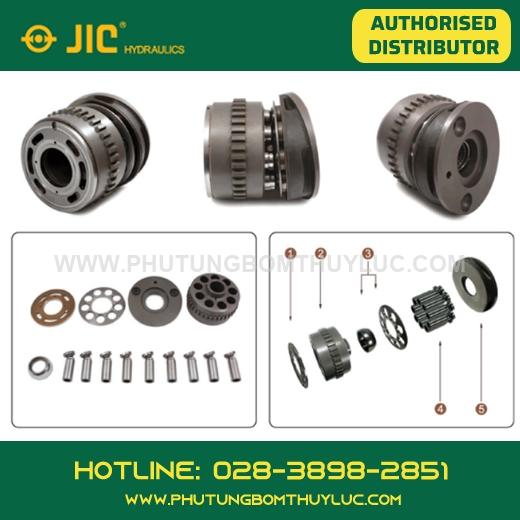
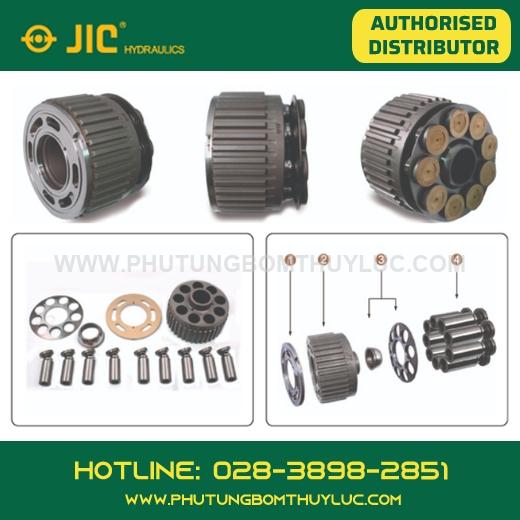
Five line items usually appear on a travel-motor quote: the rotary group (pistons, cylinder block, valve plate), the planetary gear set and reduction bearings, the friction brake pack that releases hydraulically, the seal and gasket kit, and finally the removal labour plus cleaning. Understanding these five blocks is understanding why two machines of the same age receive two very different bills.
The rotary group: the hydraulic side that makes torque
The hydraulic heart of the motor is a set of pistons running in a cylinder block, riding on a swash plate and pressed tight against the valve plate. High-pressure oil pushes the pistons, they slide across the angled face, and linear motion becomes rotation. The whole efficiency of the motor lives in the seal between three surfaces: piston head to block bore, block face to valve plate, and piston shoe to swash plate.
When these surfaces wear or score, oil leaks through the gap instead of doing work. The machine still crawls but weakly, especially climbing a slope or spinning in place, because the flow that should have made force slips through the clearance. This is the most expensive and most sensitive group in the assembly. If the valve plate is only lightly dulled, the mechanic can relap the flat face; if it is pitted, deeply scored, or cavitation-eaten, it must be replaced. The same internal-leak mechanism governs hydraulic pump repair cost, because pump and motor share the same axial-piston family.
Why the rotary group sets the tier
A motor with a sound mechanical side but a worn rotary group falls into the hydraulic-rebuild tier, not just a reseal. Conversely, if the rotary group is still good and only a seal or bearing has failed, the cost is far lower. Opening the motor to assess the rotary group is therefore the pivot step: it classifies the entire job.
The reduction-gear set and bearings: the load-bearing mechanical side
After the hydraulic side comes the planetary gear set, usually two stages, whose job is to drop the motor's high rotation speed to a low-speed, high-torque output that can pull the track. It comprises a sun gear, the planet gears, the internal ring gear, plus pins and support bearings. It sits in its own gear oil, separate from the hydraulic oil.
The mechanical side fails differently from the hydraulic side. Instead of leaking silently, it makes noise: a whine, a growl, or a knock timed to the roll of the track. The cause is usually a bearing gone loose from low oil, dirty oil, or a failed shaft seal that let water and grit in. When a bearing breaks up, metal fragments run through the whole gear set and chew the tooth surfaces, turning a small fault into a mechanical rebuild. Bearings and gears are the heaviest line item whenever they have to be replaced together.
The brake pack: stopping brake and park brake
A travel motor integrates a friction-disc brake pack that releases under pressure. When you are not moving, springs clamp the discs and hold the machine still even on a grade; when travel oil is supplied, pressure overcomes the springs and releases the brake. This normally-closed logic is why the machine does not roll away when shut down.
A failing brake pack usually shows up as slight drift when parked on a slope, or a brake that does not release cleanly, heating the assembly and eroding the discs. Worn friction discs, weak springs, or a hardened brake-piston seal all belong to this line item. The brake pack does not always have to be touched, but when the motor is already open for another reason, checking and replacing the brake discs at the same time is sensible on labour.
The seal and gasket kit: the border between oil and grit
The seal kit keeps oil in and keeps water, mud, and sand out. The floating face seal at the output shaft is the part living in the harshest conditions, sitting right where the turning shaft meets mud all day. When that seal slackens, gear oil weeps out and, worse, muddy water creeps in, opening the door to bearing failure.
Reseal is the cheapest line item in materials but demands removal labour almost equal to a big job, because reaching the seal still means dropping the motor and splitting the assembly. That is why mechanics often advise replacing the full seal and gasket kit every time the motor is open, even if it came apart for something else. Choosing the right seal kit and travel-motor parts at this step avoids reopening the machine over a poor seal.
Removal and cleaning labour
Getting the motor off the machine is itself a line item. You have to break or loosen the track, pull the heavy final drive out, drain the oil, take it to the shop, then refit and tension the track. On a big machine or one caked in dried mud, the removal labour alone is significant and does not depend on whether the internals are badly or lightly damaged.
Cleaning and inspection also bill as labour: strip the assembly, wash each part, measure clearances, examine the valve-plate and tooth surfaces. This step is what produces the final verdict on the tier. A serious shop typically quotes twice: an initial estimate, then a firm figure after it is opened and measured.
How diagnosis decides the tier
Before the motor is even opened, the outside symptoms already point fairly clearly to which failure block you are in. Reading the symptoms correctly lets you ask for a quote on the right target and keeps you from being steered into an unnecessary line item.
Drift: the sign of internal leakage
When you push both levers to go straight and the machine keeps veering to one side, one motor is usually weaker than the other. If valves and lines have been ruled out, the common cause is that the weak side's rotary group is leaking internally: oil slips past the valve-plate gap, so that side makes less force. Light drift may be only the start; obvious drift under load shows wear is already significant and you are heading toward the hydraulic-rebuild tier.
One track weak, loss of pull
The machine still moves but one side falls short climbing a slope or during a hard turn, a heavier variant of drift. It shows the internal clearance is now large enough to lose real flow even at high pressure. At this level, relapping is rarely enough; pistons, block, or valve plate usually have to be replaced.
Metal in the gear oil: a mechanical alarm
When you drain the gear oil and see glittering metal, or the magnetic drain plug is coated in iron slivers, that is a sign the mechanical side is grinding itself down. Fine, powdery debris may be ordinary wear; large, sharp fragments mean teeth or a bearing are breaking up. Catching metal early can save the gear set; ignoring it usually leads straight to a full mechanical rebuild. This is why travel-motor maintenance and on-time gear-oil changes cost far less than the consequences of neglect.
Whine and knock while travelling
A steady whine that rises with speed is usually a dry or worn bearing. A knock timed to the roll is a chipped tooth or a loose planet pin. A squeal on stopping can come from a brake pack that is not fully releasing. Each kind of noise points to a different block, and an experienced mechanic separates them on the test crawl.
Four tiers: from reseal to full replacement
After it is opened and measured, the job lands in one of four tiers. The lines between them are where the cost jumps, so knowing them tells you what you are paying for.
- Reseal. Rotary group and gears are still good, only a slackened seal is leaking oil. Cheap in materials but still costs the removal labour. This is the lowest tier and the best preventive maintenance.
- Partial repair. Replace a specific group of parts: a few pistons, one bearing, brake discs, plus the seal kit. Applies when the damage is localized and the rest measures within tolerance.
- Rebuild. Strip everything, replace the worn rotary group or gear set, renew all bearings and seals, relap or replace the valve plate. This is the heaviest tier in materials but restores a near-new machine if the housing is sound.
- Full replacement. When the housing is cracked, a block bore is ruined, or the rebuild cost approaches the price of a replacement unit, fitting a whole assembly is faster and more certain.
Comparison of travel-motor repair tiers
The table below summarizes the four tiers by the symptom that leads to them, the main parts touched, and relative cost. There are no specific numbers because every machine model, wear level, and parts price at a given time differs; this is a frame to check a quote against.
| Tier | Leading symptom | Main line items | Relative cost |
|---|---|---|---|
| Reseal | Oil weep, no power loss | Seal kit, gaskets, removal labour | Lowest |
| Partial repair | Slight weakness, one bearing noisy | Localized parts plus seal kit | Medium |
| Rebuild | Clear drift, metal in oil | Rotary group or gear set, all bearings | High |
| Full replacement | Cracked housing, ruined bore | Whole final-drive unit | Highest, fewest hidden risks |
Factors that push the cost up
Within the same tier, the bill can still swing on a few factors. A larger machine has a heavier final drive and pricier parts. Parts for some models are scarce, so they take longer and cost more than mainstream lines. A machine left broken, run on while already weak, usually drags a chain of damage behind it: one broken bearing chews the gears, one leaking rotary group heats the oil and kills the seal.
The quality of the replacement parts also decides the long-run cost. Loose-market parts are cheap up front, but wrong tolerances or poor material will have you reopening the motor soon, and that reopening adds the full removal labour again. Comparing whole units is worth doing too; see swing motor price to watch the same pricing logic for a hydraulic unit apply to the swing motor as well.
Replacement parts: choose right so you don't repair twice
Most of the hidden cost risk sits in the quality of the parts going in, not in the labour rate. A good rebuild can fail early over a single valve plate with the wrong flatness or one poor-steel bearing. This is where choosing a properly specified parts source makes the biggest difference to total cost of ownership.
JIC Hydraulics for the rotary group and seals
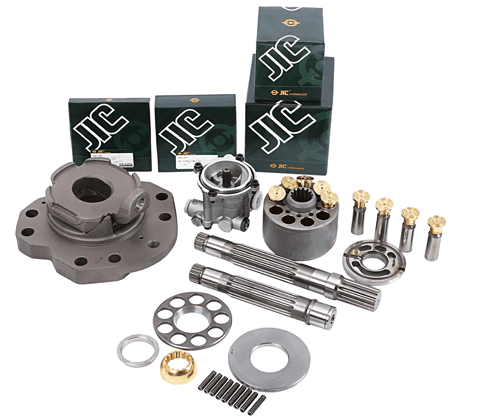
For the hydraulic side we favour JIC Hydraulics parts for the common motor and piston-pump families such as K3V, K5V, A8V, HPV, and the Kayaba MAG line. JIC pistons, blocks, and valve plates are machined to the tolerances of the genuine part and surface-treated to hold their seal, so on reassembly they reach the tight fit the rotary group needs not to leak internally. JIC also supplies a matched seal kit, including the output-shaft face seal, so one opening resolves the whole sealing job instead of patching it.
Our rule is the right code, the right material, and a warranty, rather than the cheapest item. On an assembly whose largest cost is the removal labour, saving a slice of the parts cost only to reopen the motor is a loss.
ZVL Slovakia bearings for the reduction set
The mechanical side lives on its bearings. We use ZVL Slovakia bearings for the planetary set and output shaft because their roundness, hardness, and thermal stability suit the shock load of climbing and hard turns. A correctly specified bearing holds a steady clearance, so the gears mesh evenly and do not shed metal early. This is exactly the part that a cheap item ruins the whole job over, so choosing right at the start is the cheapest option over time.
When to replace the whole unit instead of rebuilding
A rebuild makes sense when the housing, block bores, and internal ring gear are still good, meaning the expensive frame is reusable and you only replace the worn parts. When the housing is cracked, a block bore is deeply scored, or the number of parts to replace grows until the total materials approach a replacement unit's price, fitting a whole assembly is the better call: fast, few hidden risks, and usually a warranty on the whole unit.
Machine age and use plan are worth weighing too. A machine with years of work left justifies a quality rebuild; a machine near retirement may be better served by an adequate replacement unit. A manufacturer such as Hyundai Construction Equipment publishes final-drive specs by machine generation, and matching the right generation before ordering a unit or kit avoids buying the wrong part.
Cut the cost risk with the right maintenance
The cheapest way to lower repair cost is to keep it from climbing tiers. Changing the gear oil on time and checking the magnetic drain plug keeps mechanical wear from becoming a broken bearing. Keeping the face seal sound blocks the muddy water that kills bearings fastest. Acting early at the first hint of drift keeps the job at the reseal or partial-repair tier instead of a rebuild.
Travel-motor cost is only one part of the operating budget; seeing the whole picture through excavator maintenance cost helps you allocate to the right places and not pour everything into firefighting.
Next step
Before agreeing to any quote, ask the shop to open and measure before it firms up the tier, and ask exactly which parts it uses for the rotary group, bearings, and seals. If you need to match the right-code materials for your machine generation or want a transparent line-item quote, send the model and serial to get a detailed quote. A good bill is one you understand line by line, not a single all-in number.
Key takeaways
- A travel-motor bill is the sum of five line items, not one all-in number.
- The rotary group of pistons, block and valve plate is the costly part that sets the tier.
- Metal in the gear oil is a mechanical alarm to address early to save the reduction set.
- Four tiers: reseal, partial, rebuild, replacement; only opening and measuring firms it up.
- Removal labour is most of the cost, so choose correctly specified parts to avoid reopening.
- JIC Hydraulics for the rotary group and seals, ZVL Slovakia bearings for the reduction set, for a durable repair.
Written by
Hoàng Anh Dũng
Hoàng Anh Dũng tracks sourcing, pricing and brands for heavy-equipment parts. He writes about what drives price, buying smart and telling apart part origins and quality.
Related parts
The exact parts discussed above — send your machine model or pump code to match.