Quick answer
Cheap spare parts can work, but a very low price almost always trades away material, machining, or lifespan. Quality replacement parts with a clear source and warranty are often a sound choice; unbranded floating stock is best avoided. Choose by total running cost, not just the figure on the purchase invoice.
Cheap spare parts are not always bad, but a very low price almost always has a reason behind it. Someone has to cut somewhere: thinner material, sloppier machining, or a skipped heat-treatment step you cannot see with your eyes. On an excavator, a cheap figure on the invoice tends to come back as downtime, hot oil, and one more pump teardown. This article is blunt: when to avoid very cheap parts, when a sensible replacement is a good choice, and how to buy so it is worth the money.
Are cheap spare parts worth using?
Short answer: yes, but only if you know exactly what you are buying. Some parts are cheap because the maker genuinely optimized cost while keeping real quality. Others are cheap because they trimmed exactly the things you cannot check by eye. The buyer job is to tell those two apart before fitting, not after the machine is parked.
Cheap because of what — breaking down the price
A part carries several stacked layers of cost: material, machining, heat treatment, inspection, packaging, and warranty. When the price drops sharply, ask which layer just got cut. Usually they cut the layers that create durability, since that is the hardest part for a customer to verify. You save today, and the machine pays it back a few hundred hours later.
Material: the first thing people cut
Good steel and alloy cost noticeably more than plain steel, and the difference sits entirely inside. For load-bearing parts like pistons, blocks, or shafts, the wrong material means early failure almost for certain. From outside two parts look identical, but the metal core differs in hardness and toughness. This is where very cheap parts hide problems most, especially on load-bearing heavy-equipment parts.
Machining and precision
Hydraulic parts live on correct clearance and smooth sliding surfaces. If the tolerance drifts, oil slips through the gap and pressure will not build under load. Sloppily machined parts still run when new, then wear loose very quickly after. You will hear the pump whine and feel the machine fade every time the oil heats up.
Heat treatment and lifespan
Heat treatment is the surface-hardening step that the naked eye cannot see. Skip it, and the part still looks bright and clean but wears fast under load. This is exactly why two seemingly identical parts differ in both price and lifespan. On pumps and motors, missing proper heat treatment is a slow death sentence, hidden until it is too late.
Hydraulic rotary group — the most sensitive zone
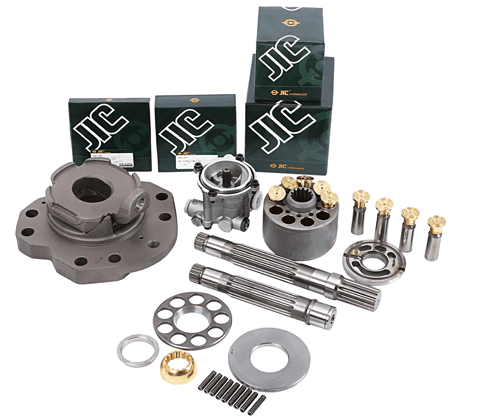
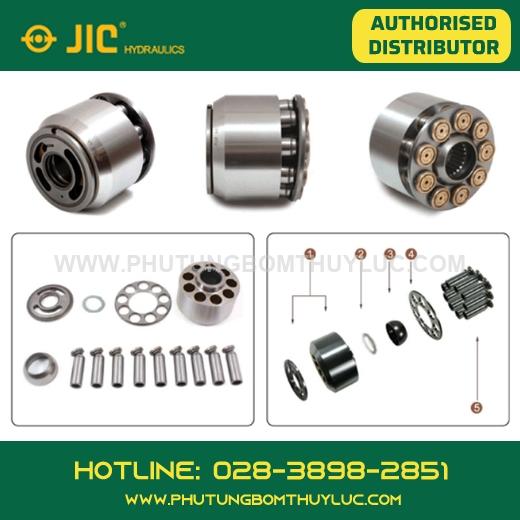
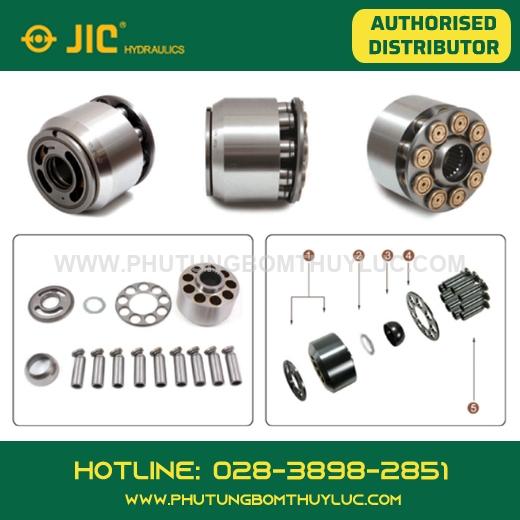
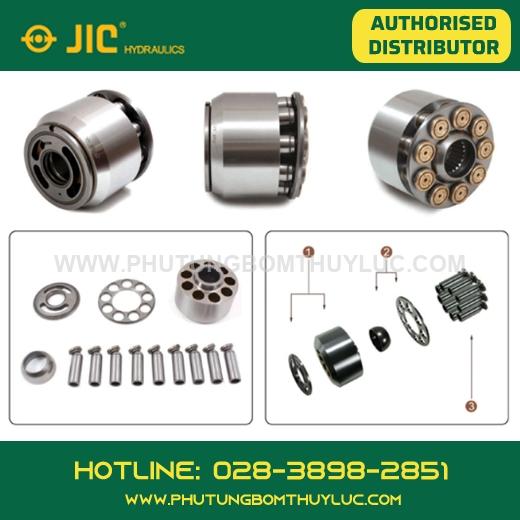
The rotary group is the heart of the hydraulic system, and it is where cheap parts do the most harm to the whole assembly. A hydraulic rotary group with wrong tolerances drags the downstream valve and motor down with it. On common pump families like K3V or K5V, I favor JIC Hydraulics rotary groups for their steady material and machining precision, backed by a clear warranty — a trustworthy replacement, not floating stock. Saving a little while risking the whole pump is never worth it.
Seals: small part, big consequence
A hydraulic seals kit costs only a tiny fraction of the pump, yet a poor seal causes leaks and pressure loss fast. Rubber of the wrong compound goes hard, cracks, and weeps under constant heat and hot oil. For seals, I often choose PET Seals because the material holds up to heat and oil over time. Saving on the seal kit is usually the most expensive saving people make.
Bearings and bushings
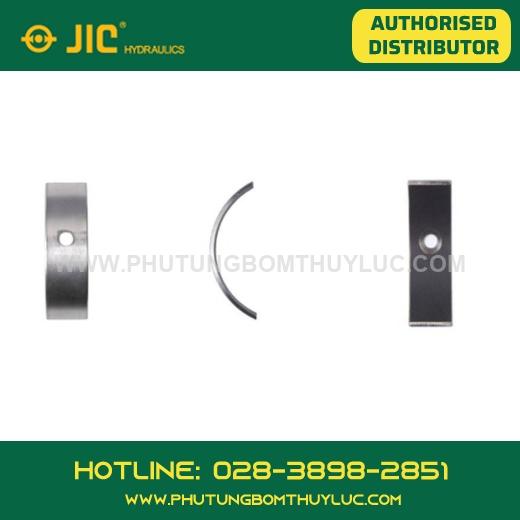
Bearings support the shaft and keep the clearance where it belongs. A poor bearing runs hot, gets noisy, and lets the shaft wobble after only a short time under load. Bearings with a clear source, machined to the right grade, run quieter and cooler to the touch on the housing. It is a small part, but it takes the whole assembly with it if it fails mid-job.
How is floating stock different from a proper replacement?
A proper replacement always has a maker, a standard, and a warranty standing behind it. Floating stock has no clear maker, no paperwork, and nobody responsible when it fails. Both get called aftermarket, but the two are far apart in nature. To understand this line clearly, read our guide on genuine vs aftermarket.
Signs a too-cheap part hides risk
A price abnormally low against the market is the first sign to stop. No maker name, no warranty, and blurry printed labels and boxes are all red flags. A seller who cannot answer where the part comes from is a very suspicious sign too. Trust the trade instinct: if it sounds too good, there is usually a hidden angle.
The real cost is not on the purchase invoice
On an excavator, the biggest cost is downtime, not the part itself. One pump teardown burns labor, oil, filters, and several working days for the whole crew. A cheap part that has to be redone twice costs many times more than a good one from the start. Count by machine hours earned, not by the figure of the single item.
When is a sensible replacement a good choice?
Expensive does not always mean good, and not every replacement is poor. On older machines, machines near retirement, or lightly loaded parts, a quality replacement is a very sensible choice. The condition is a clear source, a standard, and a clear warranty. That is smart saving, quite different from buying blind just to be cheap.
Quick comparison table
| Criteria | Genuine | Quality replacement | Cheap floating stock |
|---|---|---|---|
| Material | To factory spec | Equivalent, controlled | Unclear, often cut |
| Machining | High precision | Steady, correct tolerance | Sloppy, drifting |
| Warranty | Yes | Yes, clear | Almost none |
| Risk | Low | Low to medium | High |
| When to choose | New machine, heavy load | Most cases | Best avoided |
How to choose worthwhile parts — step by step
- Identify the exact part and exact machine model before asking price.
- Ask clearly about the maker, the source, and the warranty terms.
- Compare on total running cost, not just the purchase price.
- Prioritize load-bearing parts: choose quality, do not skimp.
- For minor low-load parts, a good replacement is enough.
- Keep the invoice and batch details so warranty still holds.
Ask hard about source and warranty
An honest seller can always tell you whose part it is, where it is made, and how it is warrantied. A warranty is not just a promise; it is how they actually stand behind their product. If the answer keeps circling and staying vague, be more careful. One clear piece of paperwork is often worth more than a few percent off.
Inspect on receipt
When the part arrives, check the sliding surfaces for scratches or burrs. Measure a few key dimensions if you have the right tools on hand. Recount the seal and gasket kit to confirm it is complete and the right type. Catching it early means you can still swap it; fitting first and finding out later costs a teardown.
Correct installation also decides lifespan
A good part fitted sloppily still fails early. Thorough cleaning, correct torque, and the right oil and filters are mandatory companions. Many bad-part complaints are really wrong installation or dirty oil in the system. Do not blame the part entirely when the install work was not done properly.
Which standards to rely on?
Standards let you talk with facts instead of gut feeling. For bearings and material durability, technical documents from a maker like SKF are a good reference on tolerances and load. Read our guide on part-quality standards to know what to look at when comparing. With a standard in hand, a cheap price cannot lead you by the nose.
Common mistakes when chasing cheap
The biggest mistake is comparing price while forgetting source and warranty. The second is buying a heavy-load part on the lowest price you can find. The third is skipping warranty to save a very small amount. All three lead to the same place: pulling the machine apart one more time.
What about cheap parts on a machine near retirement?
For a machine about to be sold or only idling along, the math changes completely. Here cheap spare parts can be acceptable, as long as they do not spread damage to other assemblies. Still avoid anything that could kill the central pump or motor. Save where it is safe, and do not gamble on the parts at the heart of the machine.
Cheap parts make sense for cyclic wear items
Some parts are made to wear out and get replaced on a cycle, not to last the machine's life. Filters, certain gaskets changed at each service, and wear pads are familiar examples. For this group, a quality replacement at a softer price is a very sensible choice. The logic is simple: you already swap them regularly, so you need not pay for a decade of life. Match the money you spend to each part's role and its replacement interval. Even so, do not drop to no-source floating stock, because debris from poor parts still travels into the system and harms other parts. A replacement with a clear source, just at the sensible tier, is enough for this group.
Test a cheap batch in a low-risk spot first
Before you trust a cheap batch, try it in the lowest-risk spot on the machine. Fit that part on a light-load or easy-to-swap component first, not straight into the heart of the machine. Watch it over one real work cycle: feel the heat, look for leaks, listen for odd noise. Keep the old part or a known-good spare on hand to swap back right away if needed. If it holds up over a few hundred hours under load, you have evidence the source is passable. If it fails, you lose only a cheap, easy part, not the whole pump. This turns a cheap purchase into a controlled test instead of a gamble on the machine.
Downtime risk when a cheap part fails mid-job
The heaviest cost of a cheap part is not the part; it is the machine stopping in the middle of a job. On a site with a deadline, one part failing at the wrong hour stalls the whole crew, not just the machine. Operators still get paid, and rented trucks still bill while they sit and wait. Worse is a spreading failure: a cheap rotary group taking the valve and motor with it turns a short stop into a long repair. Weigh the small saving in front of you against the chance of a stop at the busiest time. The more a machine earns, the more reliability outweighs the lowest price. For parts that stop the machine when they fail, buying with a warranty is almost always the cheaper path.
Short conclusion for the busy owner
A too-cheap part is rarely cheap for real; the cost just moves somewhere else. Choose by total cost, ask hard about source, and only save where it is truly safe. If you need advice on the exact part for your machine model, see heavy-equipment parts or call the Việt Trung Hải technical team to choose what is worth the money.
Key takeaways
- A very low price almost always trades away material, machining, or heat treatment.
- Quality replacements with a clear source and warranty are a sound choice.
- Floating stock with no source and no accountability is best avoided.
- Rotary groups and seals are sensitive zones; do not skimp there.
- Count by total cost and machine hours, not just the purchase price.
- Correct installation and clean oil also decide part lifespan.
Written by
Hoàng Anh Dũng
Hoàng Anh Dũng tracks sourcing, pricing and brands for heavy-equipment parts. He writes about what drives price, buying smart and telling apart part origins and quality.
Related parts
The exact parts discussed above — send your machine model or pump code to match.
Related products
 Kayaba (KYB) · PSVBushing – Kayaba PSVD2-17PSVD2On requestView · get a quote
 Kayaba (KYB) · PSVRotary group – Kayaba PSV2-55TPSV2On requestView · get a quote
 Kayaba (KYB) · PSVRotary group – Kayaba PSV2-60TPSV2On requestView · get a quote
 Kayaba (KYB) · PSVRotary group – Kayaba PSV2-63TPSV2On requestView · get a quote