Quick answer
How to read an excavator parts quote comes down to checking six fixed items on every line: the part number and description tied to the right machine, genuine versus replacement, quantity and unit, single part or full kit, the warranty terms, and the exclusions such as fitting labour, freight and VAT. Only when all six match are you comparing the same thing, not one number against another.
Two quotes for the same part can differ several times over, and most of that gap hides in the lines you did not read closely. Reading an excavator parts quote properly means checking six fixed items: the part number and description, whether it is genuine or a replacement, the quantity and unit, whether the line is a single part or a kit, the warranty terms, and what the price excludes. Only when those six match are you comparing the same thing, not one number against another.
This guide goes straight into unpacking each line, flags the signs of a vague quote, and shows how to ask for a clear quotation you can drop straight into a maintenance plan.
What a good parts quote actually tells you
A quote is not a price list. It is a conditional promise: the supplier says they will deliver this exact part, at this quality, within this time, subject to these terms. When a line lacks information, the missing piece does not vanish, it simply turns into risk that lands on you at goods-in or during the fit.
The mechanism is plain. The seller knows exactly what they are offering; the buyer guesses from the final figure. That information gap is where every later dispute begins: parts that do not match the machine, a missing seal inside a kit, warranty that falls short of expectations, or an invoice padded with tax and freight that was never mentioned at quoting. Reading the quote carefully closes that gap before you pay a deposit.
One foundation first: a part price only means something when tied to the right machine, the right assembly and the right quality grade. K3V112 and K3V140 are two different pump bodies within the same K3V family; a "seal kit" can include shaft and piston seals or just the outer shaft seal. Compare the wrong layer of information and the cheaper number is usually the number missing something.
How do you read a parts quote correctly?
You read it correctly by checking the six fixed items below in order before you compare any number, until it becomes a habit. Read them in this order and you will catch most of the difference between suppliers on paper, before money leaves the account.
1. Do the part number and description match your exact machine
Start with the identity line. A serious quote gives both a part number and a description, and the description must name the right assembly: main pump, travel motor, swing motor, control valve, or just one component inside that assembly. It should carry machine information too: the model, the machine code, and ideally the frame or engine number for cross-referencing.
Why does this line matter so much? Because many parts look alike but are not interchangeable. The valve plate, piston block or drive shaft of a K3V112 and a K5V140 can share an overall shape yet differ in fit dimensions. If a quote only says "hydraulic pump" with no number and no target machine, you have no way to know you are buying the right thing. When you need to verify a number against the maker, check the machine manufacturer's own technical documents, for example the Volvo CE site for Volvo models, rather than trusting a generic description. Telling genuine from fake, and reading labels, is covered more fully in spotting counterfeit parts.
2. Genuine, quality-standard or generic replacement
This is the most frequently omitted line, and the one that creates the widest price gap. A part can be genuine imported stock, a quality-standard part from an independent manufacturer with real quality control, or a generic replacement of unknown origin. These three grades differ in material, machining precision and service life, so placing them side by side without stating the grade makes the number meaningless.
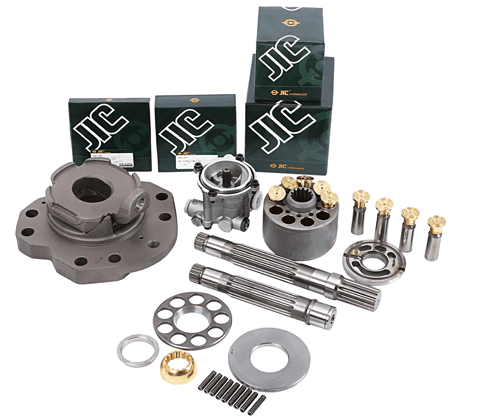
A good quote states the grade outright and, if it is a high-quality replacement, names the brand so you can verify it. For hydraulic pump parts, the replacement brand we put first is JIC Hydraulics, because core elements such as the piston block, valve plate and shaft are machined to tolerances close to the original, not rough castings polished up. Whether to go cheap or go standard is weighed in are cheap parts worth using.
3. Quantity, unit, and single part versus full kit
These three pieces of information often get merged and cause the most confusion. The quantity must be clear; the unit must be clear; and above all, it must be clear whether the line is a single component or a whole kit.
The classic example is the seal kit. A "pump seal kit" can be a complete bag with shaft seal, piston seals, O-rings and back-up rings; it can also be just the outer shaft seal. If a quote offers "seals" much cheaper, the odds are they are offering one piece while the other side offers the whole bag. Likewise, a "pump overhaul kit" at two vendors can contain a different list of parts. Always ask for the component list inside a kit before comparing kit price with kit price.
4. How clearly the warranty terms are written
A warranty is only worth anything when you know what it covers and under what conditions. A bare line reading "12-month warranty" is close to useless unless it states: warranty by time or by machine hours, counted from delivery or from installation, whether it covers faults from wrong installation or only material defects, and what conditions keep it valid, such as running the recommended oil grade like ISO VG46 or VG68.
The mechanism behind this is practical. Most early pump failures come from oil contamination or wrong installation, not material defects, so a serious warranty always carries conditions on oil, filtration and fitting procedure. A supplier willing to write clear conditions usually understands the product; one that dodges conditions usually does not want to be held to anything.
5. Lead time and stock status
An attractive price attached to a fuzzy delivery time is not an attractive price. A quote needs to distinguish stock on hand from parts that must be ordered in, because those two states directly affect how many days the machine sits idle.
Read the wording closely. "In stock" means it can ship now; "on order" means it depends on an inbound schedule; "estimated" means not yet certain. For a machine that is down, every waiting day is a real opportunity cost, so a slightly higher quote that ships now is often cheaper over the whole job. Balancing supply against time is discussed in where to buy excavator parts.
6. What the quote leaves out
This is the most overlooked item, and where the real cost usually swells at the end. A part-price line often excludes removal and fitting labour, freight, and value-added tax. Some quotes already include VAT, some do not; some deliver to your workshop, some charge freight separately.
To compare fairly, bring both quotes to the same baseline: both with or without VAT, both with or without freight, both with or without fitting labour. A "cheaper" figure that excludes tax and shipping can end up dearer than a "higher" figure that includes everything. These hidden lines are also why total maintenance cost tends to drift from the original budget, as analysed in excavator maintenance cost.
A checklist table: reading each line on a quote
The table below summarises the six items and the check question for each line. Print it and set it beside the quote, and you will see at once which line is missing.
| Line on the quote | What you should see | Red flag when missing |
|---|---|---|
| Number and description | Part number, assembly name, target machine code | Only a vague "hydraulic pump" |
| Quality grade | Genuine, branded quality-standard, or replacement | No grade, no brand named |
| Quantity and unit | Clear quantity, clear unit, single or kit | "Kit" with no component list |
| Warranty | Term, start point, oil and fitting conditions | Bare "warranty", no conditions |
| Delivery | In stock or on order, estimated days | "Contact us" or left blank |
| Exclusions | VAT, freight, labour included or not | No mention of tax or freight |
Comparing two quotes for the same part
Suppose you hold two quotes for the same K3V-family main pump. Quote A is clearly cheaper and only reads "K3V pump, 12-month warranty". Quote B is higher, gives the full pump number, the target machine code, a quality-standard grade under the JIC Hydraulics brand, a PET Seals seal kit, warranty by machine hours with oil conditions, and states VAT included, delivered to the workshop.
Read through the six-item frame and the gap is no longer about dear versus cheap. Quote A leaves four of six lines blank, meaning four unpriced risks: possibly a pump for a different machine model, possibly a missing seal, possibly a warranty with no oil condition and so easily refused, and possibly tax and freight not yet added. A's low figure is really an incomplete figure. That is why a quote you can read is always worth more than a number you can read.
Signs of a vague parts quote
A few signs repeat often enough to put you on guard straight away:
- Generic description, no part number, no target machine code.
- No distinction between genuine, quality-standard and replacement.
- The word "kit" used with no listing of what is inside.
- Warranty in a single line, no start point, no conditions.
- Lead time left as "contact us" or blank.
- Nothing said about VAT, freight and fitting labour.
- A price unusually low against the going rate for the same grade.
The more of these lines a quote leaves out, the more risk it pushes onto you. An unusually low price is especially suspect, because in the parts market an outsized gap almost always comes from a drop in quality grade or a stripped-down component list, rarely from goodwill.
Why the lowest number on paper is not always cheapest fitted
The real cost of a part does not stop at the purchase price. It includes the part price, fitting labour, the days the machine waits for delivery, and the chance of a redo if the part is wrong or fails early. A cheap loose-market replacement pump costs less to buy, but loose tolerances can cause internal leakage, pressure drop and hot oil, then pull you into a second teardown. Add the labour and downtime of both events, and the initial "cheap" number swells considerably.
So the quote-reading frame should tie to total cost of ownership, not just the price line. A transparent quote lets you calculate that total; a vague quote hides exactly the variables that decide it.
JIC Hydraulics and how we write a pump quote
For hydraulic pump and motor parts, we put JIC Hydraulics first on the quote because it is a quality-standard replacement, machining the pump core to tolerances that track the original: the piston block, valve plate, shaft and slipper set are matched rather than mixed. That keeps working clearances within the design band, so the pump holds pressure and runs cooler than a rough casting. When we quote a JIC part, we state the target pump family, the grade, the warranty scope with its oil condition, and the stock status.
Within this same group, the ancillary materials are also itemised separately so you can see exactly what you are paying for. The full pump and motor catalogue sits on the heavy-equipment parts page.
PET Seals seals and ZVL bearings: read the ancillary lines closely
Two lines often treated lightly on a pump quote are the seal kit and the bearings, yet these decide whether the pump runs smoothly or leaks early. For seals, we prefer PET Seals because the material holds up to heat and hydraulic oil steadily, staying sealed at working pressure instead of hardening and weeping soon after. For bearings, ZVL Slovakia is the first choice because roundness and roller fatigue life set the service life of the rotating group.
When reading a quote, check whether the seal kit is listed as a full kit or just one piece, and whether the bearing brand is named. These two small lines are often where a "cheap" quote has quietly cut a corner.
What to send us for a clear quote
To get back a quote you can read, give us the full inputs from the start. Send us the machine code and the frame or engine number, a photo of the label on the assembly you need, a description of the symptom if it is a failure, and the date you need the machine running again. With that, we can fill in all six items for each line rather than offering a bare number.
In return, a proper quote from us carries the number and description tied to the right machine, the quality grade with a named brand, the quantity and contents of each kit, warranty with conditions, lead time by stock status, and exclusions spelled out. You can start by sending a request through the quotation page.
Fitting the quote into a maintenance plan and budget
A quote you can read has value beyond this one purchase: it becomes data for the next time. When each line states the quality grade, warranty and lead time, you build a record for budgeting and a replacement schedule across the whole fleet, instead of chasing prices from scratch each round. This is where quote-reading joins the bigger picture of the parts market: understand how price is built up and you negotiate and plan better.
The sensible next step is not to hunt for the lowest figure, but to ask for a quote that fills all six items for your exact machine, then compare line by line. When two sheets of paper speak the same language, the right choice usually shows itself.
Key takeaways
- Read a quote by six fixed items: number and description, quality grade, quantity and kit, warranty, lead time, exclusions.
- A part number with the target machine code is the minimum; a bare hydraulic pump description is a red flag.
- Know whether a line is genuine, branded quality-standard or generic replacement before comparing price.
- A seal kit or overhaul kit can differ in contents by vendor; always ask for the list inside.
- A bare warranty with no start point and no oil condition is close to worthless when you need it.
- The lowest number on paper is not always cheapest once labour, downtime and redo risk are added.
Written by
Hoàng Anh Dũng
Hoàng Anh Dũng tracks sourcing, pricing and brands for heavy-equipment parts. He writes about what drives price, buying smart and telling apart part origins and quality.
Related parts
The exact parts discussed above — send your machine model or pump code to match.